

alb10668306
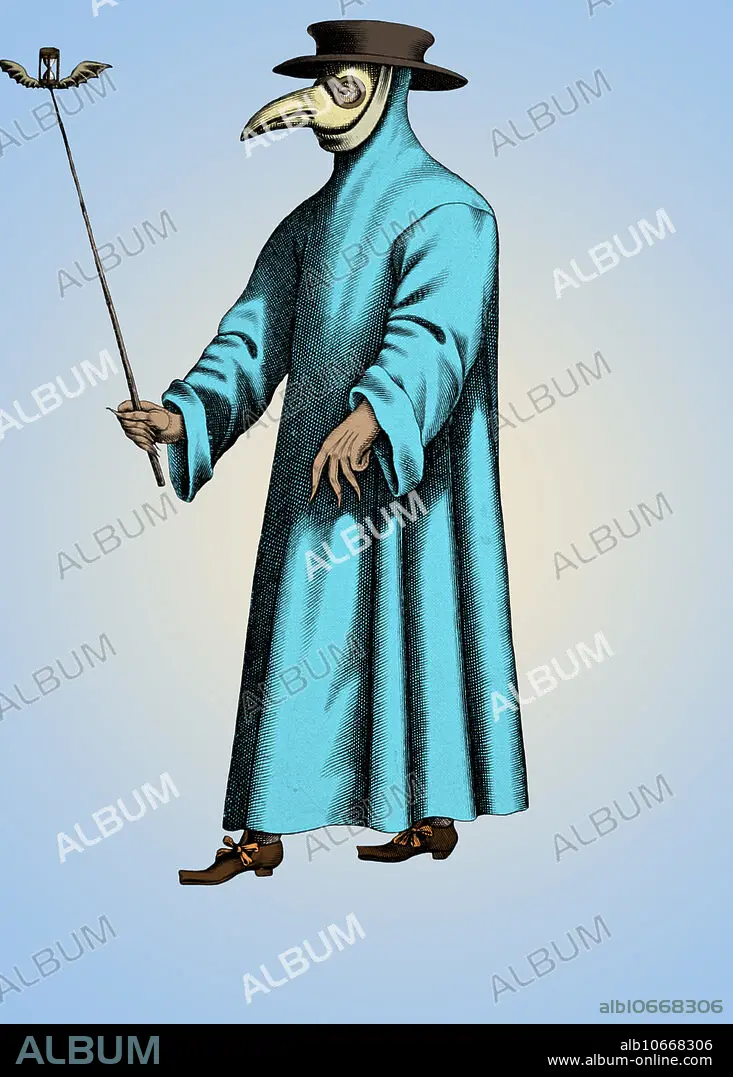
Plague Doctor, 17th Century
| Partager |
|---|
 Pinterest Pinterest |
 Twitter Twitter |
 Facebook Facebook |
 Copier le lien Copier le lien |
 Email Email |
|
Ajouter à une autre Lightbox |
|
Ajouter à une autre Lightbox |


Avez-vous déjà un compte? S'identifier
Vous n'avez pas de compte ? S'inscrire
Acheter cette image.
Sélectionnez l'usage:

Titre: Plague Doctor, 17th Century
Légende: Voir la traduction automatique
The beak doctor costume worn by plague doctors had a wide brimmed leather hood to indicate their profession. They used wooden canes to point out areas needing attention, to examine patients without touching them, to keep people away, and to remove clothing from plague victims without having to touch them. The mask had glass openings for the eyes and a curved beak shaped like that of a bird. The mask had two small nose holes and was a type of respirator which contained aromatic items; dried flowers, herbs, spices, camphor or a vinegar sponge. Doctors believed the herbs would counter the smells of the plague and prevent them from becoming infected.
The beak doctor costume worn by plague doctors had a wide brimmed leather hood to indicate their profession. They used wooden canes to point out areas needing attention, to examine patients without touching them, to keep people away, and to remove clothing from plague victims without having to touch them. The mask had glass openings for the eyes and a curved beak shaped like that of a bird. The mask had two small nose holes and was a type of respirator which contained aromatic items; dried flowers, herbs, spices, camphor or a vinegar sponge. Doctors believed the herbs would counter the smells of the plague and prevent them from becoming infected.
Crédit: Album / Science Source
Autorisations: ? Autorisation de modèle: Non - ? Autorisation de propriété: Non
Questions sur les droits?
Questions sur les droits?
Taille de l'image: 3600 × 5031 px | 51.8 MB
Taille d'impression: 30.5 × 42.6 cm | 1417.3 × 1980.7 in (300 dpi)
Mots clés: 17E SIECLE • 17EME S • ANGOISSANT • ARBRE: ROSEAU • BADAUD • BIZARRE • CONTAGIEUX • CUIR • DIX-SEPTIÈME SIÈCLE • DOCTEUR • DOCTEURS • ILLUSTRATION • LUGUBRE • MEDECIN • MIASME • PESTE • ROME • ROSEAU • ROSEAUX • SINISTRE • XVIIE SIECLE
