

alb3815991
Codex Fejérvà ¡ry-Mayer, 15th Century
| Partager |
|---|
 Pinterest Pinterest |
 Twitter Twitter |
 Facebook Facebook |
 Copier le lien Copier le lien |
 Email Email |
|
Ajouter à une autre Lightbox |
|
Ajouter à une autre Lightbox |


Avez-vous déjà un compte? S'identifier
Vous n'avez pas de compte ? S'inscrire
Acheter cette image.
Sélectionnez l'usage:

Titre: Codex Fejérvà ¡ry-Mayer, 15th Century
Légende: Voir la traduction automatique
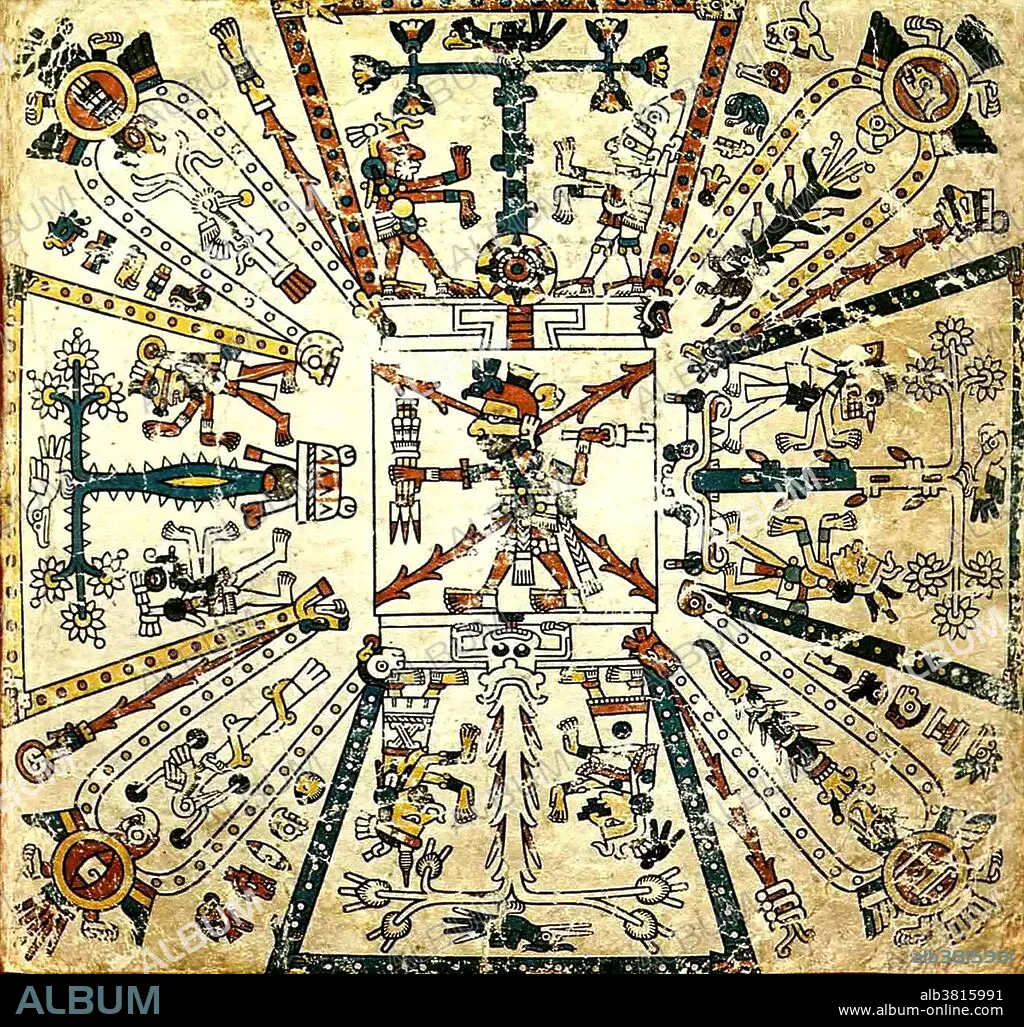
Codex Fejérváry-Mayer depicts specific aspects of the tonalpohualli, the sacred 260-day Mesoamerican augural cycle. The painted manuscript divides the world into five parts. T-shaped trees delineate compass points: east at the top, west on the bottom, north on the left, and south on the right. The four directions are distributed around a sacred center, shown here as Xiuhtecuhlti. In Aztec mythology, Xiuhtecuhtli was the god of fire, day and heat. The senior-deity of the Aztec pantheon, he was the lord of volcanoes, the personification of life after death, warmth in cold (fire), light in darkness and food during famine. At the end of a 52-year cycle it was feared that the gods would discontinue their contract with mankind. To appease them, at the end of such a cycle feasts were held in their honor, where Xiuhtecuhtli as the god of fire was the center of their attention. The Codex Fejérváry-Mayer is an Aztec Codex of central Mexico. It is one of the rare pre-Hispanic manuscripts that have survived the Spanish conquest of Mexico. The Codex is a typical tonalamatl, which is an almanac that deals with the tonalpohualli calendar. Its elaboration is typically pre-Columbian: it is made on deerskin parchment folded accordion-style into 23 pages.
Codex Fejérváry-Mayer depicts specific aspects of the tonalpohualli, the sacred 260-day Mesoamerican augural cycle. The painted manuscript divides the world into five parts. T-shaped trees delineate compass points: east at the top, west on the bottom, north on the left, and south on the right. The four directions are distributed around a sacred center, shown here as Xiuhtecuhlti. In Aztec mythology, Xiuhtecuhtli was the god of fire, day and heat. The senior-deity of the Aztec pantheon, he was the lord of volcanoes, the personification of life after death, warmth in cold (fire), light in darkness and food during famine. At the end of a 52-year cycle it was feared that the gods would discontinue their contract with mankind. To appease them, at the end of such a cycle feasts were held in their honor, where Xiuhtecuhtli as the god of fire was the center of their attention. The Codex Fejérváry-Mayer is an Aztec Codex of central Mexico. It is one of the rare pre-Hispanic manuscripts that have survived the Spanish conquest of Mexico. The Codex is a typical tonalamatl, which is an almanac that deals with the tonalpohualli calendar. Its elaboration is typically pre-Columbian: it is made on deerskin parchment folded accordion-style into 23 pages.
Personnalités: AZTEC
Crédit: Album / Science Source / New York Public Library
Autorisations: ? Autorisation de modèle: Non - ? Autorisation de propriété: Non
Questions sur les droits?
Questions sur les droits?
Taille de l'image: 3326 × 3164 px | 30.1 MB
Taille d'impression: 28.2 × 26.8 cm | 1309.4 × 1245.7 in (300 dpi)
Mots clés: ART, ICONE • AZTEC • CÉLÈBRE • CELEBRITE • ICÔNE (ORTHODOXIE) • ICONE • ICONOGRAPHIE • ICÙNE • ILLUSTRATION • PEINTURE ICONE
