

alb4874863
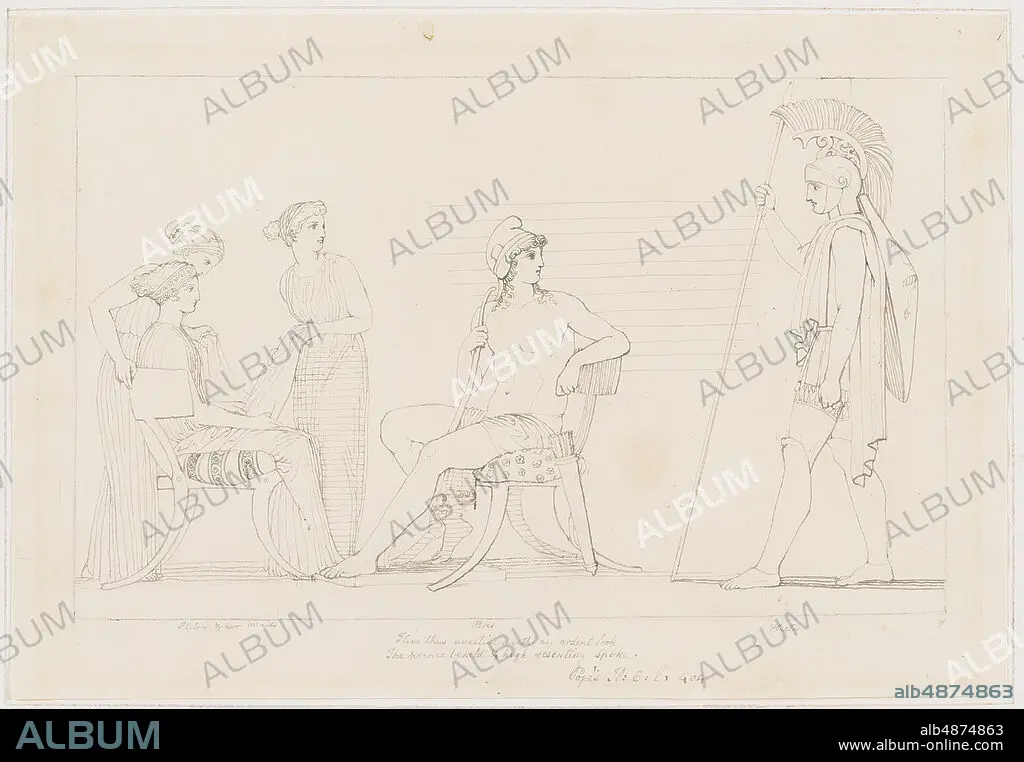
John Flaxman, Hector Chiding Paris, 1792-1793, pen and grey ink, brush and black ink over graphite on wove paper, 8 3/8 in. x 12 1/8 in. (21.27 cm. x 30.8 cm.), This drawing by the English Neoclassical sculptor and illustrator John Flaxman conjures a scene from Homer's 'Iliad', the first book the artist illustrated to great acclaim. (His later projects included Dante's 'Divine Comedy,' and Aeschylus.) Commissioned by Mrs. Hare-Naylor in 1792 or 1793 and created in Rome, Flaxman's drawing for the 'Iliad' shows the Trojan leader Hector chastising Paris for defending Troy haphazardly. Flaxman used this drawing as a preparatory study for the published engraving of the encounter. The final work is simplified even further, as it drops Helen's maids and presents the nude, effeminate Paris resting on a bow, his head lowered in shame. Flaxman's drawings of classical scenes and his designs for Josiah Wedgwood's ceramic wares sparked a craze throughout Europe for his silhouetted figures, which Flaxman had developed from engravings of Greek vases.
| Partager |
|---|
 Pinterest Pinterest |
 Twitter Twitter |
 Facebook Facebook |
 Copier le lien Copier le lien |
 Email Email |
|
Ajouter à une autre Lightbox |
|
Ajouter à une autre Lightbox |


Avez-vous déjà un compte? S'identifier
Vous n'avez pas de compte ? S'inscrire
Acheter cette image.
Sélectionnez l'usage:

Légende: Voir la traduction automatique
John Flaxman, Hector Chiding Paris, 1792-1793, pen and grey ink, brush and black ink over graphite on wove paper, 8 3/8 in. x 12 1/8 in. (21.27 cm. x 30.8 cm.), This drawing by the English Neoclassical sculptor and illustrator John Flaxman conjures a scene from Homer's 'Iliad', the first book the artist illustrated to great acclaim. (His later projects included Dante's 'Divine Comedy,' and Aeschylus.) Commissioned by Mrs. Hare-Naylor in 1792 or 1793 and created in Rome, Flaxman's drawing for the 'Iliad' shows the Trojan leader Hector chastising Paris for defending Troy haphazardly. Flaxman used this drawing as a preparatory study for the published engraving of the encounter. The final work is simplified even further, as it drops Helen's maids and presents the nude, effeminate Paris resting on a bow, his head lowered in shame. Flaxman's drawings of classical scenes and his designs for Josiah Wedgwood's ceramic wares sparked a craze throughout Europe for his silhouetted figures, which Flaxman had developed from engravings of Greek vases.
John Flaxman, Hector Chiding Paris, 1792-1793, pen and grey ink, brush and black ink over graphite on wove paper, 8 3/8 in. x 12 1/8 in. (21.27 cm. x 30.8 cm.), This drawing by the English Neoclassical sculptor and illustrator John Flaxman conjures a scene from Homer's 'Iliad', the first book the artist illustrated to great acclaim. (His later projects included Dante's 'Divine Comedy,' and Aeschylus.) Commissioned by Mrs. Hare-Naylor in 1792 or 1793 and created in Rome, Flaxman's drawing for the 'Iliad' shows the Trojan leader Hector chastising Paris for defending Troy haphazardly. Flaxman used this drawing as a preparatory study for the published engraving of the encounter. The final work is simplified even further, as it drops Helen's maids and presents the nude, effeminate Paris resting on a bow, his head lowered in shame. Flaxman's drawings of classical scenes and his designs for Josiah Wedgwood's ceramic wares sparked a craze throughout Europe for his silhouetted figures, which Flaxman had developed from engravings of Greek vases.
Personnalités: JOHN FLAXMAN
Crédit: Album / quintlox
Autorisations: ? Autorisation de modèle: Non - ? Autorisation de propriété: Non
Questions sur les droits?
Questions sur les droits?
Taille de l'image: 6000 × 4152 px | 71.3 MB
Taille d'impression: 50.8 × 35.2 cm | 2362.2 × 1634.6 in (300 dpi)
