

alb10996244
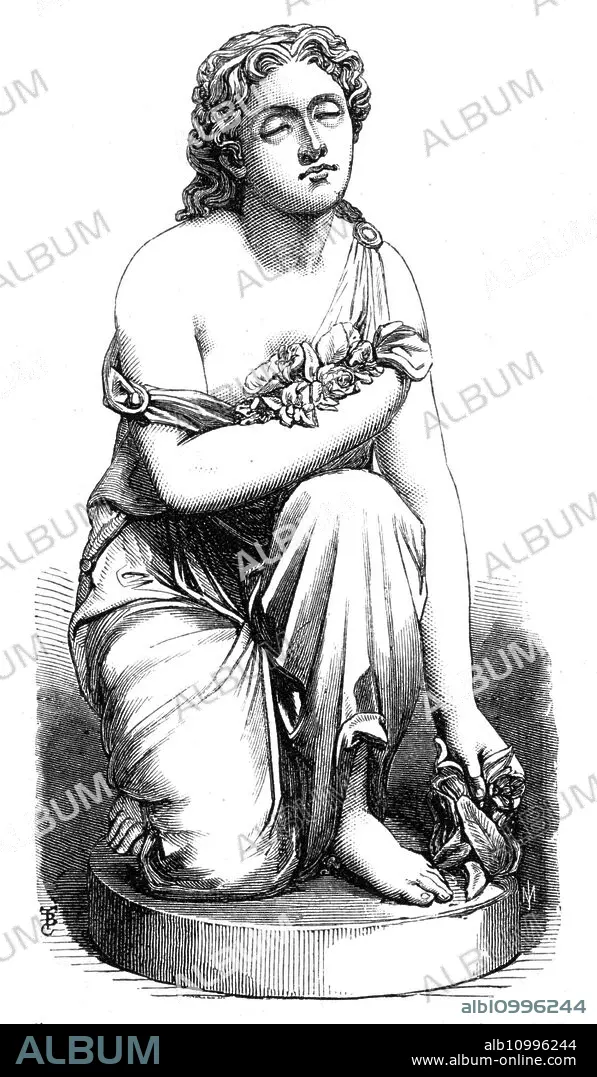
Nydia, the Blind Flower-Girl of Pompeii..., by C. F. Fuller, in the Royal Academy exhibition, 1868 Creator: Unknown.
| Partager |
|---|
 Pinterest Pinterest |
 Twitter Twitter |
 Facebook Facebook |
 Copier le lien Copier le lien |
 Email Email |
|
Ajouter à une autre Lightbox |
|
Ajouter à une autre Lightbox |


Avez-vous déjà un compte? S'identifier
Vous n'avez pas de compte ? S'inscrire
Acheter cette image.
Sélectionnez l'usage:

Titre: Nydia, the Blind Flower-Girl of Pompeii..., by C. F. Fuller, in the Royal Academy exhibition, 1868 Creator: Unknown.
Légende: Voir la traduction automatique
Nydia, the Blind Flower-Girl of Pompeii, gathering flowers in the garden of Glaucus, by C. F. Fuller, in the Royal Academy exhibition, 1868. Sculpture inspired by Lord Lytton's "Last Days of Pompeii". 'That portion of the narrative...seems in particular to offer a subject very susceptible of artistic treatment, and it has accordingly found a worthy illustrator in Mr. Fuller, of Florence, one of the most distinguished of our younger race of sculptors. Regarded from a technical point of view, this marble statue appears to us to indicate a marked advance in power on the part of the sculptor; the execution generally is as skilful and finished as in former works, but the carving of the flesh more happily expresses the soft rounding of the female forms in youth and health by those cushiony adipose tissues which at once nourish and beautify. The groping, apprehensive, keenly-listening habit so sadly characteristic of blindness, is also well expressed in the elevated chin, as she stoops feeling for the flowers; ah! how sweet-scented for her. There is much artistic feeling, too, although there may be less of strict physiological truth in the treatment of the eyes. Instead of the vacant stare of the born blind, they peer, as if she fain would see'. From "Illustrated London News", 1868.
Nydia, the Blind Flower-Girl of Pompeii, gathering flowers in the garden of Glaucus, by C. F. Fuller, in the Royal Academy exhibition, 1868. Sculpture inspired by Lord Lytton's "Last Days of Pompeii". 'That portion of the narrative...seems in particular to offer a subject very susceptible of artistic treatment, and it has accordingly found a worthy illustrator in Mr. Fuller, of Florence, one of the most distinguished of our younger race of sculptors. Regarded from a technical point of view, this marble statue appears to us to indicate a marked advance in power on the part of the sculptor; the execution generally is as skilful and finished as in former works, but the carving of the flesh more happily expresses the soft rounding of the female forms in youth and health by those cushiony adipose tissues which at once nourish and beautify. The groping, apprehensive, keenly-listening habit so sadly characteristic of blindness, is also well expressed in the elevated chin, as she stoops feeling for the flowers; ah! how sweet-scented for her. There is much artistic feeling, too, although there may be less of strict physiological truth in the treatment of the eyes. Instead of the vacant stare of the born blind, they peer, as if she fain would see'. From "Illustrated London News", 1868.
Personnalités: CHARLES FRANCIS FULLER
Crédit: Album / The Print Collector/Heritage Images
Autorisations: ? Autorisation de modèle: Non requis - ? Autorisation de propriété: Non requis
Questions sur les droits?
Questions sur les droits?
Taille de l'image: 1396 × 2393 px | 9.6 MB
Taille d'impression: 11.8 × 20.3 cm | 549.6 × 942.1 in (300 dpi)
