alb3670232
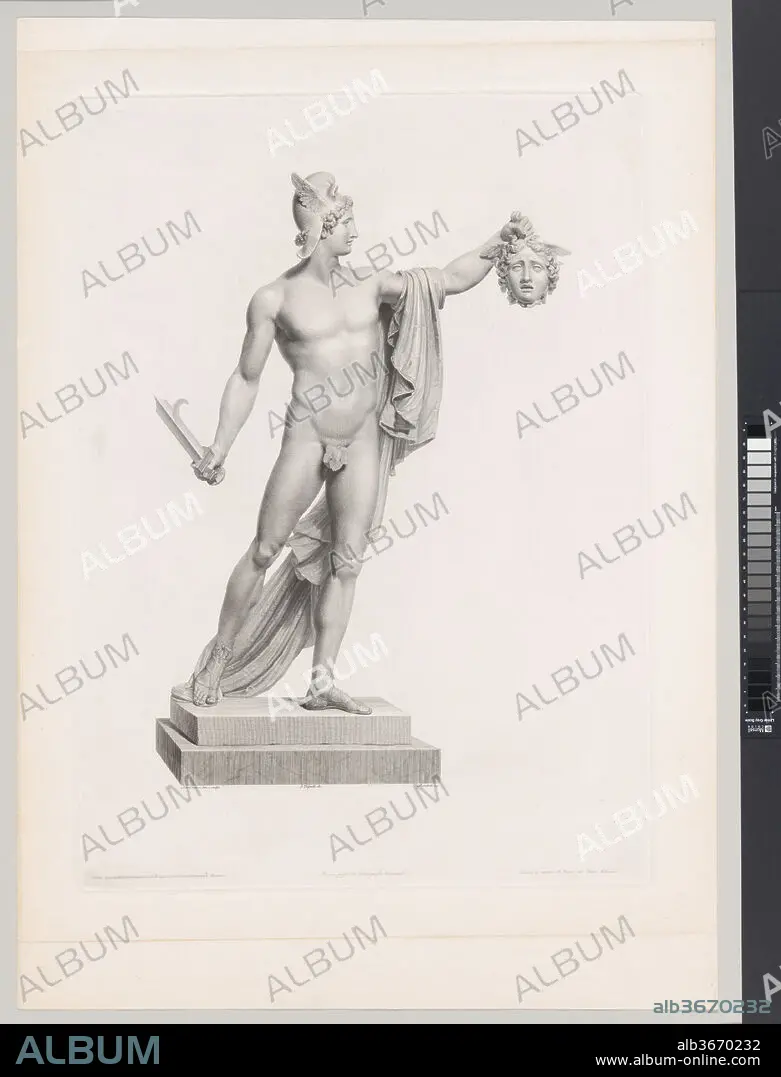
AFTER ANTONIO CANOVA, DOMENICO MARCHETTI, INTERMEDIARY DRAUGHTSMAN GIOVANNI TOGNOLLI. Perseus Triumphant
| Partager |
|---|
 Pinterest Pinterest |
 Twitter Twitter |
 Facebook Facebook |
 Copier le lien Copier le lien |
 Email Email |
|
Ajouter à une autre Lightbox |
|
Ajouter à une autre Lightbox |


Avez-vous déjà un compte? S'identifier
Vous n'avez pas de compte ? S'inscrire
Acheter cette image.
Sélectionnez l'usage:

Auteur:
Titre:
Perseus Triumphant
Légende:
Voir la traduction automatique
Perseus Triumphant. Artist: Domenico Marchetti (Italian, Rome ca. 1780-after 1844 Rome); Intermediary draughtsman Giovanni Tognolli (Italian, Bieno 1786-1862 Rome (?)); After Antonio Canova (Italian, Possagno 1757-1822 Venice). Dimensions: Plate: 24 7/8 × 17 15/16 in. (63.2 × 45.5 cm)
Sheet: 31 in. × 21 15/16 in. (78.7 × 55.7 cm). Date: 1813.
One of the most heroic acts of Perseus, son of Jupiter and the mortal princess Danae, was the beheading of the snake-haired Medusa. In a witty play on the power of the Gorgon's severed head to turn men to stone, Canova's hero looks directly at it and has indeed become marble. The sculptor created his first version of the Perseus, shown here, on his own initiative and in secrecy. In 1801 it was revealed to such acclaim that Pope Pius VII (r. 1800-1823) installed it in the niche formerly occupied by the revered Apollo Belvedere, which had been carried off to France by Napoleon. A visiting Polish countess requested a replica, which Canova completed in 1806. That second version, more fluent and lyrical in its treatment, is now in the Metropolitan Museum (67.110.1).
Technique/matériel:
etching and engraving
Musée:
Metropolitan Museum of Art, New York, USA
Crédit:
Album
Autorisations:
Taille de l'image:
3204 x 4200 px | 38.5 MB
Taille d'impression:
27.1 x 35.6 cm | 10.7 x 14.0 in (300 dpi)
