

alb5466395
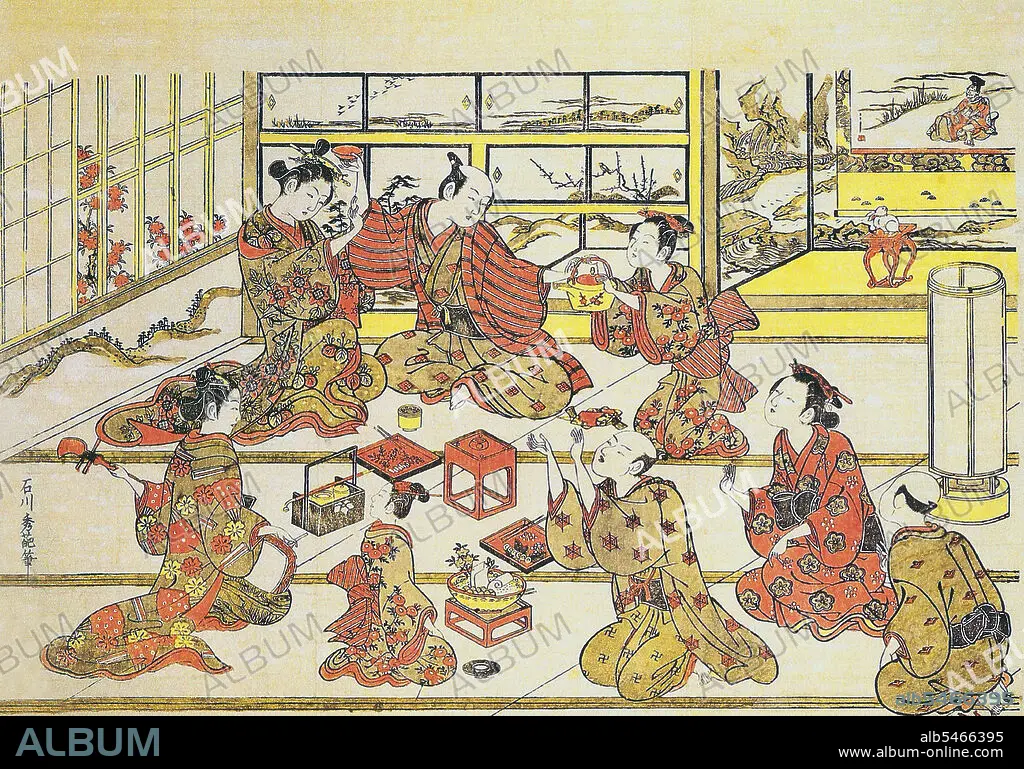
Scene in a seiro 'green house' or high class pleasure house in Yoshiwara red light district, Edo (Old Tokyo).
| Partager |
|---|
 Pinterest Pinterest |
 Twitter Twitter |
 Facebook Facebook |
 Copier le lien Copier le lien |
 Email Email |
|
Ajouter à une autre Lightbox |
|
Ajouter à une autre Lightbox |


Avez-vous déjà un compte? S'identifier
Vous n'avez pas de compte ? S'inscrire
Acheter cette image.
Sélectionnez l'usage:

Titre: Scene in a seiro 'green house' or high class pleasure house in Yoshiwara red light district, Edo (Old Tokyo).
Légende: Voir la traduction automatique
Ishikawa Toyonobu (1711 - July 1, 1785) was a Japanese ukiyo-e print artist. He is sometimes said to have been the same person as Nishimura Shigenobu, a contemporary ukiyo-e artist and student of Nishimura Shigenaga about whom very little is known. A pupil of Nishimura Shigenaga, Toyonobu produced many monochrome 'lacquer prints' (urushi-e) which reflected the influence of Okumura Masanobu as well. Many of these were yakusha-e (actor prints) and bijinga (images of beautiful women), including images of standing courtesans, whose faces conveyed an impassivity typical of the works of the Kaigetsudi school. Later in his career, Toyonobu became one of the leading producers of color prints, chiefly benizuri-e ('rose prints'), but stopped producing ukiyo-e shortly after Suzuki Harunobu pioneered the full-color print (nishiki-e) in 1765.
Ishikawa Toyonobu (1711 - July 1, 1785) was a Japanese ukiyo-e print artist. He is sometimes said to have been the same person as Nishimura Shigenobu, a contemporary ukiyo-e artist and student of Nishimura Shigenaga about whom very little is known. A pupil of Nishimura Shigenaga, Toyonobu produced many monochrome 'lacquer prints' (urushi-e) which reflected the influence of Okumura Masanobu as well. Many of these were yakusha-e (actor prints) and bijinga (images of beautiful women), including images of standing courtesans, whose faces conveyed an impassivity typical of the works of the Kaigetsudi school. Later in his career, Toyonobu became one of the leading producers of color prints, chiefly benizuri-e ('rose prints'), but stopped producing ukiyo-e shortly after Suzuki Harunobu pioneered the full-color print (nishiki-e) in 1765.
Crédit: Album / Pictures From History/Universal Images Group
Autorisations: ? Autorisation de modèle: Non - ? Autorisation de propriété: Non
Questions sur les droits?
Questions sur les droits?
Taille de l'image: 5000 × 3497 px | 50.0 MB
Taille d'impression: 42.3 × 29.6 cm | 1968.5 × 1376.8 in (300 dpi)
Mots clés: ART (CATÉGORIE) • ART • ART, PEINTURE • ASIE • ASIE, CONTINENT • CONTINENT ASIE • COURTISANE • FILLE DE JOIE • HISOIRE • HISTOIRE • ISHIKAWA TOYONOBU • JAPON • JAPONAIS • JAPONAISE • MODE • MODE: MASCULINE • ORNEMENT, JAPONAIS • PEINTURE • PROSTITUÉE • PROSTITUÉES • PUTAIN • SEXUALITE PROSTITUEES • STYLE • TABLEAU • TABLEAUX • VETEMENT: MODE
