

alb4116932
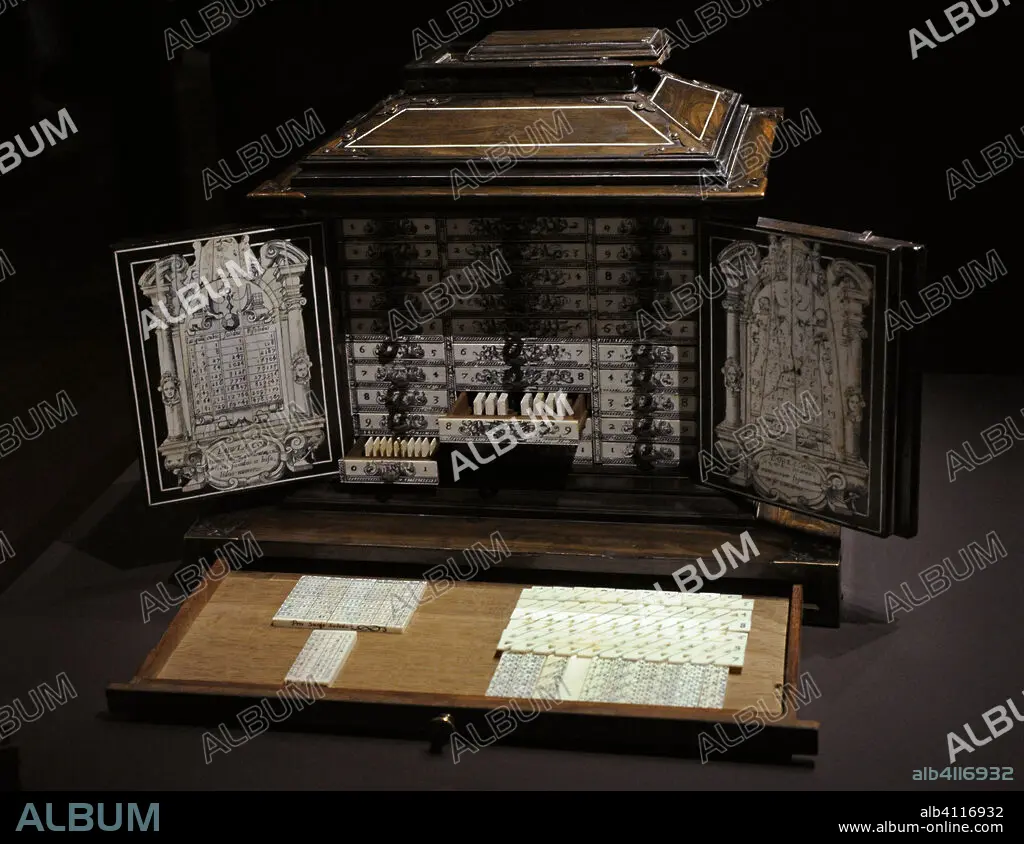
Napier's calculating machines, 17th century (after 1617). In a case with doors and thirty drawers are kept the counters of two abacuses, designed by the Scottish mathematician John Napier (1550-1617). The first abacus consists of sixty numbered rods, called "Napier's bones". It was widely spread in Europe, being used as a portable abacus until the 18th century. The second one, called promptuary, is composed of about three hundred numbered and perforated strips for fast multiplications. Verawood with ivory inlay. National Archaeological Museum. Madrid. Spain.
| Partager |
|---|
 Pinterest Pinterest |
 Twitter Twitter |
 Facebook Facebook |
 Copier le lien Copier le lien |
 Email Email |
|
Ajouter à une autre Lightbox |
|
Ajouter à une autre Lightbox |


Avez-vous déjà un compte? S'identifier
Vous n'avez pas de compte ? S'inscrire
Acheter cette image.
Sélectionnez l'usage:

Légende: Voir la traduction automatique
Napier's calculating machines, 17th century (after 1617). In a case with doors and thirty drawers are kept the counters of two abacuses, designed by the Scottish mathematician John Napier (1550-1617). The first abacus consists of sixty numbered rods, called "Napier's bones". It was widely spread in Europe, being used as a portable abacus until the 18th century. The second one, called promptuary, is composed of about three hundred numbered and perforated strips for fast multiplications. Verawood with ivory inlay. National Archaeological Museum. Madrid. Spain.
Napier's calculating machines, 17th century (after 1617). In a case with doors and thirty drawers are kept the counters of two abacuses, designed by the Scottish mathematician John Napier (1550-1617). The first abacus consists of sixty numbered rods, called "Napier's bones". It was widely spread in Europe, being used as a portable abacus until the 18th century. The second one, called promptuary, is composed of about three hundred numbered and perforated strips for fast multiplications. Verawood with ivory inlay. National Archaeological Museum. Madrid. Spain.
Emplacement: National Archaeological Museum. Madrid. Spain.
Crédit: Album / Prisma
Autorisations: ? Autorisation de modèle: Non - ? Autorisation de propriété: Non
Questions sur les droits?
Questions sur les droits?
Taille de l'image: 4016 × 3101 px | 35.6 MB
Taille d'impression: 34.0 × 26.3 cm | 1581.1 × 1220.9 in (300 dpi)
Mots clés: 17E SIECLE • 17EME S • ABAQUE • APPAREIL • BOIS • BOULIER • DIX-SEPTIÈME SIÈCLE • ECOSSAIS • ECOSSE • EUROPE • EUROPÉEN • HISOIRE • HISTOIRE • INSTRUMENT • INSTRUMENTS: SCIENTIFIQUES • LOGE (THEATRE) • MACHINE A CALCULER • MATHEMATICIEN • MATHÉMATIQUE • MATHEMATIQUES • MEUBLE • MOBILIER • MULTIPLICATION (MATHEMATIQUES) • NATIONAL ARCHAEOLOGICAL MUSEUM. MADRID. SPAIN. • NUMEROTATION • PLANCHE • PORTE (BATIMENT) • PORTE (MAISON) • PORTE • PORTÉS • SCIENCE: INSTRUMENTS • SCIENCE: MATHEMATIQUE • SCOTLAND • TIROIR • XVIIE SIECLE
