

alb3625939
SISTRUM
| Partager |
|---|
 Pinterest Pinterest |
 Twitter Twitter |
 Facebook Facebook |
 Copier le lien Copier le lien |
 Email Email |
|
Ajouter à une autre Lightbox |
|
Ajouter à une autre Lightbox |


Avez-vous déjà un compte? S'identifier
Vous n'avez pas de compte ? S'inscrire
Acheter cette image.
Sélectionnez l'usage:

Titre: SISTRUM
Légende: Voir la traduction automatique
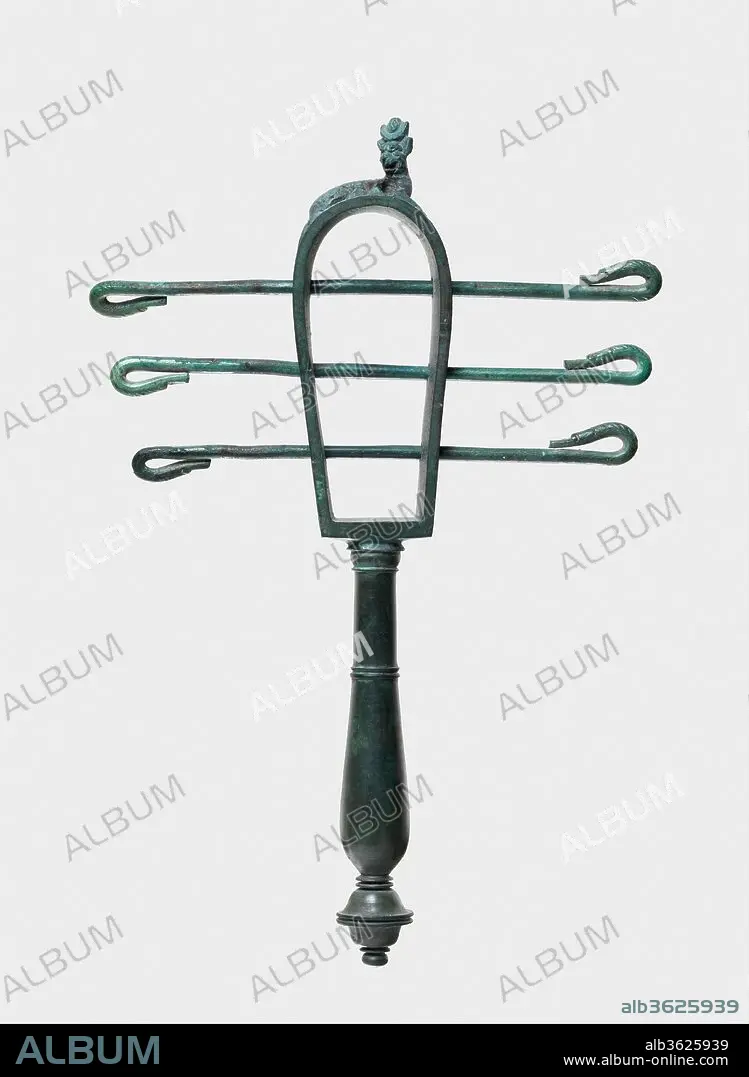
Sistrum. Dimensions: h. 20.6 cm (8 1/8 in); w. 14 cm (5 1/2 in). Date: A.D. 1st-2nd century. Although the sound elements have disappeared, the wires are preserved on this functional arc sistrum. The wires terminate in duck heads; in pharaonic examples they mainly take the form of reared cobras. Sound disks would move on the wires, which might also themselves move, to rattle against one another. Where the sound elements are preserved, they are flat or cymbal-like pieces of metal. This arc sistrum is a type seen outside Egypt in the Roman period in the context of Isis cults that encircled the Mediterranean. It does not show the goddess face at the juncture of arc and handle, presumably because the ancient fetish of Bat / Hathor was not understood as necessarily relevant. Indeed, the naos sistrum iconic for Hathor apparently did not move beyond Egypt at all. Atop the sistrum lies a cat, wearing a crescent and disk, with her young. The cat may represent solar associations, or the pacified aspect of the goddess soothed by the sistrum, or she might simply evoke an Egyptian atmosphere. At either side, below the projecting ends of the bars on the flat sides of the arc are what appear to be a crown of Isis and a pine-cone, the latter a Roman symbol of good fortune.
Sistrum. Dimensions: h. 20.6 cm (8 1/8 in); w. 14 cm (5 1/2 in). Date: A.D. 1st-2nd century. Although the sound elements have disappeared, the wires are preserved on this functional arc sistrum. The wires terminate in duck heads; in pharaonic examples they mainly take the form of reared cobras. Sound disks would move on the wires, which might also themselves move, to rattle against one another. Where the sound elements are preserved, they are flat or cymbal-like pieces of metal. This arc sistrum is a type seen outside Egypt in the Roman period in the context of Isis cults that encircled the Mediterranean. It does not show the goddess face at the juncture of arc and handle, presumably because the ancient fetish of Bat / Hathor was not understood as necessarily relevant. Indeed, the naos sistrum iconic for Hathor apparently did not move beyond Egypt at all. Atop the sistrum lies a cat, wearing a crescent and disk, with her young. The cat may represent solar associations, or the pacified aspect of the goddess soothed by the sistrum, or she might simply evoke an Egyptian atmosphere. At either side, below the projecting ends of the bars on the flat sides of the arc are what appear to be a crown of Isis and a pine-cone, the latter a Roman symbol of good fortune.
Technique/matériel: Bronze or copper alloy
Période: EMPIRE ROMAIN, PERIODE
Musée: Metropolitan Museum of Art, New York, USA
Crédit: Album
Autorisations: ? Autorisation de modèle: Non - ? Autorisation de propriété: Non
Questions sur les droits?
Questions sur les droits?
Taille de l'image: 3103 × 4243 px | 37.7 MB
Taille d'impression: 26.3 × 35.9 cm | 1221.7 × 1670.5 in (300 dpi)
