

alb9427841
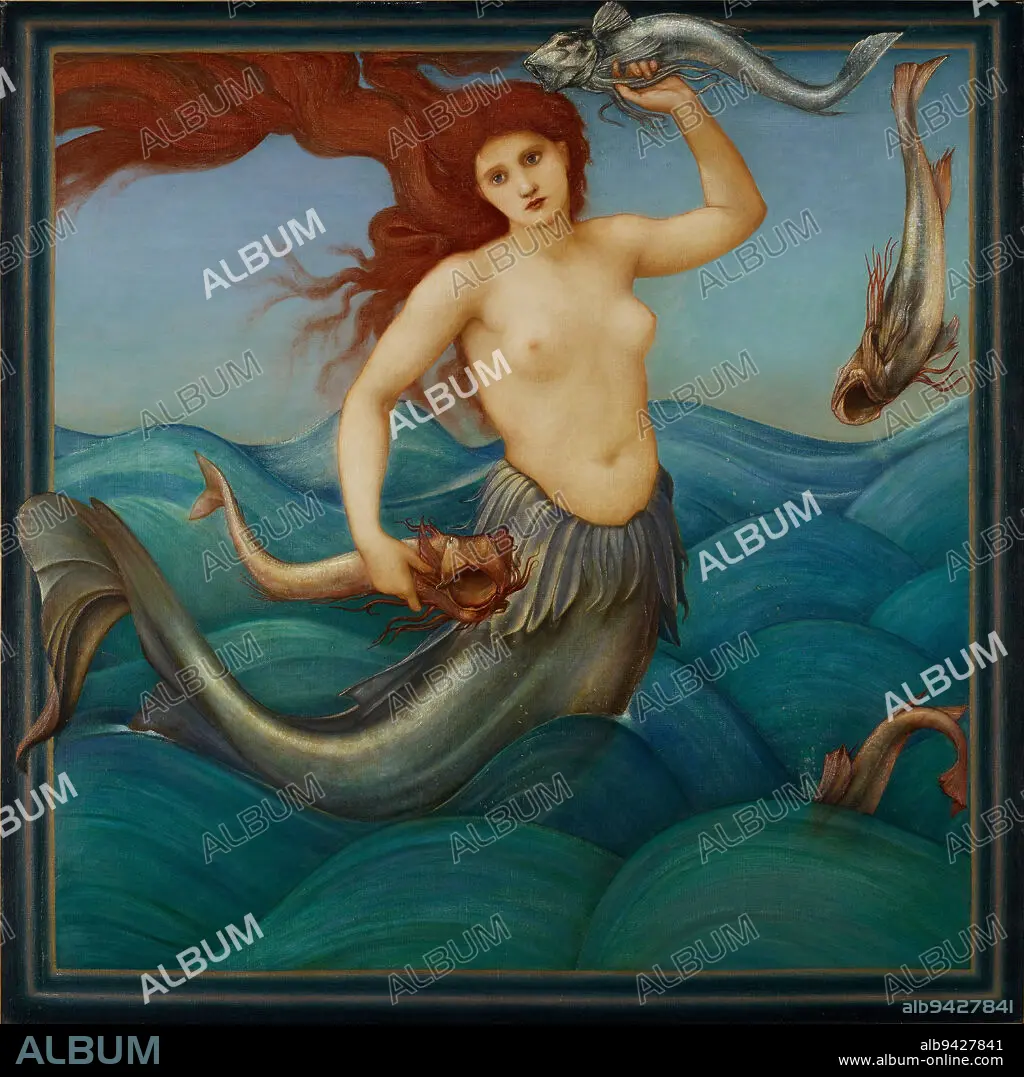
A Sea-Nymph, 1881, Edward Coley Burne-Jones, British, 1833 - 1898, 47 3/4 x 47 3/4 in. (121.29 x 121.29 cm) (sight)55 x 55 x 3 5/8 in. (139.7 x 139.7 x 9.21 cm) (outer frame), Oil on canvas, England, 19th century, Edward Burne-Jones became a founding member of William Morriss decorative art firm in 1861, where he produced countless designs and illustrations for books, tapestries, ceramic tiles, mosaics and stained glass. In 1862, he traveled to Italy where he was introduced to Botticelli, whose formal patterning profoundly influenced his subsequent development as a painter. His typical subject matter derived from medieval and classical legends charged with symbolism. In fact, he was pre-eminent in the Aesthetic movement in England and the Symbolist movement in Europe. A defining characteristic of Burne-Jones as an artist was his willful blurring of the boundaries between his painting and his decorative work, something quite evident in the conception of Sea-Nymph.
| Partager |
|---|
 Pinterest Pinterest |
 Twitter Twitter |
 Facebook Facebook |
 Copier le lien Copier le lien |
 Email Email |
|
Ajouter à une autre Lightbox |
|
Ajouter à une autre Lightbox |


Avez-vous déjà un compte? S'identifier
Vous n'avez pas de compte ? S'inscrire
Acheter cette image.
Sélectionnez l'usage:

Légende: Voir la traduction automatique
A Sea-Nymph, 1881, Edward Coley Burne-Jones, British, 1833 - 1898, 47 3/4 x 47 3/4 in. (121.29 x 121.29 cm) (sight)55 x 55 x 3 5/8 in. (139.7 x 139.7 x 9.21 cm) (outer frame), Oil on canvas, England, 19th century, Edward Burne-Jones became a founding member of William Morriss decorative art firm in 1861, where he produced countless designs and illustrations for books, tapestries, ceramic tiles, mosaics and stained glass. In 1862, he traveled to Italy where he was introduced to Botticelli, whose formal patterning profoundly influenced his subsequent development as a painter. His typical subject matter derived from medieval and classical legends charged with symbolism. In fact, he was pre-eminent in the Aesthetic movement in England and the Symbolist movement in Europe. A defining characteristic of Burne-Jones as an artist was his willful blurring of the boundaries between his painting and his decorative work, something quite evident in the conception of Sea-Nymph.
A Sea-Nymph, 1881, Edward Coley Burne-Jones, British, 1833 - 1898, 47 3/4 x 47 3/4 in. (121.29 x 121.29 cm) (sight)55 x 55 x 3 5/8 in. (139.7 x 139.7 x 9.21 cm) (outer frame), Oil on canvas, England, 19th century, Edward Burne-Jones became a founding member of William Morriss decorative art firm in 1861, where he produced countless designs and illustrations for books, tapestries, ceramic tiles, mosaics and stained glass. In 1862, he traveled to Italy where he was introduced to Botticelli, whose formal patterning profoundly influenced his subsequent development as a painter. His typical subject matter derived from medieval and classical legends charged with symbolism. In fact, he was pre-eminent in the Aesthetic movement in England and the Symbolist movement in Europe. A defining characteristic of Burne-Jones as an artist was his willful blurring of the boundaries between his painting and his decorative work, something quite evident in the conception of Sea-Nymph.
Crédit: Album / quintlox
Autorisations: ? Autorisation de modèle: Non - ? Autorisation de propriété: Non
Questions sur les droits?
Questions sur les droits?
Taille de l'image: 4577 × 4578 px | 59.9 MB
Taille d'impression: 38.8 × 38.8 cm | 1802.0 × 1802.4 in (300 dpi)
Mots clés: ANGLETARRE • ANGLETERE • ANGLETERRE • ART, PEINTURE • ARTISTE • ARTISTEL • ARTSTE • CONCEPTION • EUROPE • GRANDE BERTAGNE • GRANDE BRETAGNE • GRANDE-BRETAGNE • HUILE • ILLUSTRATION • INGLATERRA • ITALIE • PEINTRE • PEINTURE • ROYAUME UNI • ROYAUME-UNI • TABLEAU • TABLEAUX • TOILE • XIXE SIÈCLE
