

alb3803460
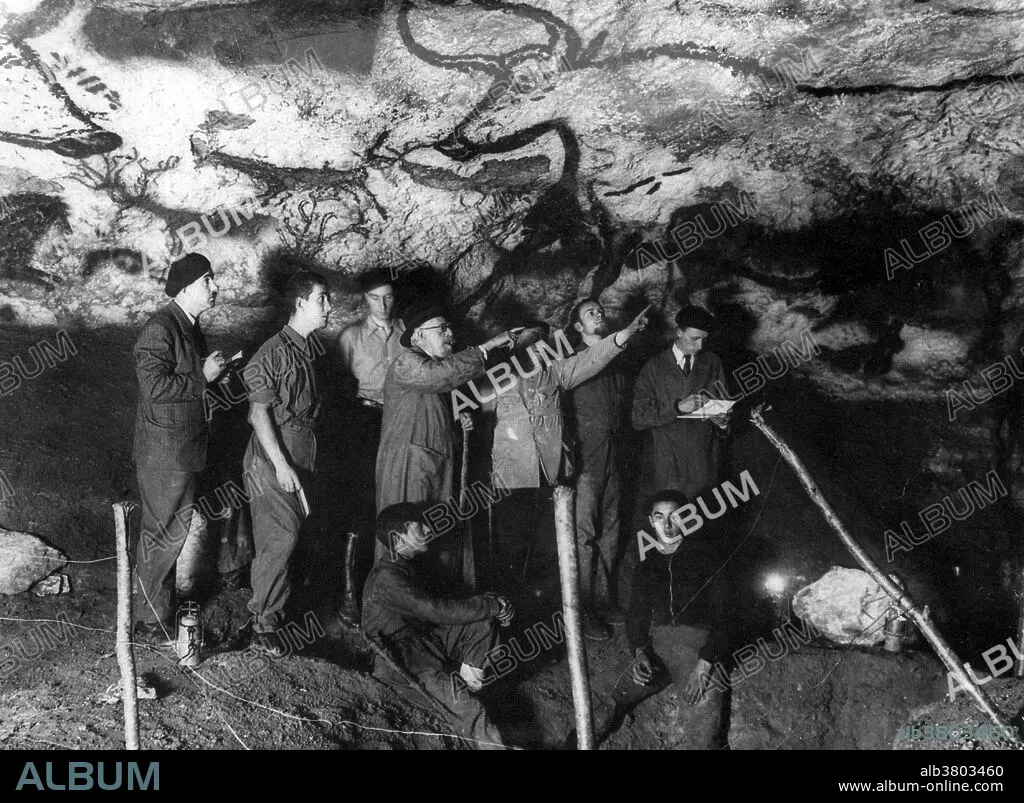
Lascaux Caves, 1940
| Partager |
|---|
 Pinterest Pinterest |
 Twitter Twitter |
 Facebook Facebook |
 Copier le lien Copier le lien |
 Email Email |
|
Ajouter à une autre Lightbox |
|
Ajouter à une autre Lightbox |


Avez-vous déjà un compte? S'identifier
Vous n'avez pas de compte ? S'inscrire
Acheter cette image.
Sélectionnez l'usage:

Titre: Lascaux Caves, 1940
Légende: Voir la traduction automatique
Lascaux (Lascaux Caves) is the setting of a complex of caves in southwestern France. They contain some of the best preserved and most spectacular works of Upper Paleolithic art, made by early humans. These paintings are estimated to be 17,300 years old. There are more than 600 paintings of horses, cows, bulls, stags, wolves, bears, lions and a rhinoceros, some even 15 feet long. In 1940, the the entrance to Lascaux Cave was discovered by Marcel Ravidat. He returned to the scene with three friends, Jacques Marsal, Georges Agnel, and Simon Coencas, and entered the cave via a long shaft. The four teenagers discovered that the cave walls were covered with depictions of animals. They kept their find a secret for a week, after which they informed their school teacher about it. In 1979, Lascaux was added to the UNESCO World Heritage Sites. Photograph originally captioned: Historic visit in 1940 by the light of acetylene lamps, In the middle, with arms outstretched, are Abbe Breuil and Count Begouen. Seated in front of them, Jacques Marsal, left, and Marcel Ravidat, right.
Lascaux (Lascaux Caves) is the setting of a complex of caves in southwestern France. They contain some of the best preserved and most spectacular works of Upper Paleolithic art, made by early humans. These paintings are estimated to be 17,300 years old. There are more than 600 paintings of horses, cows, bulls, stags, wolves, bears, lions and a rhinoceros, some even 15 feet long. In 1940, the the entrance to Lascaux Cave was discovered by Marcel Ravidat. He returned to the scene with three friends, Jacques Marsal, Georges Agnel, and Simon Coencas, and entered the cave via a long shaft. The four teenagers discovered that the cave walls were covered with depictions of animals. They kept their find a secret for a week, after which they informed their school teacher about it. In 1979, Lascaux was added to the UNESCO World Heritage Sites. Photograph originally captioned: Historic visit in 1940 by the light of acetylene lamps, In the middle, with arms outstretched, are Abbe Breuil and Count Begouen. Seated in front of them, Jacques Marsal, left, and Marcel Ravidat, right.
Crédit: Album / Science Source / New York Public Library
Autorisations: ? Autorisation de modèle: Non - ? Autorisation de propriété: Non
Questions sur les droits?
Questions sur les droits?
Taille de l'image: 4500 × 3298 px | 42.5 MB
Taille d'impression: 38.1 × 27.9 cm | 1771.7 × 1298.4 in (300 dpi)
Mots clés: ARCHÉLOGIE • ARCHEOLOGIE SITES • ARCHEOLOGIE • ARCHÉOLOLOGIE • ART PREHISTORIQUE • CÉLÈBRE • CELEBRITE • EUROPÉEN • ÉVÉNEMENT • SITES ARCHEOLOGIQUES • UNESCO • XXE SIECLE
