

alb3769912
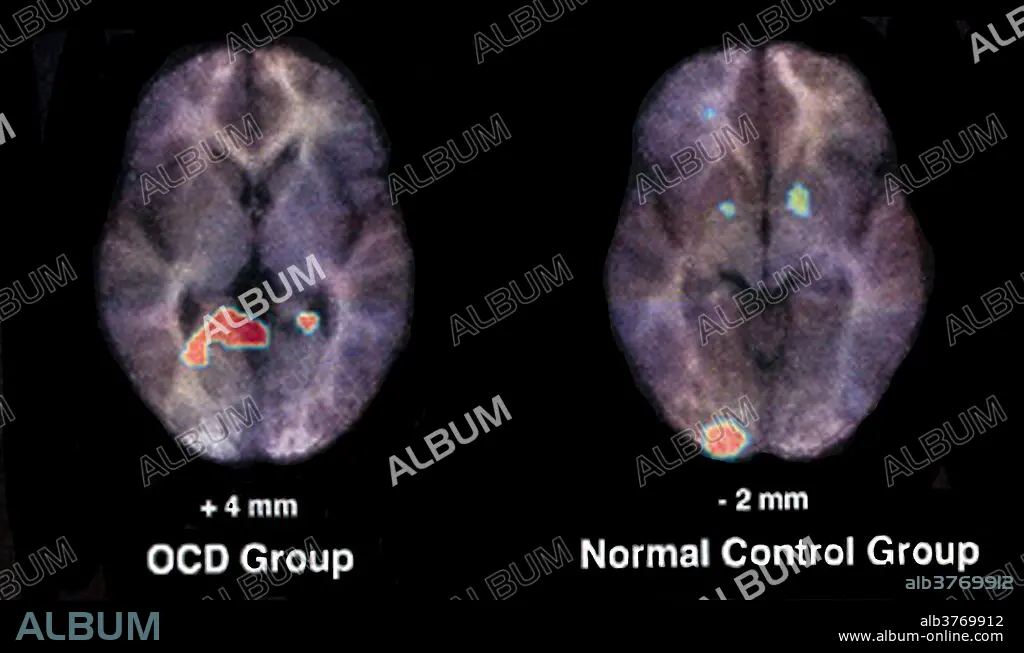
PET Scan, Normal and OCD Brain
| Partager |
|---|
 Pinterest Pinterest |
 Twitter Twitter |
 Facebook Facebook |
 Copier le lien Copier le lien |
 Email Email |
|
Ajouter à une autre Lightbox |
|
Ajouter à une autre Lightbox |


Avez-vous déjà un compte? S'identifier
Vous n'avez pas de compte ? S'inscrire
Acheter cette image.
Sélectionnez l'usage:

Titre: PET Scan, Normal and OCD Brain
Légende: Voir la traduction automatique
PET scan of normal brain acitivity (right) compared to OCD brain activity (left) when subjects performed the same cognitive task. Obsessive-compulsive disorder (OCD) is a mental disorder where people feel the need to check things repeatedly, perform certain routines repeatedly, or have certain thoughts repeatedly. People are unable to control either the thoughts or the activities. Common activities include hand washing, counting of things, and checking to see if a door is locked. Some may have difficulty throwing things out. These activities occur to such a degree that the person's daily life is negatively affected. Dated July 7, 2009.
PET scan of normal brain acitivity (right) compared to OCD brain activity (left) when subjects performed the same cognitive task. Obsessive-compulsive disorder (OCD) is a mental disorder where people feel the need to check things repeatedly, perform certain routines repeatedly, or have certain thoughts repeatedly. People are unable to control either the thoughts or the activities. Common activities include hand washing, counting of things, and checking to see if a door is locked. Some may have difficulty throwing things out. These activities occur to such a degree that the person's daily life is negatively affected. Dated July 7, 2009.
Crédit: Album / Science Source / National Institute of Mental Health/NIH
Autorisations: ? Autorisation de modèle: Non - ? Autorisation de propriété: Non
Questions sur les droits?
Questions sur les droits?
Taille de l'image: 4500 × 2636 px | 33.9 MB
Taille d'impression: 38.1 × 22.3 cm | 1771.7 × 1037.8 in (300 dpi)
Mots clés: 21E SIECLE • HUMAIN • MEDICAL • PERSONNE • TOMOGRAPHIE • XXIE SIECLE
