alb5170907
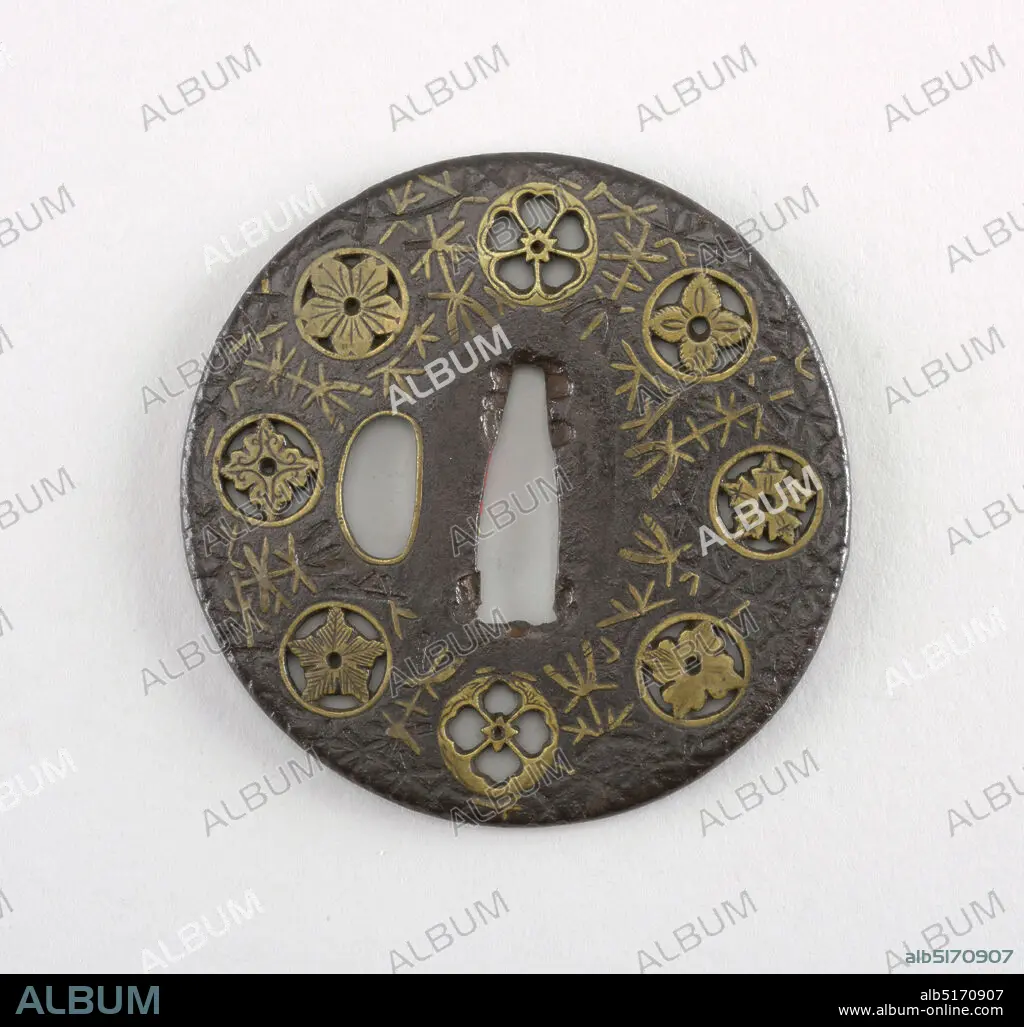
Tsuba, Pierced iron, engraved brass inlay, The iron tsuba is round in shape, with sukashi (openwork), and has hon zogan (true inlay) decoration of shinchu hira (flat brass) showing mon-jirushi ni mogosa (various crests with waterweed). This Bizen Yoshiro style of inlay does not stand above the surface of the iron, and was a specialty of the Fushimi Yoshiro, Takahashi school., At the center is the nakago-ana, an opening through which the sword passes. At left is sashi ura, the side which faces the blade. Its opening takes the hangetsu-kei (half moon) shape and has shinchu fukurin (brass rim) covers. Surrounding these openings, is the seppadai, a flat oval area that is migaki (burnished). The rim of the tsuba is round, or maru-mimi., Japan, 15961615, metalwork, Decorative Arts, Tsuba.
| Partager |
|---|
 Pinterest Pinterest |
 Twitter Twitter |
 Facebook Facebook |
 Copier le lien Copier le lien |
 Email Email |
|
Ajouter à une autre Lightbox |
|
Ajouter à une autre Lightbox |


Avez-vous déjà un compte? S'identifier
Vous n'avez pas de compte ? S'inscrire
Acheter cette image.
Sélectionnez l'usage:

Légende:
Voir la traduction automatique
Tsuba, Pierced iron, engraved brass inlay, The iron tsuba is round in shape, with sukashi (openwork), and has hon zogan (true inlay) decoration of shinchu hira (flat brass) showing mon-jirushi ni mogosa (various crests with waterweed). This Bizen Yoshiro style of inlay does not stand above the surface of the iron, and was a specialty of the Fushimi Yoshiro, Takahashi school., At the center is the nakago-ana, an opening through which the sword passes. At left is sashi ura, the side which faces the blade. Its opening takes the hangetsu-kei (half moon) shape and has shinchu fukurin (brass rim) covers. Surrounding these openings, is the seppadai, a flat oval area that is migaki (burnished). The rim of the tsuba is round, or maru-mimi., Japan, 15961615, metalwork, Decorative Arts, Tsuba
Crédit:
Album / quintlox
Autorisations:
Taille de l'image:
4853 x 4614 px | 64.1 MB
Taille d'impression:
41.1 x 39.1 cm | 16.2 x 15.4 in (300 dpi)
Mots clés:
DEMI-LUNE • FER • FORMÉ • FORMES • GAUCHE • INCRUSTATION • INTARSIA • METAL FER • TECHNIQUE: INCRUSTATION • TSUBA
