

alb3913118
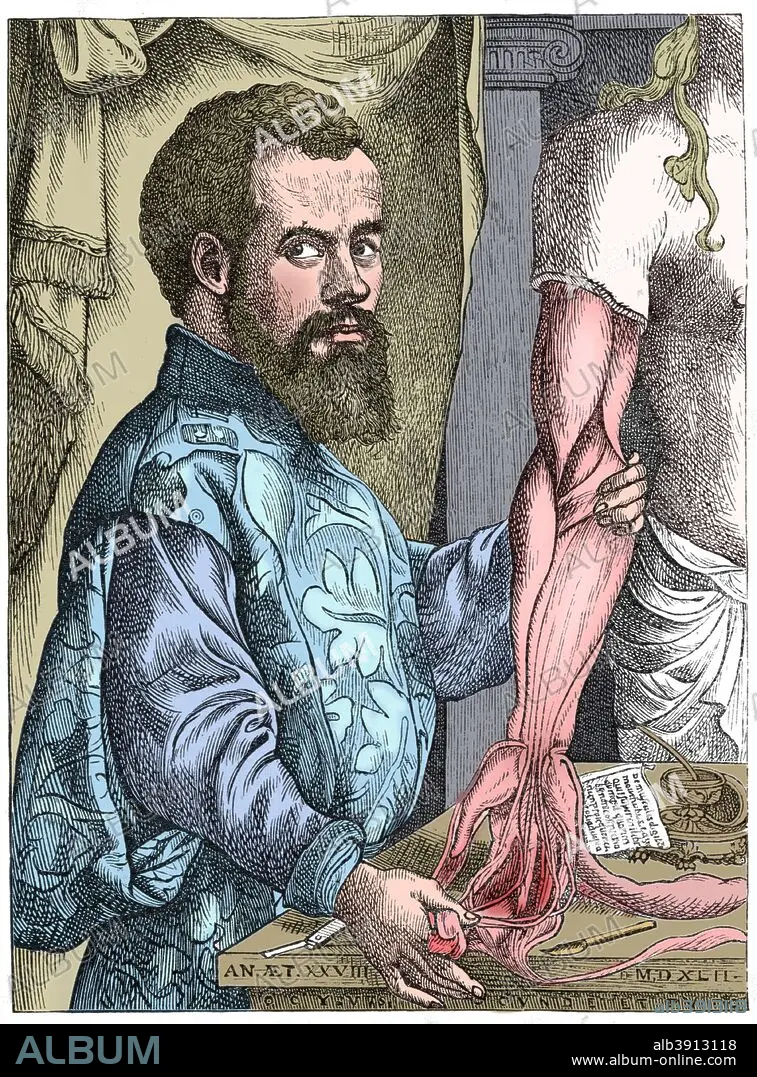
Andreas Vesalius, 16th century Flemish anatomist. Artist: Unknown.
| Partager |
|---|
 Pinterest Pinterest |
 Twitter Twitter |
 Facebook Facebook |
 Copier le lien Copier le lien |
 Email Email |
|
Ajouter à une autre Lightbox |
|
Ajouter à une autre Lightbox |


Avez-vous déjà un compte? S'identifier
Vous n'avez pas de compte ? S'inscrire
Acheter cette image.
Sélectionnez l'usage:

Titre: Andreas Vesalius, 16th century Flemish anatomist. Artist: Unknown.
Légende: Voir la traduction automatique
Andreas Vesalius, 16th century Flemish anatomist. Vesalius' (1514-1564) great work on anatomy De Humani Corporis Fabrica (On the Structure of the Human Body) (1543) was a landmark, with accurate depictions of parts of the body, including the nervous system. Vesalius based his work on dissection and personal observation, disproving the belief that because, in Genesis, God created Eve from Adam's rib, men had one less rib than women. He contradicted Aristotle's teaching that the heart is the seat of the emotions, replacing it with the brain and the nervous system. After Jan Stevan Calcar (c1499-1546). (Colorised black and white print).
Andreas Vesalius, 16th century Flemish anatomist. Vesalius' (1514-1564) great work on anatomy De Humani Corporis Fabrica (On the Structure of the Human Body) (1543) was a landmark, with accurate depictions of parts of the body, including the nervous system. Vesalius based his work on dissection and personal observation, disproving the belief that because, in Genesis, God created Eve from Adam's rib, men had one less rib than women. He contradicted Aristotle's teaching that the heart is the seat of the emotions, replacing it with the brain and the nervous system. After Jan Stevan Calcar (c1499-1546). (Colorised black and white print).
Crédit: Album / Heritage Images / The Print Collector
Autorisations: ? Autorisation de modèle: Non - ? Autorisation de propriété: Non
Questions sur les droits?
Questions sur les droits?
Taille de l'image: 3592 × 4860 px | 49.9 MB
Taille d'impression: 30.4 × 41.1 cm | 1414.2 × 1913.4 in (300 dpi)
Mots clés: 16E SIECLE • 16EME S • ANATOMIE • BONHOMME • COULEUR • HOMME • OCCUPATION • PROFESSION • SANTE • SEIZIÈME SIÈCLE • XVIE SIECLE
