

alb5539278
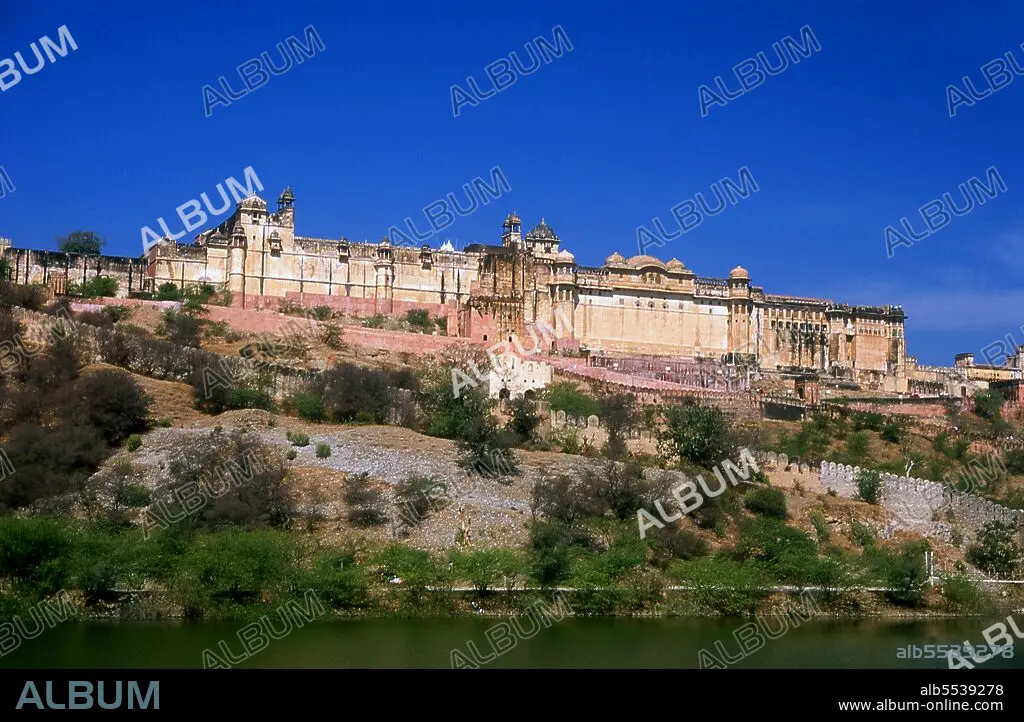
India: Amber (Amer) Palace and Fort, Amer, near Jaipur, Rajasthan
| Partager |
|---|
 Pinterest Pinterest |
 Twitter Twitter |
 Facebook Facebook |
 Copier le lien Copier le lien |
 Email Email |
|
Ajouter à une autre Lightbox |
|
Ajouter à une autre Lightbox |


Avez-vous déjà un compte? S'identifier
Vous n'avez pas de compte ? S'inscrire
Acheter cette image.
Sélectionnez l'usage:

Titre: India: Amber (Amer) Palace and Fort, Amer, near Jaipur, Rajasthan
Légende: Voir la traduction automatique
Amer Palace and Fort (Hindi: ???? ?????, also spelled and pronounced as Amber) was built by Raja Man Singh I (December 21, 1550 – July 6, 1614). Jaipur is the capital and largest city of the Indian state of Rajasthan. It was founded on 18 November 1727 by Maharaja Sawai Jai Singh II, the ruler of Amber, after whom the city was named. The city today has a population of 3.1 million. Jaipur is known as the Pink City of India. The city is remarkable among pre-modern Indian cities for the width and regularity of its streets which are laid out into six sectors separated by broad streets 34 m (111 ft) wide. The urban quarters are further divided by networks of gridded streets. Five quarters wrap around the east, south, and west sides of a central palace quarter, with a sixth quarter immediately to the east. The Palace quarter encloses the sprawling Hawa Mahal palace complex, formal gardens, and a small lake. Nahargarh Fort, which was the residence of the King Sawai Jai Singh II, crowns the hill in the northwest corner of the old city. The observatory, Jantar Mantar, is a World Heritage Site.
Amer Palace and Fort (Hindi: ???? ?????, also spelled and pronounced as Amber) was built by Raja Man Singh I (December 21, 1550 – July 6, 1614). Jaipur is the capital and largest city of the Indian state of Rajasthan. It was founded on 18 November 1727 by Maharaja Sawai Jai Singh II, the ruler of Amber, after whom the city was named. The city today has a population of 3.1 million. Jaipur is known as the Pink City of India. The city is remarkable among pre-modern Indian cities for the width and regularity of its streets which are laid out into six sectors separated by broad streets 34 m (111 ft) wide. The urban quarters are further divided by networks of gridded streets. Five quarters wrap around the east, south, and west sides of a central palace quarter, with a sixth quarter immediately to the east. The Palace quarter encloses the sprawling Hawa Mahal palace complex, formal gardens, and a small lake. Nahargarh Fort, which was the residence of the King Sawai Jai Singh II, crowns the hill in the northwest corner of the old city. The observatory, Jantar Mantar, is a World Heritage Site.
Crédit: Album / Pictures From History/Universal Images Group
Autorisations: ? Autorisation de modèle: Non - ? Autorisation de propriété: Non
Questions sur les droits?
Questions sur les droits?
Taille de l'image: 5100 × 3332 px | 48.6 MB
Taille d'impression: 43.2 × 28.2 cm | 2007.9 × 1311.8 in (300 dpi)
Mots clés: AMBRE JAUNE • ARCHITCETURE • ARCHITECTURE • ARCHITECTURE: CHATEAU • ARCITECTURE • ASIE • ASIE, CONTINENT • CHATEAU • CONTINENT ASIE • HISOIRE • HISTOIRE • INDE • INDES • INDIEN • INDIENNE • INDIENS • INTERIEUR: PALAIS • MOGHOL • PALACE • PALAIS ÉTÉ • PALAIS • PALAIS, INTERIEUR • PERIODE DES PREMIERS PALAIS
