

alb3883051
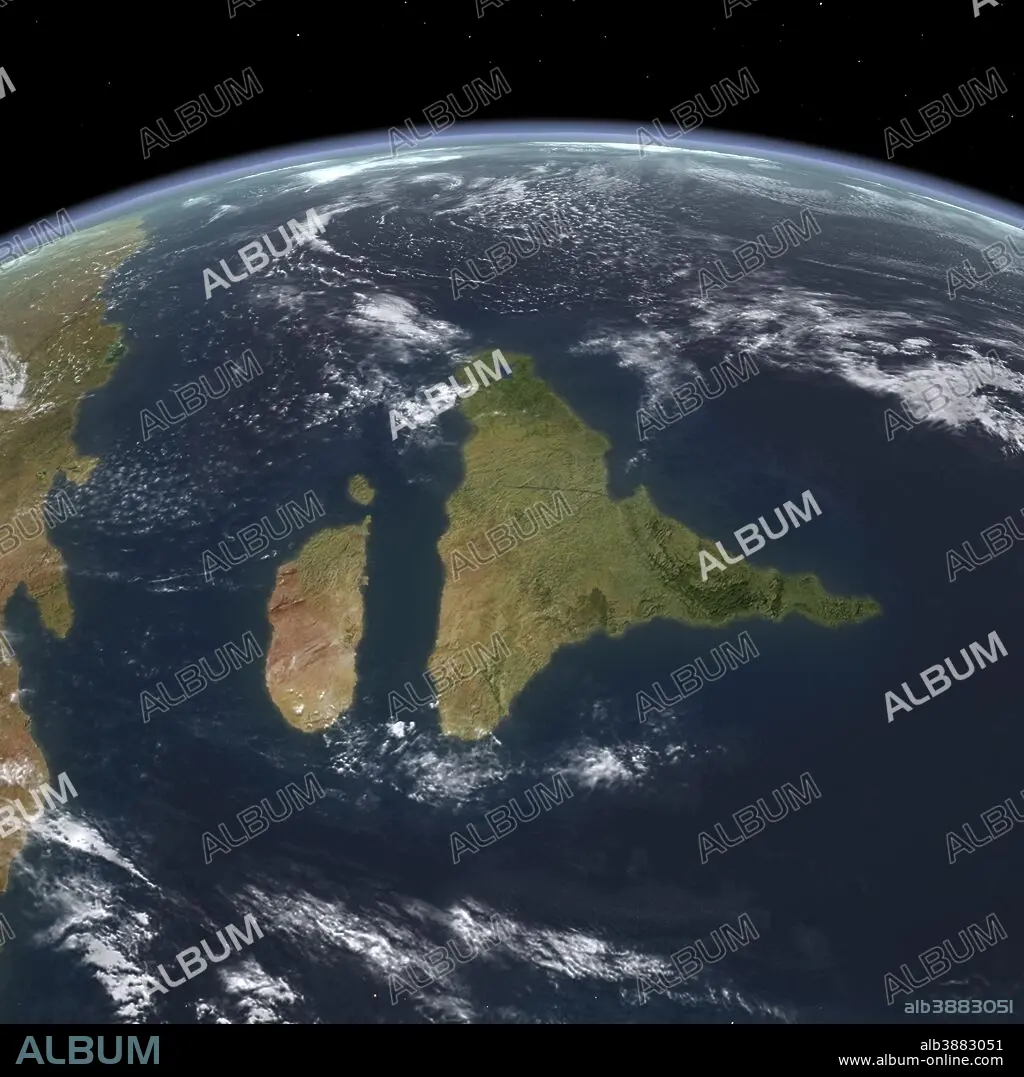
View of the Indian subcontinent during the Late Cretaceous period.
| Partager |
|---|
 Pinterest Pinterest |
 Twitter Twitter |
 Facebook Facebook |
 Copier le lien Copier le lien |
 Email Email |
|
Ajouter à une autre Lightbox |
|
Ajouter à une autre Lightbox |


Avez-vous déjà un compte? S'identifier
Vous n'avez pas de compte ? S'inscrire
Acheter cette image.
Sélectionnez l'usage:

Titre: View of the Indian subcontinent during the Late Cretaceous period.
Légende: Voir la traduction automatique
This is how the Indian subcontinent may have appeared 70 million years ago during the Late Cretaceous period. Looking north, immediately to India's west is the island continent of Madagascar and further west is the eastern coast of southern Africa.. . In the distant past India and Madagascar formed a single continent, however India was part of a separate tectonic plate that subsequently began to drift northward. This northward motion (covering about 8 inches per year making it among the fastest on the Earth's lithosphere) split India from Madagascar and carried it north across the Tethys Ocean until it collided with Eurasia about 50 to 35 million years ago. This collision between the Indian and Eurasian plates joined India to South Asia and created the Tibetan Plateau and the Himalaya Mountains, a process which is still evolving to this day.
This is how the Indian subcontinent may have appeared 70 million years ago during the Late Cretaceous period. Looking north, immediately to India's west is the island continent of Madagascar and further west is the eastern coast of southern Africa.. . In the distant past India and Madagascar formed a single continent, however India was part of a separate tectonic plate that subsequently began to drift northward. This northward motion (covering about 8 inches per year making it among the fastest on the Earth's lithosphere) split India from Madagascar and carried it north across the Tethys Ocean until it collided with Eurasia about 50 to 35 million years ago. This collision between the Indian and Eurasian plates joined India to South Asia and created the Tibetan Plateau and the Himalaya Mountains, a process which is still evolving to this day.
Crédit: Album / Walter Myers/Stocktrek Images
Taille de l'image: 4260 × 4260 px | 51.9 MB
Taille d'impression: 36.1 × 36.1 cm | 1677.2 × 1677.2 in (300 dpi)
Mots clés: AFRIQUE • ASTRONOMIE • ASTRONOMIE: PLANETES • COSMOS • EVOLUTION • GEOGRAPHIE • GEOLOGIE • MER • NATURE • OCEAN • ORIGINE • PAYSAGE MARITIME • PLANETE • PLANÈTES • SCIENCE DE LA NATURE • SCIENCE: ASTRONOMIE • SCIENCES PHYSIQUES ET NATURELLES • SYSTEME SOLAIRE
