

alb5483223
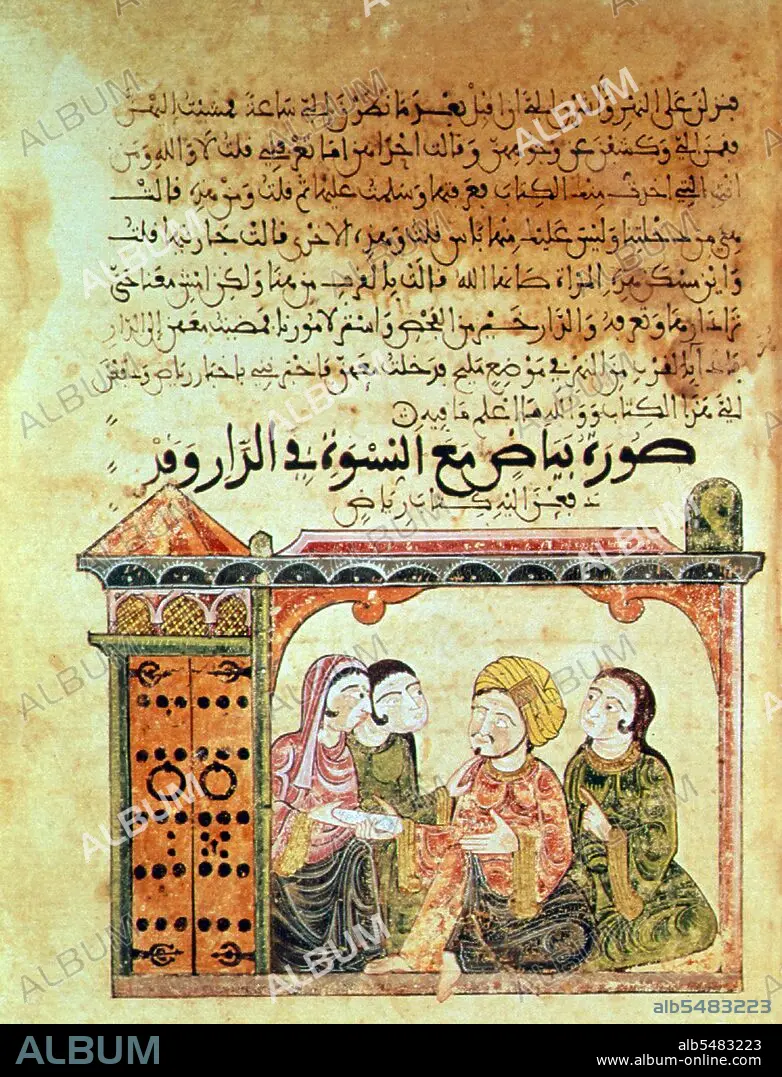
Spain: An illustration from the Tale of Bayad and Riyad, Al-Andaluz (Islamic Andalucia, late 12th century)
| Partager |
|---|
 Pinterest Pinterest |
 Twitter Twitter |
 Facebook Facebook |
 Copier le lien Copier le lien |
 Email Email |
|
Ajouter à une autre Lightbox |
|
Ajouter à une autre Lightbox |


Avez-vous déjà un compte? S'identifier
Vous n'avez pas de compte ? S'inscrire
Acheter cette image.
Sélectionnez l'usage:

Titre: Spain: An illustration from the Tale of Bayad and Riyad, Al-Andaluz (Islamic Andalucia, late 12th century)
Légende: Voir la traduction automatique
Hadith Baya? wa Riya? (The Story of Bayad and Riyad) or Qissat Bayad wa Riyad is a 13th-century Arabic love story. The main characters of the tale are Bayad, a merchant's son and a foreigner from Damascus, Riyad, a well educated girl in the court of an unnamed Hajib (vizier or minister) of 'Iraq (Mesopotamia) and a 'Lady' (al-sayyida). The Hadith Bayad wa Riyad manuscript is believed to be the only illustrated manuscript known to have survived from more than eight centuries of Muslim and Arab presence in Spain. The sole manuscript is in the Vatican Library, where it is catalogued as Codex Vat. Arabo 368. This fragment of the medieval love story of Bayad and Riyad may have been taken from Tunis by the troops of Charles V. It is one of the rarest and most singular Arabic manuscripts in the Vatican collection. Written in maghribi script, it was probably copied in Spain in the first half of the thirteenth century from an eastern manuscript of the Baghdad school. The miniaturist, however, adapted the original illustrations to a western setting and changed oriental architectural details to Spanish ones. This codex remains one of the only known examples of Muslim figurative painting in Spain. In the page shown here, we see Bayad receiving a letter from Riyad in the house of three women. The appearance of the house is clearly western rather than eastern.
Hadith Baya? wa Riya? (The Story of Bayad and Riyad) or Qissat Bayad wa Riyad is a 13th-century Arabic love story. The main characters of the tale are Bayad, a merchant's son and a foreigner from Damascus, Riyad, a well educated girl in the court of an unnamed Hajib (vizier or minister) of 'Iraq (Mesopotamia) and a 'Lady' (al-sayyida). The Hadith Bayad wa Riyad manuscript is believed to be the only illustrated manuscript known to have survived from more than eight centuries of Muslim and Arab presence in Spain. The sole manuscript is in the Vatican Library, where it is catalogued as Codex Vat. Arabo 368. This fragment of the medieval love story of Bayad and Riyad may have been taken from Tunis by the troops of Charles V. It is one of the rarest and most singular Arabic manuscripts in the Vatican collection. Written in maghribi script, it was probably copied in Spain in the first half of the thirteenth century from an eastern manuscript of the Baghdad school. The miniaturist, however, adapted the original illustrations to a western setting and changed oriental architectural details to Spanish ones. This codex remains one of the only known examples of Muslim figurative painting in Spain. In the page shown here, we see Bayad receiving a letter from Riyad in the house of three women. The appearance of the house is clearly western rather than eastern.
Crédit: Album / Pictures From History/Universal Images Group
Autorisations: ? Autorisation de modèle: Non - ? Autorisation de propriété: Non
Questions sur les droits?
Questions sur les droits?
Taille de l'image: 3536 × 4633 px | 46.9 MB
Taille d'impression: 29.9 × 39.2 cm | 1392.1 × 1824.0 in (300 dpi)
