

alb5530372
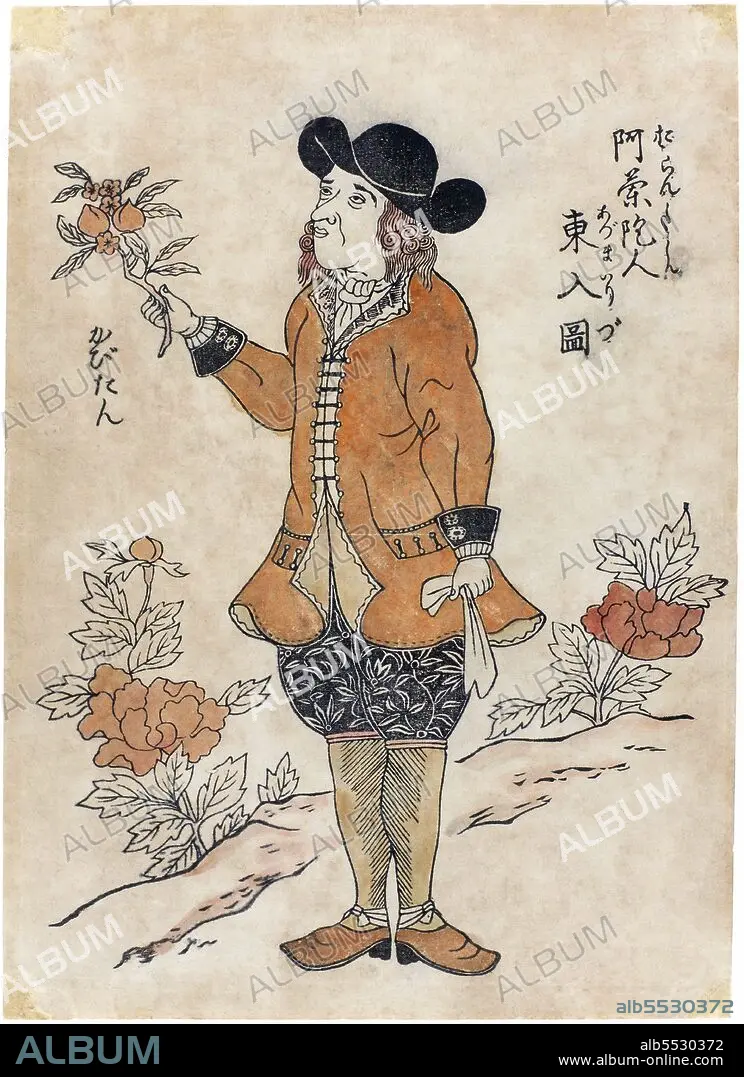
Japan: A Dutch captain in Nagasaki, c. 1700, artist unknown
| Partager |
|---|
 Pinterest Pinterest |
 Twitter Twitter |
 Facebook Facebook |
 Copier le lien Copier le lien |
 Email Email |
|
Ajouter à une autre Lightbox |
|
Ajouter à une autre Lightbox |


Avez-vous déjà un compte? S'identifier
Vous n'avez pas de compte ? S'inscrire
Acheter cette image.
Sélectionnez l'usage:

Titre: Japan: A Dutch captain in Nagasaki, c. 1700, artist unknown
Légende: Voir la traduction automatique
The Dutch trader or merchant depicted in this scene would most probably have been working with the Dutch East India Company (VOC), which had established a monopoly on trade with Japan provided the Europeans maintained their barracks and trading post off the mainland in Dejima. Dejima, or Deshima (literally ‘Exit Island’), is a small artificial island built in the bay of Nagasaki in 1634 during the Edo period. Dejima was built to constrain foreign traders as part of ‘sakoku’, a self-imposed isolationist policy. Originally built to house Portuguese traders, it changed to a Chinese and Dutch trading post from 1641 until 1853 during which time the Dutch mostly bartered for Japanese gold, silver and copper with East Indies’ spices, Indian cloth and Chinese silk and porcelain. Dejima Dutch Trading Post has since been designated a Japanese national historic site.
The Dutch trader or merchant depicted in this scene would most probably have been working with the Dutch East India Company (VOC), which had established a monopoly on trade with Japan provided the Europeans maintained their barracks and trading post off the mainland in Dejima. Dejima, or Deshima (literally ‘Exit Island’), is a small artificial island built in the bay of Nagasaki in 1634 during the Edo period. Dejima was built to constrain foreign traders as part of ‘sakoku’, a self-imposed isolationist policy. Originally built to house Portuguese traders, it changed to a Chinese and Dutch trading post from 1641 until 1853 during which time the Dutch mostly bartered for Japanese gold, silver and copper with East Indies’ spices, Indian cloth and Chinese silk and porcelain. Dejima Dutch Trading Post has since been designated a Japanese national historic site.
Crédit: Album / Pictures From History/Universal Images Group
Autorisations: ? Autorisation de modèle: Non - ? Autorisation de propriété: Non
Questions sur les droits?
Questions sur les droits?
Taille de l'image: 3600 × 4955 px | 51.0 MB
Taille d'impression: 30.5 × 42.0 cm | 1417.3 × 1950.8 in (300 dpi)
Mots clés: ART (CATÉGORIE) • ART • ART, PEINTURE • ASIE • ASIE, CONTINENT • CONTINENT ASIE • GEISHA • HISOIRE • HISTOIRE • HOLLANDAIS • HOLLANDAISE • HOLLANDE • JAPON • JAPONAIS • JAPONAISE • METIER • MODE • MODE: MASCULINE • NAGASAKI • ORNEMENT, JAPONAIS • PAYS BAS • PEINTURE • TABLEAU • TABLEAUX • VETEMENT: HOLLANDAIS • VETEMENT: MODE
