

alb3808493
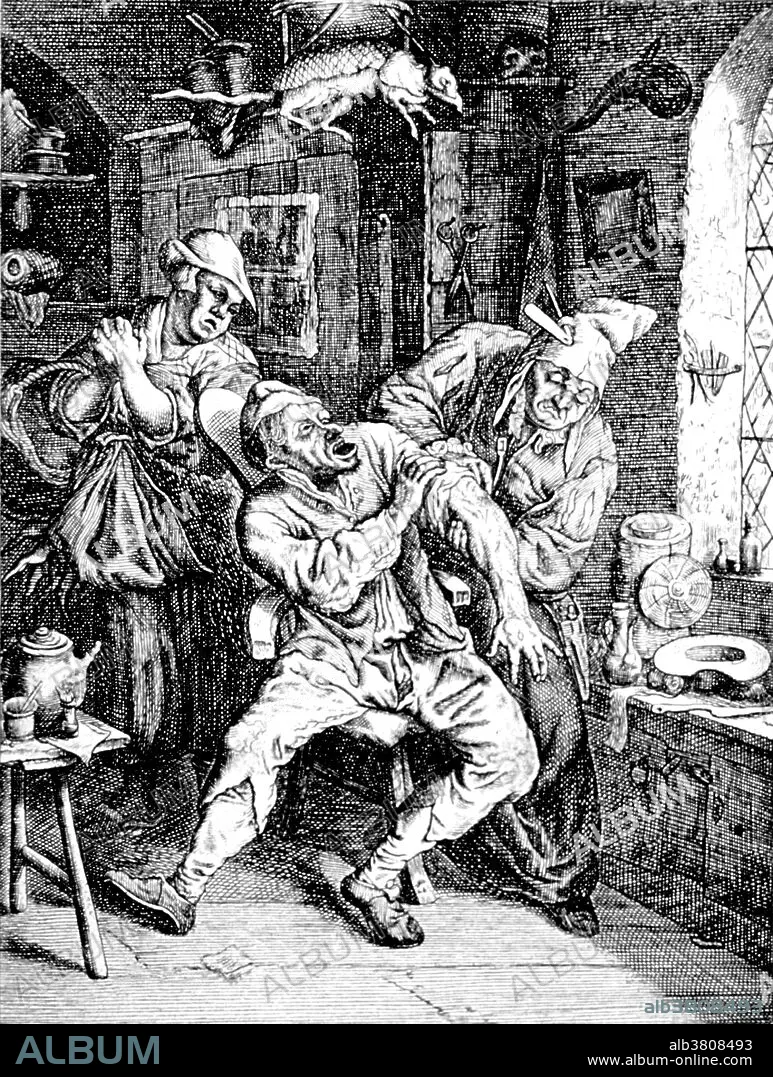
Barber-Surgeon Treating Patient, 17th Century
| Partager |
|---|
 Pinterest Pinterest |
 Twitter Twitter |
 Facebook Facebook |
 Copier le lien Copier le lien |
 Email Email |
|
Ajouter à une autre Lightbox |
|
Ajouter à une autre Lightbox |


Avez-vous déjà un compte? S'identifier
Vous n'avez pas de compte ? S'inscrire
Acheter cette image.
Sélectionnez l'usage:

Titre: Barber-Surgeon Treating Patient, 17th Century
Légende: Voir la traduction automatique
Man, sitting on a chair, is having his arm bandaged by the village physician. A concerned woman waits in the background. In Europe in the 13th century a new type of craftsmen emerged in towns; the barber-surgeon. They cut hair, pulled teeth and performed simple operations such as amputations and setting broken bones and looking after soldiers during or after a battle. Barber-surgeons performed a technique for reconstructing the nose paving the way for the development of modern plastic surgery. The barber surgeon was one of the most common medical practitioners of medieval Europe. In 1745 a bill was passed separating barbers from surgeons. When the barber-surgeons separated, the barber kept the pole as their identification. The pole consists of red and white, or red, white and blue stripes. Red for blood, white for bandages and blue for veins. Engraving by Cornelis Dusart.
Man, sitting on a chair, is having his arm bandaged by the village physician. A concerned woman waits in the background. In Europe in the 13th century a new type of craftsmen emerged in towns; the barber-surgeon. They cut hair, pulled teeth and performed simple operations such as amputations and setting broken bones and looking after soldiers during or after a battle. Barber-surgeons performed a technique for reconstructing the nose paving the way for the development of modern plastic surgery. The barber surgeon was one of the most common medical practitioners of medieval Europe. In 1745 a bill was passed separating barbers from surgeons. When the barber-surgeons separated, the barber kept the pole as their identification. The pole consists of red and white, or red, white and blue stripes. Red for blood, white for bandages and blue for veins. Engraving by Cornelis Dusart.
Crédit: Album / NLM/Science Source
Autorisations: ? Autorisation de modèle: Non - ? Autorisation de propriété: Non
Questions sur les droits?
Questions sur les droits?
Taille de l'image: 3172 × 4200 px | 38.1 MB
Taille d'impression: 26.9 × 35.6 cm | 1248.8 × 1653.5 in (300 dpi)
Mots clés: CHIRURGIE • CHIRURGIEN • EUROPÉEN • ILLUSTRATION • MEDECINE CHIRURGIE • MEDICAL • OPERATION MEDICALE • OPERATION
