

alb2033012
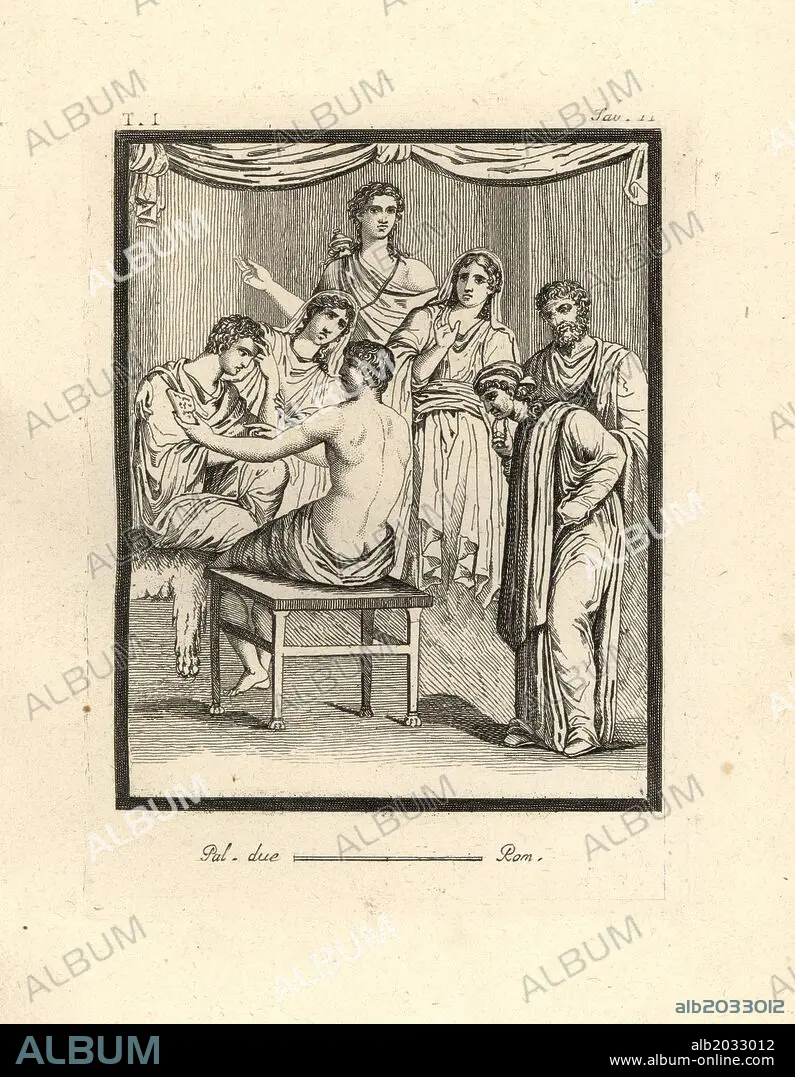
Perhaps this is the moment Iphigenia recognizes Orestes in Euripides' "Iphigenia in Aulis"? The painting shows a pensive Orestes, his sister Iphigenia, his friend Pylades, King Thoas and a chorus of young and old women. Behind them is a statue of Diana with her quiver. Excavated in Resina in 1749. Copperplate engraved by Tommaso Piroli from his own "Antichita di Ercolano" (Antiquities of Herculaneum), Rome, 1789. Italian artist and engraver Piroli (1752-1824) published six volumes between 1789 and 1807 documenting the murals and bronzes found in Heraculaneum and Pompeii.
| Partager |
|---|
 Pinterest Pinterest |
 Twitter Twitter |
 Facebook Facebook |
 Copier le lien Copier le lien |
 Email Email |
|
Ajouter à une autre Lightbox |
|
Ajouter à une autre Lightbox |


Avez-vous déjà un compte? S'identifier
Vous n'avez pas de compte ? S'inscrire
Acheter cette image.
Sélectionnez l'usage:

Légende: Voir la traduction automatique
Perhaps this is the moment Iphigenia recognizes Orestes in Euripides' "Iphigenia in Aulis"? The painting shows a pensive Orestes, his sister Iphigenia, his friend Pylades, King Thoas and a chorus of young and old women. Behind them is a statue of Diana with her quiver. Excavated in Resina in 1749. Copperplate engraved by Tommaso Piroli from his own "Antichita di Ercolano" (Antiquities of Herculaneum), Rome, 1789. Italian artist and engraver Piroli (1752-1824) published six volumes between 1789 and 1807 documenting the murals and bronzes found in Heraculaneum and Pompeii.
Perhaps this is the moment Iphigenia recognizes Orestes in Euripides' "Iphigenia in Aulis"? The painting shows a pensive Orestes, his sister Iphigenia, his friend Pylades, King Thoas and a chorus of young and old women. Behind them is a statue of Diana with her quiver. Excavated in Resina in 1749. Copperplate engraved by Tommaso Piroli from his own "Antichita di Ercolano" (Antiquities of Herculaneum), Rome, 1789. Italian artist and engraver Piroli (1752-1824) published six volumes between 1789 and 1807 documenting the murals and bronzes found in Heraculaneum and Pompeii.
Crédit: Album / Florilegius
Autorisations: ? Autorisation de modèle: Non - ? Autorisation de propriété: Non
Questions sur les droits?
Questions sur les droits?
Taille de l'image: 4749 × 6119 px | 83.1 MB
Taille d'impression: 40.2 × 51.8 cm | 1869.7 × 2409.1 in (300 dpi)
Mots clés: ANTIQUITE • ANTIQUITÉS • ART (CATÉGORIE) • ART ROMAIN • ART • ARTISTE • ARTISTEL • ARTSTE • BASTILLE 1789 • BRONZE • BRONZES • CHOEUR (MUSIQUE) • CHOEURS • CHORALE • CISELEUR • DESSIN MURAL • EPOQUE ROMAINE • FRAVURE • FRESQUE • FRESQUES • GRAVURE • ITALIE POMPEI • ITALIEN • ITALIENNE • MATERIAU BRONZE • MURAL • MUSICIEN CHOEURS • MUSIQUE: CHOEURS • PEINTURES MURALES • POMPEI • POMPEI, ITALIE • REVOLUTION FRANCAISE (1789-99) • REVOLUTION FRANCAISE 1789 • ROI • ROMAIN • ROME • SCULPTURE • SCULPTURES • SITE ARCHEOL.: POMPEI • STATUE • STATUT • TABLEAU MURAL • TECHNIQUE: FRESQUES • TECHNIQUE: SCULPTURE
