

alb3822575
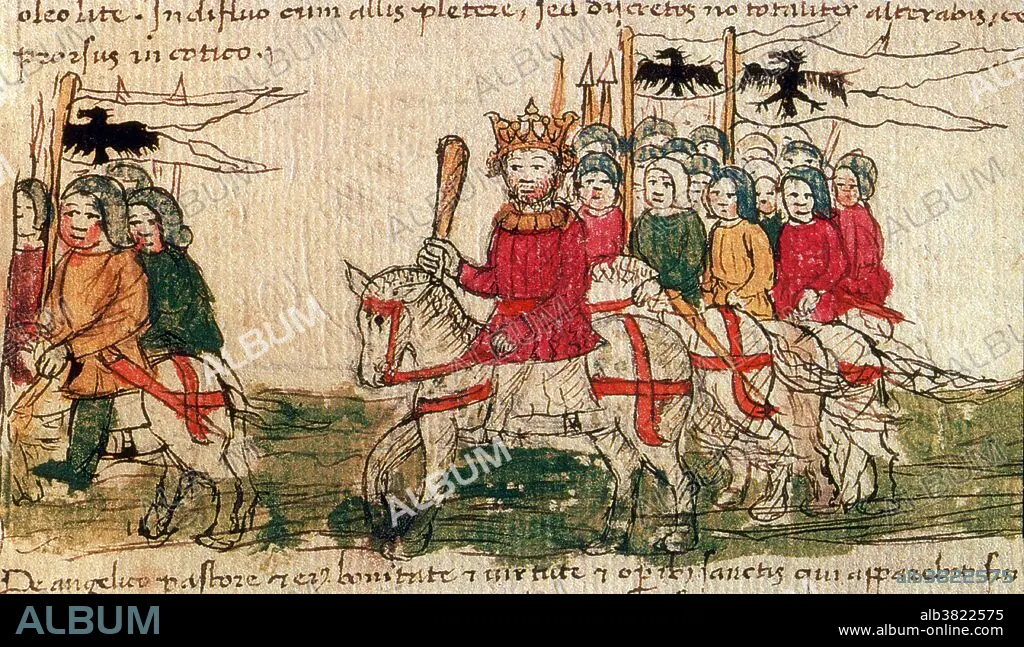
Third Crusade, Barbarossa's Crusade, 1189
| Partager |
|---|
 Pinterest Pinterest |
 Twitter Twitter |
 Facebook Facebook |
 Copier le lien Copier le lien |
 Email Email |
|
Ajouter à une autre Lightbox |
|
Ajouter à une autre Lightbox |


Avez-vous déjà un compte? S'identifier
Vous n'avez pas de compte ? S'inscrire
Acheter cette image.
Sélectionnez l'usage:

Titre: Third Crusade, Barbarossa's Crusade, 1189
Légende: Voir la traduction automatique
The Third Crusade (1189-92) was an attempt by European leaders to reconquer the Holy Land from Saladin. The elderly Holy Roman Emperor Frederick I Barbarossa responded to the call immediately. He took up the Cross at Mainz Cathedral in 1188 and was the first to set out for the Holy Land in 1189 with an army of about 100,000 men, including 20,000 knights. The Byzantine Emperor Isaac II Angelus made a secret alliance with Saladin to impede Frederick's progress in exchange for his empire's safety. Meanwhile, the Sultanate of Rum promised Frederick safety through Anatolia, but after much raiding Frederick lost patience and on May 18, 1190, the German army sacked the capital of the Sultanate, Iconium. While crossing the Saleph River on June 10, 1190, Frederick's horse slipped, throwing him against the rocks. Weak and wounded he drowned before he could be rescued. Much of his army returned to Germany in anticipation of the upcoming Imperial election. The Emperor's son, Frederick of Swabia, led the remaining 5,000 men to Antioch. There, the Emperor's body was boiled to remove the flesh, which was interred in the Church of St. Peter; his bones were put in a bag to continue the crusade.
The Third Crusade (1189-92) was an attempt by European leaders to reconquer the Holy Land from Saladin. The elderly Holy Roman Emperor Frederick I Barbarossa responded to the call immediately. He took up the Cross at Mainz Cathedral in 1188 and was the first to set out for the Holy Land in 1189 with an army of about 100,000 men, including 20,000 knights. The Byzantine Emperor Isaac II Angelus made a secret alliance with Saladin to impede Frederick's progress in exchange for his empire's safety. Meanwhile, the Sultanate of Rum promised Frederick safety through Anatolia, but after much raiding Frederick lost patience and on May 18, 1190, the German army sacked the capital of the Sultanate, Iconium. While crossing the Saleph River on June 10, 1190, Frederick's horse slipped, throwing him against the rocks. Weak and wounded he drowned before he could be rescued. Much of his army returned to Germany in anticipation of the upcoming Imperial election. The Emperor's son, Frederick of Swabia, led the remaining 5,000 men to Antioch. There, the Emperor's body was boiled to remove the flesh, which was interred in the Church of St. Peter; his bones were put in a bag to continue the crusade.
Crédit: Album / NYPL/Science Source
Autorisations: ? Autorisation de modèle: Non - ? Autorisation de propriété: Non
Questions sur les droits?
Questions sur les droits?
Taille de l'image: 4800 × 2785 px | 38.2 MB
Taille d'impression: 40.6 × 23.6 cm | 1889.8 × 1096.5 in (300 dpi)
Mots clés: ARME • ARMES • CAVALIERS • CÉLÈBRE • CELEBRITE • CHEVALERIE • CHEVALIER • CHEVALIERS • CROISE • ECRITURE ENLUMINURES • ENLUMINURES • ÉVÉNEMENT • GENTLEMAN • GUERRE SAINTE • GUERRE • HOMME • ILLUSTRATION • MANUSCRIT ENLUMINE • PERSONNAGES • PERSONNALITÉS • PERSONNE • ROI • TROISIEME CROISADE
