

alb12764020
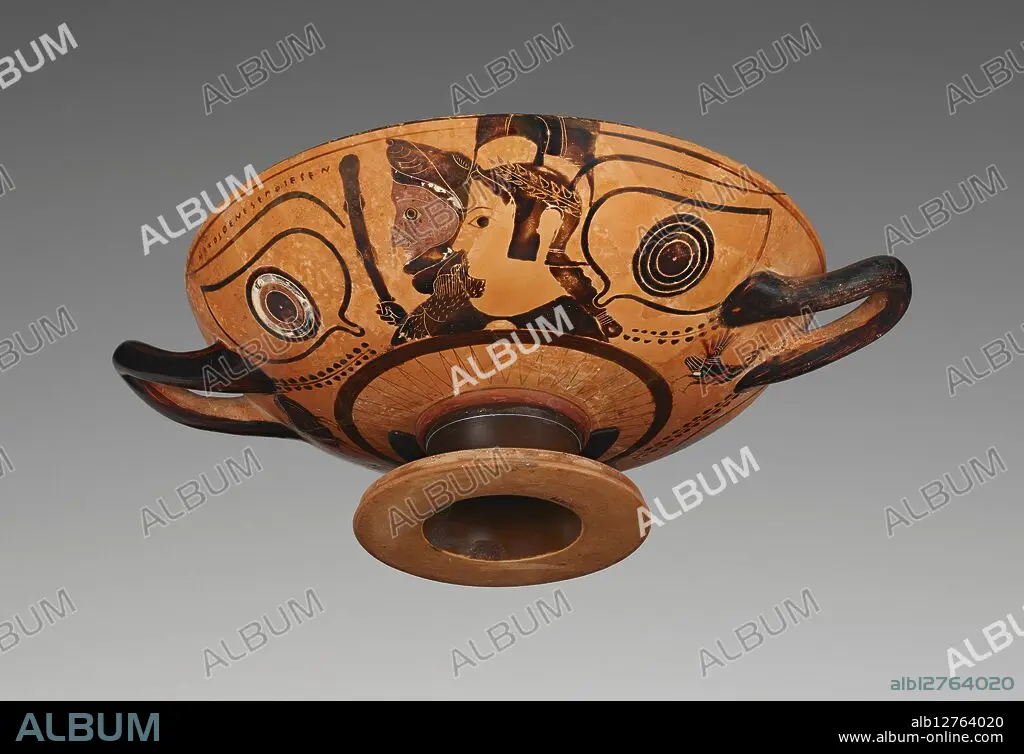
VILLA GIULIA PAINTER, NIKOSTHENES. Attic Black-Figure Eye Cup, about 530 BC. Creators: Villa Giulia Painter, Nikosthenes.
| Partager |
|---|
 Pinterest Pinterest |
 Twitter Twitter |
 Facebook Facebook |
 Copier le lien Copier le lien |
 Email Email |
|
Ajouter à une autre Lightbox |
|
Ajouter à une autre Lightbox |


Avez-vous déjà un compte? S'identifier
Vous n'avez pas de compte ? S'inscrire
Acheter cette image.
Sélectionnez l'usage:

Auteur: VILLA GIULIA PAINTER • NIKOSTHENES
Titre: Attic Black-Figure Eye Cup, about 530 BC. Creators: Villa Giulia Painter, Nikosthenes.
Légende: Voir la traduction automatique
Wine Cup with Herakles and Athena. Additional Info: A pair of large eyes frames busts of the hero Herakles and his patron goddess Athena on one side of this black-figure cup. In the 500s BC, Greek vase-painters frequently placed eyes on cups, perhaps because they were believed to be apotropaic--that is, they had the power to ward off evil -- or so that the cup would be transformed into a mask when a drinker raised it to his lips . Above the left eyebrow runs the signature of the potter Nikosthenes. The other side of the cup has a similar scene with three busts, two female and one male. The female figure in the middle was once painted white and wears a type of headdress called a polos, typical of Greek goddesses. These busts, however, are harder to identify than those on the front of the cup. Some scholars identify them as Zeus, Hebe, and Hera, suggesting that the subject of the cup as a whole would be the apotheosis of Herakles, his introduction on Mount Olympus as a god. Others, however, interpret the heads as Hades, Persephone, and Demeter and the cup's theme as Herakles' introduction into the Eleusinian Mysteries, a cult that promised a better afterlife to its followers.
Wine Cup with Herakles and Athena. Additional Info: A pair of large eyes frames busts of the hero Herakles and his patron goddess Athena on one side of this black-figure cup. In the 500s BC, Greek vase-painters frequently placed eyes on cups, perhaps because they were believed to be apotropaic--that is, they had the power to ward off evil -- or so that the cup would be transformed into a mask when a drinker raised it to his lips . Above the left eyebrow runs the signature of the potter Nikosthenes. The other side of the cup has a similar scene with three busts, two female and one male. The female figure in the middle was once painted white and wears a type of headdress called a polos, typical of Greek goddesses. These busts, however, are harder to identify than those on the front of the cup. Some scholars identify them as Zeus, Hebe, and Hera, suggesting that the subject of the cup as a whole would be the apotheosis of Herakles, his introduction on Mount Olympus as a god. Others, however, interpret the heads as Hades, Persephone, and Demeter and the cup's theme as Herakles' introduction into the Eleusinian Mysteries, a cult that promised a better afterlife to its followers.
Crédit: Album / Heritage Art/Heritage Images
Autorisations: ? Autorisation de modèle: Non - ? Autorisation de propriété: Non
Questions sur les droits?
Questions sur les droits?
Taille de l'image: 10909 × 7468 px | 233.1 MB
Taille d'impression: 92.4 × 63.2 cm | 4294.9 × 2940.2 in (300 dpi)
Mots clés: ATHENES • BRUNE • CORPS YEUX • COULEUR • DEESSE • GRECE • NIKOSTHENES • OEIL • PROFIL • PROFILS • RECIPIENT • RELIGION • VAISSEAU, RECIPIENT • VAISSELLE VAISSEAUX • VILLA GIULIA PAINTER • YEUX
