

alb5528516
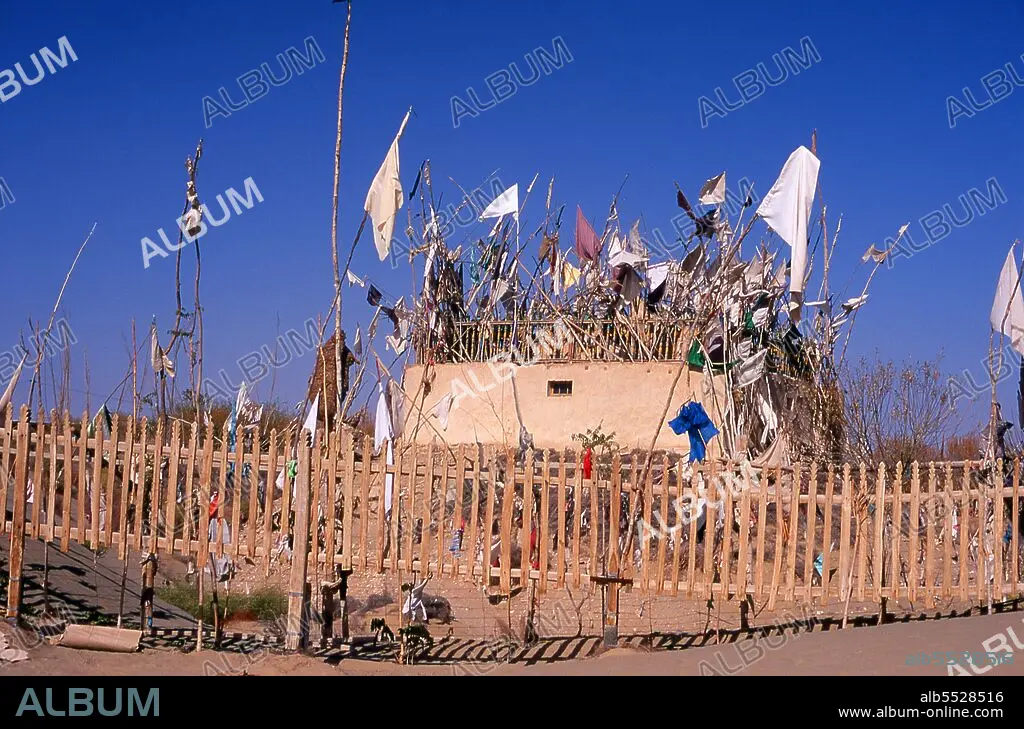
China: A tomb in the sand dunes near the Imam Asim Mazar (shrine) in the desert near Khotan, Xinjiang Province.
| Partager |
|---|
 Pinterest Pinterest |
 Twitter Twitter |
 Facebook Facebook |
 Copier le lien Copier le lien |
 Email Email |
|
Ajouter à une autre Lightbox |
|
Ajouter à une autre Lightbox |


Avez-vous déjà un compte? S'identifier
Vous n'avez pas de compte ? S'inscrire
Acheter cette image.
Sélectionnez l'usage:

Titre: China: A tomb in the sand dunes near the Imam Asim Mazar (shrine) in the desert near Khotan, Xinjiang Province.
Légende: Voir la traduction automatique
The Imam Asim Shrine and other tombs can be found 23 kilometres from Khotan (Hotan) on the southern Silk Road. It is the site of a huge pilgrimage each May. Imam Asim was one of the first Islamic missionaries to visit this area. Khotan traces its history back at least as far as the 3rd century BCE, when the eldest son of the Indian emperor Asoka is said to have settled here. It was of great importance on the Silk Road, and is claimed to have been the first place outside China to have cultivated silk. It sits astride the Karakash or ‘Black Jade’ and Yurungkash or ‘White Jade’ Rivers, which here conjoin to form the Khotan Darya, and has been famous for its jade for well over two millennia. In times past trade routes crossed the desert to the north all the way to Kuqa, and as recently as 2007 this link has been re-established for the first time in centuries with the opening of a second Desert Highway leading to Aksu, distant some 424km to the north. In 1006 Khotan was conquered by Uighur Muslims from Kashgar, and since that time the city remains a very Uighur place.
The Imam Asim Shrine and other tombs can be found 23 kilometres from Khotan (Hotan) on the southern Silk Road. It is the site of a huge pilgrimage each May. Imam Asim was one of the first Islamic missionaries to visit this area. Khotan traces its history back at least as far as the 3rd century BCE, when the eldest son of the Indian emperor Asoka is said to have settled here. It was of great importance on the Silk Road, and is claimed to have been the first place outside China to have cultivated silk. It sits astride the Karakash or ‘Black Jade’ and Yurungkash or ‘White Jade’ Rivers, which here conjoin to form the Khotan Darya, and has been famous for its jade for well over two millennia. In times past trade routes crossed the desert to the north all the way to Kuqa, and as recently as 2007 this link has been re-established for the first time in centuries with the opening of a second Desert Highway leading to Aksu, distant some 424km to the north. In 1006 Khotan was conquered by Uighur Muslims from Kashgar, and since that time the city remains a very Uighur place.
Crédit: Album / David Henley/Pictures from History/Universal Images Group
Autorisations: ? Autorisation de modèle: Non - ? Autorisation de propriété: Non
Questions sur les droits?
Questions sur les droits?
Taille de l'image: 5100 × 3369 px | 49.2 MB
Taille d'impression: 43.2 × 28.5 cm | 2007.9 × 1326.4 in (300 dpi)
Mots clés: ASIE • ASIE, CONTINENT • CAVEAU • CHINE • CHINOIS • CHINOISE • CONTINENT ASIE • DESERT • DESERTS • FUNÉRAIRE • GISANT • HISOIRE • HISTOIRE • IMAM • ISLAM • ISLAMIQUE • ISLMAM • MAUSOLEE • MINORITES • MORT TOMBEAU • MUSULMANE • RELIGION • RELIQUAIRE • SÉPULCRE • SÉPULTURE • TOMBE • TOMBEAU • TOMBEAUX • TOMBÉS
