

alb3600346
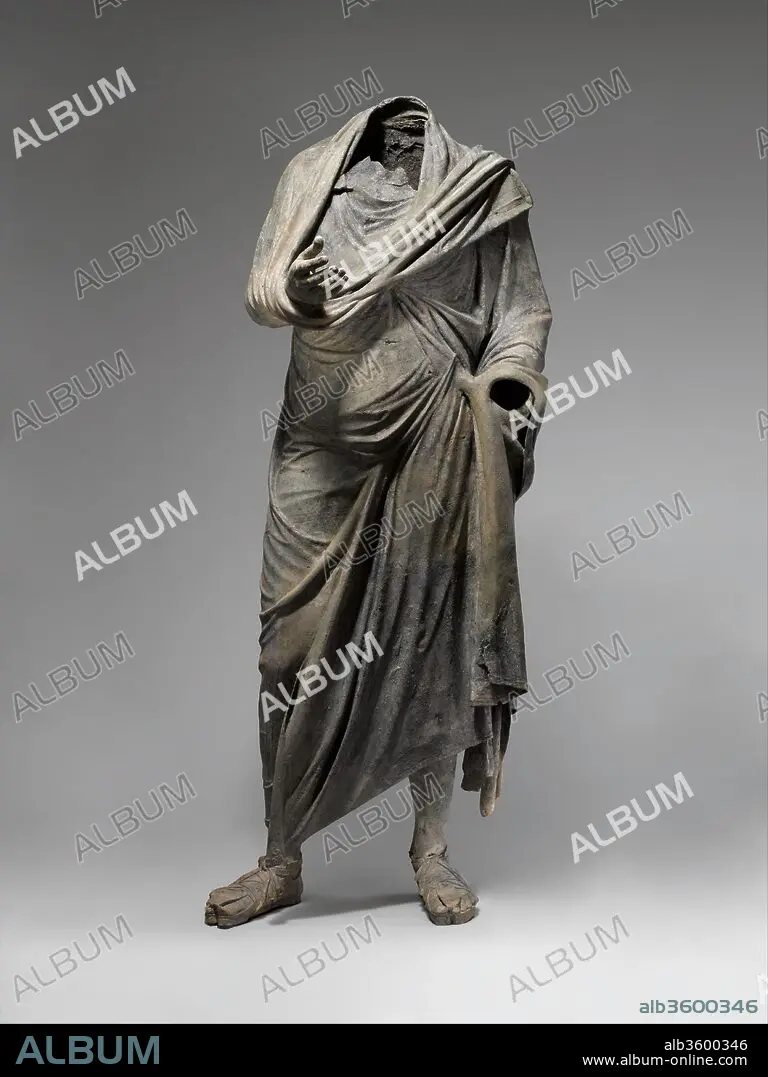
Bronze statue of a man
| Partager |
|---|
 Pinterest Pinterest |
 Twitter Twitter |
 Facebook Facebook |
 Copier le lien Copier le lien |
 Email Email |
|
Ajouter à une autre Lightbox |
|
Ajouter à une autre Lightbox |


Avez-vous déjà un compte? S'identifier
Vous n'avez pas de compte ? S'inscrire
Acheter cette image.
Sélectionnez l'usage:

Titre: Bronze statue of a man
Légende:
Traduction automatique: Statue en bronze d'un homme. Culture : grec. Dimensions : H. 73 in. (185,4 cm). Date : env. milieu du IIe-Ier siècle av. La figure se tient en contrapposto. Sa main droite s'étend des plis de son himation, avec la paume ouverte et les doigts recourbés vers le haut dans un geste d'oraison. Son bras gauche est près de son corps. L'himation est maintenu en place en partie par un poids à glands, jeté sur son épaule gauche, qui pend à son mollet. Détail rare, plusieurs bandes horizontales décorent le tissu, et peuvent avoir été peintes ou dorées. L'indication de sa musculature et de son anatomie se poursuit sous son vêtement. Les statues honorifiques comme celle-ci étaient généralement des portraits de personnalités éminentes décernées par la cité-état ou le souverain en remerciement pour des bienfaits importants. C'était la plus haute distinction qu'une ville puisse offrir. Cette figure impressionnante se dresse en contrapposto. Sa main droite s'étend des plis de son himation (manteau), avec la paume ouverte et les doigts recourbés vers le haut dans un geste d'oraison. Son bras gauche est près de son corps. L'himation est maintenu en place en partie par le poids à glands jeté sur son épaule gauche, qui pend à son mollet, et l'indication de sa musculature et de son anatomie se poursuit sous son vêtement. Les nombreuses bandes horizontales qui décorent le tissu, qui peuvent avoir été peintes ou dorées, constituent un détail rare.
Bronze statue of a man. Culture: Greek. Dimensions: H. 73 in. (185.4 cm). Date: ca. mid-2nd-1st century B.C..
The figure stands in contrapposto. His right hand stretches out from the folds of his himation, with open palm and fingers curled upward in a gesture of oration. His left arm lays close to his body. The himation is kept in place in part by a tasselled weight, thrown over his left shoulder, which hangs at his calf. A rare detail, several horizontal bands decorate the fabric, and may have been painted or gilded. The indication of his musculature and anatomy continues underneath his garment.
Honorific statues like this one were typically portraits of prominent individuals awarded by the city-state or ruler in gratitude for significant benefactions. They were the highest honor that a city could offer. This impressive figure stands in contrapposto. His right hand stretches out from the folds of his himation (cloak), with open palm and fingers curled upward in a gesture of oration. His left arm lies close to his body. The himation is kept in place in part by the tasseled weight thrown over his left shoulder, which hangs at his calf, and the indication of his musculature and anatomy continues underneath his garment. The several horizontal bands that decorate the fabric,which may have been painted or gilded, comprise a rare detail.
Technique/matériel: BRONZE
Période: hellénistique
Musée: Metropolitan Museum of Art, New York, USA
Crédit: Album
Autorisations: ? Autorisation de modèle: Non - ? Autorisation de propriété: Non
Questions sur les droits?
Questions sur les droits?
Taille de l'image: 3192 × 4256 px | 38.9 MB
Taille d'impression: 27.0 × 36.0 cm | 1256.7 × 1675.6 in (300 dpi)
Mots clés: BRONZE • BRONZES • EUROPE (CONTINENT) • GRECE • HELLÉNISTIQUE • MATERIAU BRONZE • METROPOLITAN MUSEUM OF ART, NEW YORK, USA • STATUES
