

alb4673220
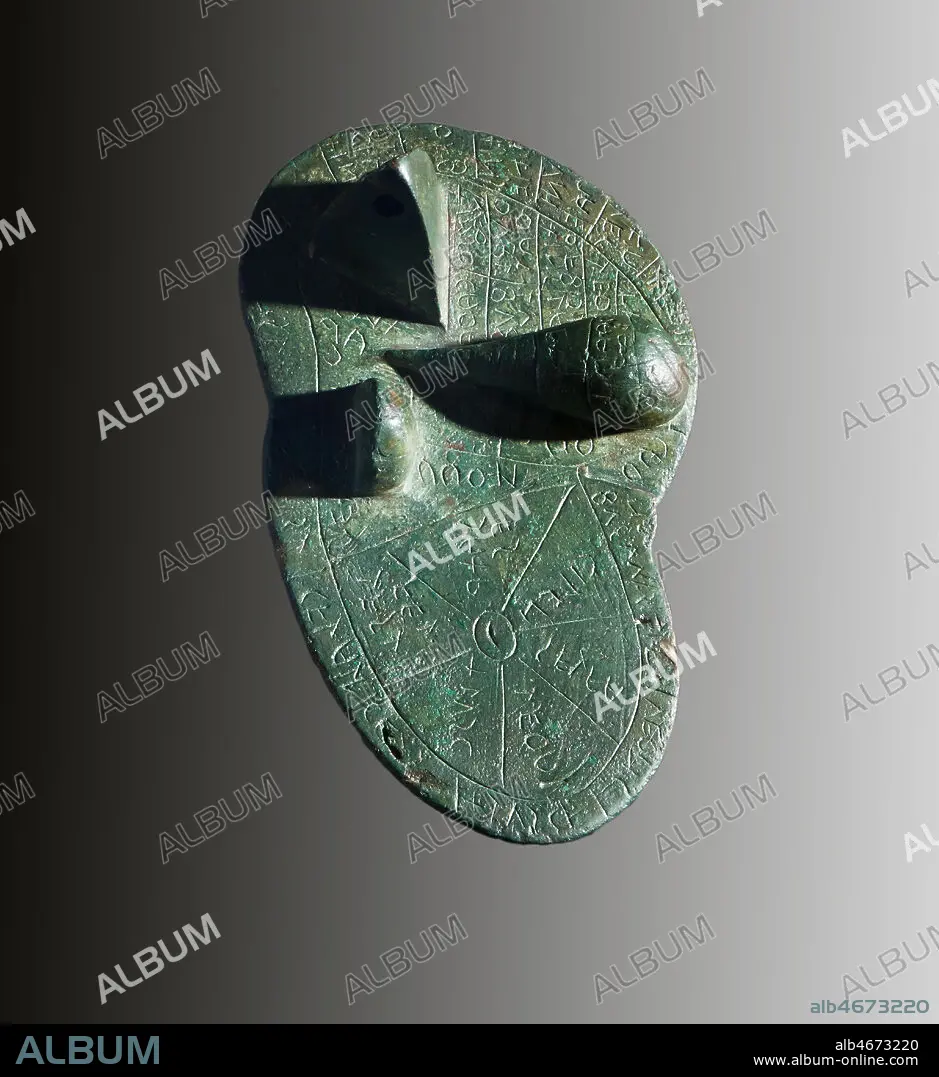
Piacenza, Palazzo Farnese, Municipal Museums: Etruscan Liver. The Liver of Piacenza is an Etruscan artifact found in 1877, near Gossolengo, in the province of Piacenza. It is a life-sized bronze model of a sheep's liver covered in Etruscan inscriptions (TLE 719), measuring 126 mm by 76 mm by 60 mm and dated to the late 2nd century BC, i.e. a time when the Piacenza region would already have been Latin-dominated.. The liver is subdivided into sections for the purposes of performing haruspicy (hepatoscopy). The outer rim of the Piacenza liver is divided into 16 sections; since according to the testimony of Pliny and Cicero, the Etruscan divided the heavens into 16 astrological houses, it has been suggested that the liver is supposed to represent a model of the cosmos, and its parts should be identified as constellations or astrological signs.
| Partager |
|---|
 Pinterest Pinterest |
 Twitter Twitter |
 Facebook Facebook |
 Copier le lien Copier le lien |
 Email Email |
|
Ajouter à une autre Lightbox |
|
Ajouter à une autre Lightbox |


Avez-vous déjà un compte? S'identifier
Vous n'avez pas de compte ? S'inscrire
Acheter cette image.
Sélectionnez l'usage:

Légende: Voir la traduction automatique
Piacenza, Palazzo Farnese, Municipal Museums: Etruscan Liver. The Liver of Piacenza is an Etruscan artifact found in 1877, near Gossolengo, in the province of Piacenza. It is a life-sized bronze model of a sheep's liver covered in Etruscan inscriptions (TLE 719), measuring 126 mm by 76 mm by 60 mm and dated to the late 2nd century BC, i.e. a time when the Piacenza region would already have been Latin-dominated.. The liver is subdivided into sections for the purposes of performing haruspicy (hepatoscopy). The outer rim of the Piacenza liver is divided into 16 sections; since according to the testimony of Pliny and Cicero, the Etruscan divided the heavens into 16 astrological houses, it has been suggested that the liver is supposed to represent a model of the cosmos, and its parts should be identified as constellations or astrological signs.
Piacenza, Palazzo Farnese, Municipal Museums: Etruscan Liver. The Liver of Piacenza is an Etruscan artifact found in 1877, near Gossolengo, in the province of Piacenza. It is a life-sized bronze model of a sheep's liver covered in Etruscan inscriptions (TLE 719), measuring 126 mm by 76 mm by 60 mm and dated to the late 2nd century BC, i.e. a time when the Piacenza region would already have been Latin-dominated.. The liver is subdivided into sections for the purposes of performing haruspicy (hepatoscopy). The outer rim of the Piacenza liver is divided into 16 sections; since according to the testimony of Pliny and Cicero, the Etruscan divided the heavens into 16 astrological houses, it has been suggested that the liver is supposed to represent a model of the cosmos, and its parts should be identified as constellations or astrological signs.
Crédit: Album / Ghigo Roli
Autorisations: ? Autorisation de modèle: Non - ? Autorisation de propriété: Non
Questions sur les droits?
Questions sur les droits?
Taille de l'image: 4096 × 4467 px | 52.3 MB
Taille d'impression: 34.7 × 37.8 cm | 1612.6 × 1758.7 in (300 dpi)
Mots clés: AGNEAU • ANIMAL: MOUTON • ART (CATÉGORIE) • ART • AUGURE • BREBIS • BRONZE • BRONZES • DIVINATION • FOIE • FUTUR • HISOIRE • HISTOIRE • ITALIE • MAGIE • MATERIAU BRONZE • MOUTON • MOUTONS • MUSÉE • ORACLE • PIACENZA (PC) • PREDICTION • PRESAGE • PROPHETIE • PROPHETIES • TROUPEAU DE MOUTONS
