

alb8372045
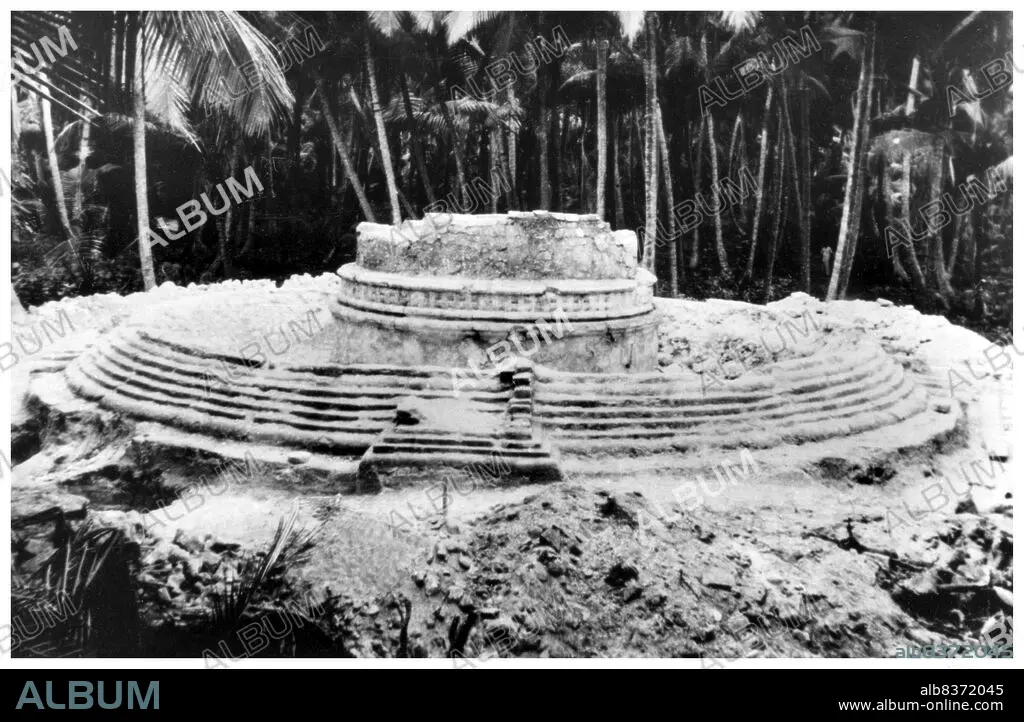
Maldives: Buddhist stupa excavated on Thoddu Island in 1959, probably 9th century CE
| Partager |
|---|
 Pinterest Pinterest |
 Twitter Twitter |
 Facebook Facebook |
 Copier le lien Copier le lien |
 Email Email |
|
Ajouter à une autre Lightbox |
|
Ajouter à une autre Lightbox |


Avez-vous déjà un compte? S'identifier
Vous n'avez pas de compte ? S'inscrire
Acheter cette image.
Sélectionnez l'usage:

Titre: Maldives: Buddhist stupa excavated on Thoddu Island in 1959, probably 9th century CE
Légende: Voir la traduction automatique
Buddhism in the Maldives was the predominant religion at least until the 12th century CE. It is not clear how Buddhism was introduced into the islands although there are a number of competing theories. The predominant view is that it was introduced with the expansion of the Sinhalese people from neighboring Sri Lanka who are primarily Buddhist.
. In February 2012, a group of Islamic extremists forced their way into the National Museum in Male and attacked the museum's collection of pre-Islamic sculptures, destroying or severely damaging nearly the entire collection about thirty Hindu and Buddhist sculptures dating from the 6th to 12th centuries.
. Museum staff indicated that as the sculptures were made from very brittle coral or limestone it would be impossible to repair most of them, and only two or three pieces were in a repairable condition.
Buddhism in the Maldives was the predominant religion at least until the 12th century CE. It is not clear how Buddhism was introduced into the islands although there are a number of competing theories. The predominant view is that it was introduced with the expansion of the Sinhalese people from neighboring Sri Lanka who are primarily Buddhist.
. In February 2012, a group of Islamic extremists forced their way into the National Museum in Male and attacked the museum's collection of pre-Islamic sculptures, destroying or severely damaging nearly the entire collection about thirty Hindu and Buddhist sculptures dating from the 6th to 12th centuries.
. Museum staff indicated that as the sculptures were made from very brittle coral or limestone it would be impossible to repair most of them, and only two or three pieces were in a repairable condition.
Crédit: Album / Universal Images Group / Pictures From History
Autorisations: ? Autorisation de modèle: Non - ? Autorisation de propriété: Non
Questions sur les droits?
Questions sur les droits?
Taille de l'image: 5100 × 3332 px | 48.6 MB
Taille d'impression: 43.2 × 28.2 cm | 2007.9 × 1311.8 in (300 dpi)
Mots clés: ARCHÉLOGIE • ARCHEOLOGIE • ARCHÉOLOLOGIE • ARCHITCETURE • ARCHITECTURE • ARCITECTURE • ASIE • ASIE, CONTINENT • BOUDDHISME • BOUDDHISTE • BOUDDIQUE • BUDDISME: STUPA • CHEDI • CONTINENT ASIE • ISLAM • ISLMAM • MONUMENT FUNERAIRE, STUPA • MORT STUPA • MUSULMAN • MUSULMANE • MUSUSLMAN • RELIGION • RELIGION: BOUDDHISME • STUPA • STUPA, MONUMENT FUNERAIRE • VANDALISME
