

alb3815407
Boëthius, Medieval Philosopher
| Partager |
|---|
 Pinterest Pinterest |
 Twitter Twitter |
 Facebook Facebook |
 Copier le lien Copier le lien |
 Email Email |
|
Ajouter à une autre Lightbox |
|
Ajouter à une autre Lightbox |


Avez-vous déjà un compte? S'identifier
Vous n'avez pas de compte ? S'inscrire
Acheter cette image.
Sélectionnez l'usage:

Titre: Boëthius, Medieval Philosopher
Légende: Voir la traduction automatique
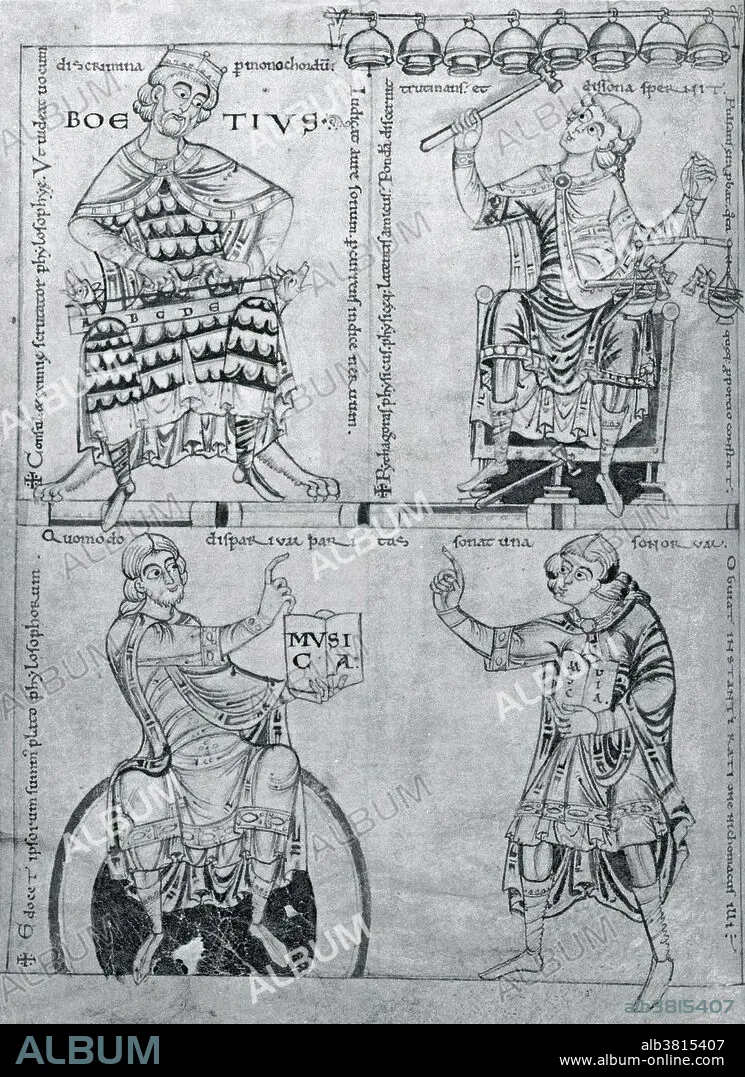
Anicius Manlius Severinus Boëthius, commonly called Boëthius (480-524/525 AD) was a philosopher of the early 6th century. Boethius, of the noble Anicia family, entered public life at a young age and was already a senator by the age of 25. This illustration is from Boethius' De institutione musica, was one of the first musical works to be printed in Venice between the years of 1491 and 1492. It was written toward the beginning of the sixth century and helped medieval authors during the ninth century understand Greek music. In his De Musica, Boethius introduced the fourfold classification of music: 1) musica mundana: music of the spheres/world 2) musica humana : harmony of human body and spiritual harmony 3) musica instrumentalis: instrumental music and 4) musica divina: music of the gods. Boethius was imprisoned and eventually executed by King Theodoric the Great, who suspected him of conspiring with the Eastern Roman Empire. While jailed, Boethius composed his Consolation of Philosophy, a philosophical treatise on fortune, death, and other issues. The Consolation became one of the most popular and influential works of the Middle Ages.
Anicius Manlius Severinus Boëthius, commonly called Boëthius (480-524/525 AD) was a philosopher of the early 6th century. Boethius, of the noble Anicia family, entered public life at a young age and was already a senator by the age of 25. This illustration is from Boethius' De institutione musica, was one of the first musical works to be printed in Venice between the years of 1491 and 1492. It was written toward the beginning of the sixth century and helped medieval authors during the ninth century understand Greek music. In his De Musica, Boethius introduced the fourfold classification of music: 1) musica mundana: music of the spheres/world 2) musica humana : harmony of human body and spiritual harmony 3) musica instrumentalis: instrumental music and 4) musica divina: music of the gods. Boethius was imprisoned and eventually executed by King Theodoric the Great, who suspected him of conspiring with the Eastern Roman Empire. While jailed, Boethius composed his Consolation of Philosophy, a philosophical treatise on fortune, death, and other issues. The Consolation became one of the most popular and influential works of the Middle Ages.
Crédit: Album / Science Source / New York Public Library
Autorisations: ? Autorisation de modèle: Non - ? Autorisation de propriété: Non
Questions sur les droits?
Questions sur les droits?
Taille de l'image: 2691 × 3699 px | 28.5 MB
Taille d'impression: 22.8 × 31.3 cm | 1059.4 × 1456.3 in (300 dpi)
Mots clés: AUTEUR • AUTEURS • BOIS, GRAVURE SUR • CÉLÈBRE • CELEBRITE • GRAVURE SUR BOIS • GRAVURE TAILLE DOUCE • HOMME • ILLUSTRATION • PERSONNE • PHILOSOPHIE • PORTAIT • PORTRAIT • POTRAIT • SCIENCE: PHILOSOPHIE • TAILLE-DOUCE • TECHNIQUE: GRAVURE SUR BOI • XYLOGRAPHIE
