

alb3802185
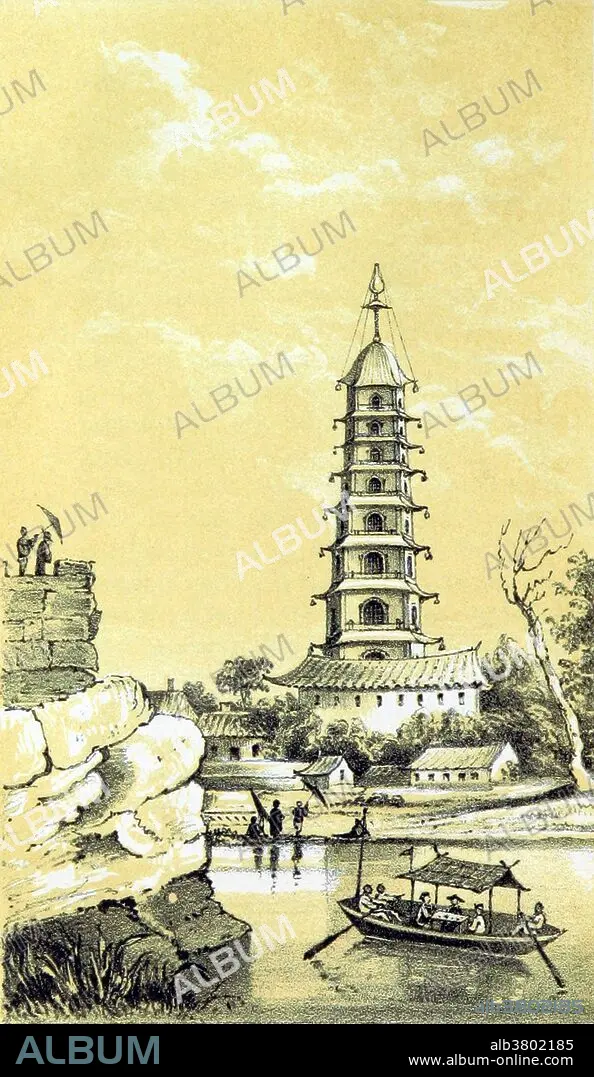
Porcelain Tower of Nanjing, 19th Century
| Partager |
|---|
 Pinterest Pinterest |
 Twitter Twitter |
 Facebook Facebook |
 Copier le lien Copier le lien |
 Email Email |
|
Ajouter à une autre Lightbox |
|
Ajouter à une autre Lightbox |


Avez-vous déjà un compte? S'identifier
Vous n'avez pas de compte ? S'inscrire
Acheter cette image.
Sélectionnez l'usage:

Titre: Porcelain Tower of Nanjing, 19th Century
Légende: Voir la traduction automatique
The Porcelain Tower (or Porcelain Pagoda) of Nanjing, also known as Bao'ensi (Temple of Repaid Gratitude), is a historical site located on the south bank of external Qinhuai River in Nanjing, China. It was a pagoda constructed in the 15th century during the Ming Dynasty. The tower was octagonal with a base of about 97 feet in diameter. When it was built, the tower was one of the largest buildings in China, rising up to a height of 260 feet with nine stories and a staircase in the middle of the pagoda, which spiraled upwards for 184 steps. The top of the roof was marked by a golden pineapple. It was first discovered by the Western world when 17th century travelers visited it, sometimes listing it as one of the Seven Wonders of the World. It was mostly destroyed in the 19th century during the course of the Taiping Rebellion. European Entitled: "View of the Pocelain Tower from the Grand Canal." Image taken from page 296 of An Aide-de-Camp's Recollections of Service in China, a residence in Hong Kong, and visits to other islands in the Chinese seas, 1844.
The Porcelain Tower (or Porcelain Pagoda) of Nanjing, also known as Bao'ensi (Temple of Repaid Gratitude), is a historical site located on the south bank of external Qinhuai River in Nanjing, China. It was a pagoda constructed in the 15th century during the Ming Dynasty. The tower was octagonal with a base of about 97 feet in diameter. When it was built, the tower was one of the largest buildings in China, rising up to a height of 260 feet with nine stories and a staircase in the middle of the pagoda, which spiraled upwards for 184 steps. The top of the roof was marked by a golden pineapple. It was first discovered by the Western world when 17th century travelers visited it, sometimes listing it as one of the Seven Wonders of the World. It was mostly destroyed in the 19th century during the course of the Taiping Rebellion. European Entitled: "View of the Pocelain Tower from the Grand Canal." Image taken from page 296 of An Aide-de-Camp's Recollections of Service in China, a residence in Hong Kong, and visits to other islands in the Chinese seas, 1844.
Crédit: Album / Science Source / British Library
Autorisations: ? Autorisation de modèle: Non - ? Autorisation de propriété: Non
Questions sur les droits?
Questions sur les droits?
Taille de l'image: 2435 × 4200 px | 29.3 MB
Taille d'impression: 20.6 × 35.6 cm | 958.7 × 1653.5 in (300 dpi)
Mots clés: ASIE • ASIE, CONTINENT • CONTINENT ASIE • DYNASTIE MANDCHOUE • DYNASTIE QING • ILLUSTRATION • PAGODE
