

alb3812160
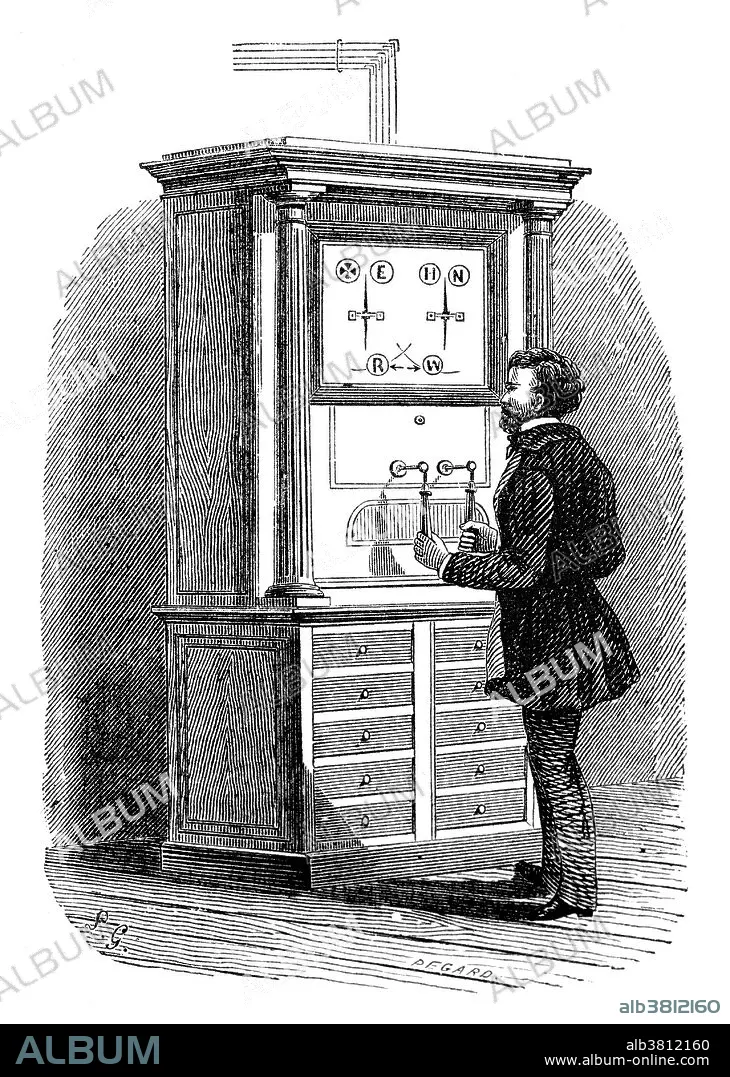
Cooke and Wheatstone Two Needle Telegraph, 1830s
| Partager |
|---|
 Pinterest Pinterest |
 Twitter Twitter |
 Facebook Facebook |
 Copier le lien Copier le lien |
 Email Email |
|
Ajouter à une autre Lightbox |
|
Ajouter à une autre Lightbox |


Avez-vous déjà un compte? S'identifier
Vous n'avez pas de compte ? S'inscrire
Acheter cette image.
Sélectionnez l'usage:

Titre: Cooke and Wheatstone Two Needle Telegraph, 1830s
Légende: Voir la traduction automatique
The Cooke and Wheatstone telegraph was an early electrical telegraph system invented by English inventors William Fothergill Cooke and Charles Wheatstone. The receiver consisted of a number of needles which could be moved by electromagnetic coils to point to letters on a board. This feature was liked by early users who were unwilling to learn codes, and employers who did not want to invest in staff training. The two-needle telegraph required three wires, one for each needle and a common return. The coding was somewhat different from the five-needle telegraph and needed to be learned, rather than read from a display. The needles could move to the left or right either one, two, or three times in quick succession, or a single time in both directions in quick succession. Either needle, or both together, could be moved. This gave a total of 24 codes, one of which was taken up by the stop code. Three letters were omitted: J, Q and Z, which were substituted
The Cooke and Wheatstone telegraph was an early electrical telegraph system invented by English inventors William Fothergill Cooke and Charles Wheatstone. The receiver consisted of a number of needles which could be moved by electromagnetic coils to point to letters on a board. This feature was liked by early users who were unwilling to learn codes, and employers who did not want to invest in staff training. The two-needle telegraph required three wires, one for each needle and a common return. The coding was somewhat different from the five-needle telegraph and needed to be learned, rather than read from a display. The needles could move to the left or right either one, two, or three times in quick succession, or a single time in both directions in quick succession. Either needle, or both together, could be moved. This gave a total of 24 codes, one of which was taken up by the stop code. Three letters were omitted: J, Q and Z, which were substituted
Personnalités: MASS
Crédit: Album / Science Source
Autorisations: ? Autorisation de modèle: Non - ? Autorisation de propriété: Non
Questions sur les droits?
Questions sur les droits?
Taille de l'image: 3100 × 4350 px | 38.6 MB
Taille d'impression: 26.2 × 36.8 cm | 1220.5 × 1712.6 in (300 dpi)
Mots clés: AIGUILLE • CÉLÈBRE • CELEBRITE • CHARLES • COMMUNICATION • DEUX • ELECTRICITE • EUROPÉEN • ILLUSTRATION • MASS • PHYSIQUE ELECTRICITE • TECHNOLOGIE • XIXE SIÈCLE
