

alb3793513
Exoplanet 55 Cancri e
| Partager |
|---|
 Pinterest Pinterest |
 Twitter Twitter |
 Facebook Facebook |
 Copier le lien Copier le lien |
 Email Email |
|
Ajouter à une autre Lightbox |
|
Ajouter à une autre Lightbox |


Avez-vous déjà un compte? S'identifier
Vous n'avez pas de compte ? S'inscrire
Acheter cette image.
Sélectionnez l'usage:

Titre: Exoplanet 55 Cancri e
Légende: Voir la traduction automatique
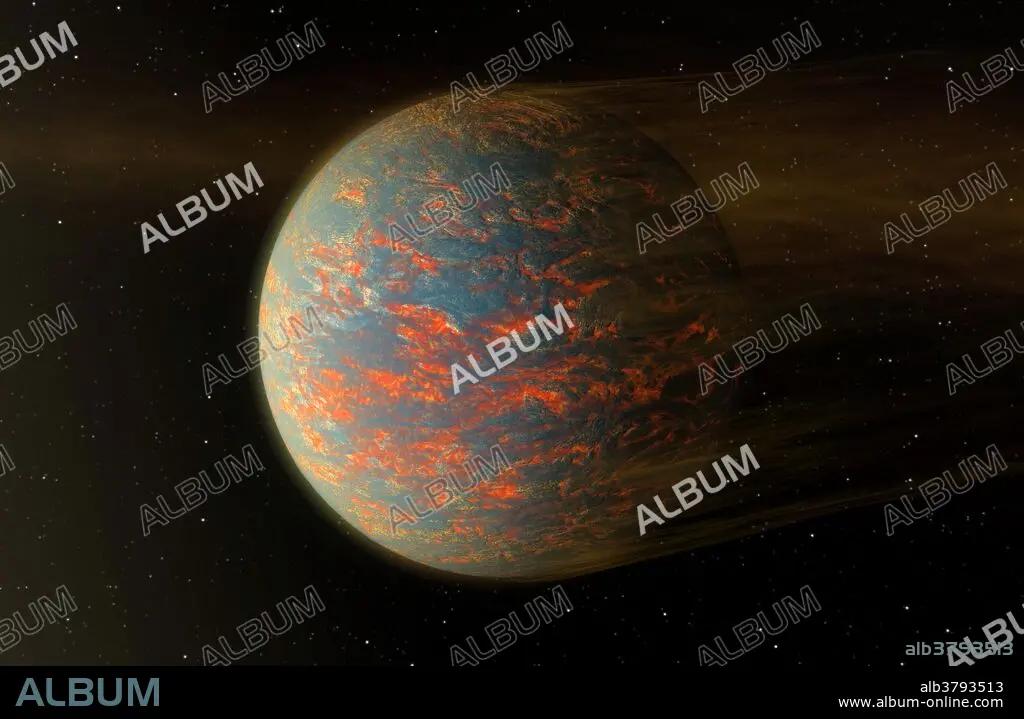
This illustration shows one possible scenario for the hot, rocky exoplanet called 55 Cancri e, which is nearly two times as wide as Earth, and resides relatively close to Earth at 40 light-years away. New data shows that the planet has extreme temperature swings from one side to the other. A possible reason for this might be the presence of lava pools. This planet is tidally locked to its star, just as our moon is to Earth, which means that one side always sizzles under the heat of its star while the other side remains in the dark. If the planet were covered in lava, then the hot, sun-facing side of the planet would have liquid lava flows, while the colder, dark side would see solidified lava rock. Such a lava planet, if it exists, would have dust streaming off of it, as illustrated here. Radiation and winds from the nearby star would blow off the material.
This illustration shows one possible scenario for the hot, rocky exoplanet called 55 Cancri e, which is nearly two times as wide as Earth, and resides relatively close to Earth at 40 light-years away. New data shows that the planet has extreme temperature swings from one side to the other. A possible reason for this might be the presence of lava pools. This planet is tidally locked to its star, just as our moon is to Earth, which means that one side always sizzles under the heat of its star while the other side remains in the dark. If the planet were covered in lava, then the hot, sun-facing side of the planet would have liquid lava flows, while the colder, dark side would see solidified lava rock. Such a lava planet, if it exists, would have dust streaming off of it, as illustrated here. Radiation and winds from the nearby star would blow off the material.
Crédit: Album / Science Source / NASA/JPL-Caltech
Autorisations: ? Autorisation de modèle: Non - ? Autorisation de propriété: Non
Questions sur les droits?
Questions sur les droits?
Taille de l'image: 5536 × 3600 px | 57.0 MB
Taille d'impression: 46.9 × 30.5 cm | 2179.5 × 1417.3 in (300 dpi)
Mots clés: ART CONCEPTUEL • ASTRONOMIE • ASTRONOMIE: PLANETES • CHALEUR • ILLUSTRATION • PLANETE • PLANÈTES • SCIENCE: ASTRONOMIE • TEMPERATURE
