

alb3600517
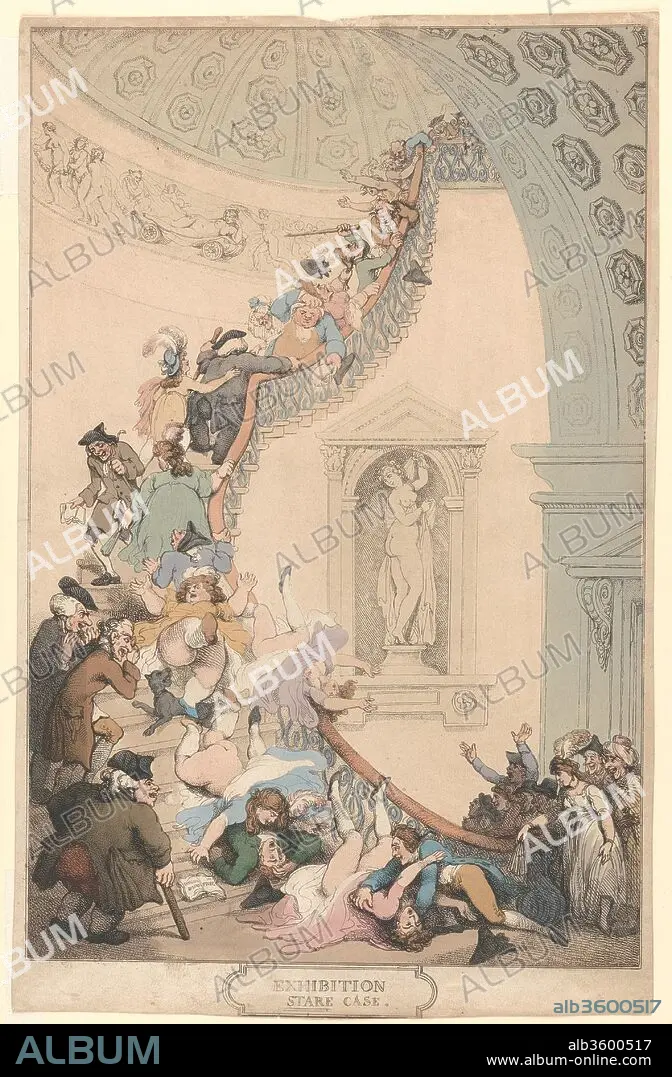
THOMAS ROWLANDSON. Exhibition "Stare" Case
| Partager |
|---|
 Pinterest Pinterest |
 Twitter Twitter |
 Facebook Facebook |
 Copier le lien Copier le lien |
 Email Email |
|
Ajouter à une autre Lightbox |
|
Ajouter à une autre Lightbox |


Avez-vous déjà un compte? S'identifier
Vous n'avez pas de compte ? S'inscrire
Acheter cette image.
Sélectionnez l'usage:

Auteur: Thomas Rowlandson (1756-1827)
Titre: Exhibition "Stare" Case
Légende:
Traduction automatique: Exposition "Stare" Case. Artiste : Thomas Rowlandson (britannique, Londres 1757-1827 Londres). Dimensions : feuille : 18 3/4 x 13 1/16 in. (47,6 x 33,2 cm). Date : 1811 ( ?). L'une des conceptions les plus exubérantes de Rowlandson, cette gravure se moque à la fois du public des expositions et de l'establishment artistique londonien. Les visiteurs désireux de voir l'exposition printanière annuelle de la Royal Academy ont du mal à négocier un escalier en colimaçon raide à Somerset House sur le Strand. À partir de 1780, ces expositions ont eu lieu dans la grande salle du grand bâtiment néoclassique de Sir William Chambers, mais pour atteindre les galeries, les visiteurs devaient gravir trois longs et étroits vols - une approche difficile qui, espérait Chambers, suggérerait une ascension vers le Parnasse. En se concentrant sur les difficultés pratiques que les escaliers présentaient pour la circulation piétonnière dans les deux sens, Rowlandson imagine la cascade produite lorsqu'une dame costaud trébuche sur un chien, puis renverse ses camarades grimpeurs comme des quilles. La plupart des corps renversés sont des femmes, et puisque les femmes à cette date ne portait pas de sous-vêtements inférieurs, la confusion générale donne aux hommes voisins un aperçu de la nudité féminine avant même qu'ils n'atteignent l'art. En incluant le célèbre sculpteur SIr Joseph Nollekens (à gauche, tenant un verre pour inspecter une beauté déchue), Rowlandson suggère que le pouvoir de la chair vivante l'emporte sur les simulacres artistiques. Même la Vénus callipyge, la statue classique dans la niche, dont le regard devrait être fixé sur son beau postérieur, a levé les yeux pour sourire à la comédie humaine qui coule à travers le décor idéalisé.
Exhibition "Stare" Case. Artist: Thomas Rowlandson (British, London 1757-1827 London). Dimensions: sheet: 18 3/4 x 13 1/16 in. (47.6 x 33.2 cm). Date: 1811 (?).
One of Rowlandson's most ebullient designs, this etching simultaneously mocks the exhibition-going public and the London art establishment. Visitors eager to view the annual spring exhibition of the Royal Academy struggle to negotiate a steep spiral staircase at Somerset House on the Strand. Beginning in 1780, these displays were held in the Great Room of Sir William Chambers's grand Neoclassical building, but to reach the galleries, visitors had to climb three long, narrow flights - a challenging approach that Chambers hoped would suggest an ascent to Parnassus. Focusing on the practical difficulties the stairs presented for two-way foot traffic, Rowlandson imagines the cascade produced when a hefty lady trips on a dog, then knocks over her fellow climbers like ninepins, Most of the bodies upended are female, and since women at this date wore no lower undergarments, the general confusion grants nearby males a glimpse of female nudity before they even reach the art. By including the well-known sculptor SIr Joseph Nollekens (at the left, holding up a glass to inspect a fallen beauty), Rowlandson suggests the power of living flesh to trump artistic simulacrums. Even the Callipygian Venus, the classical statue in the niche, whose gaze should be fixed on her own beautiful posterior, has raised her eyes to smile at the human comedy flowing through the idealized setting.
Technique/matériel: Etching, hand colored
Musée: Metropolitan Museum of Art, New York, USA
Crédit: Album
Taille de l'image: 2851 × 4347 px | 35.5 MB
Taille d'impression: 24.1 × 36.8 cm | 1122.4 × 1711.4 in (300 dpi)
