

alb3793354
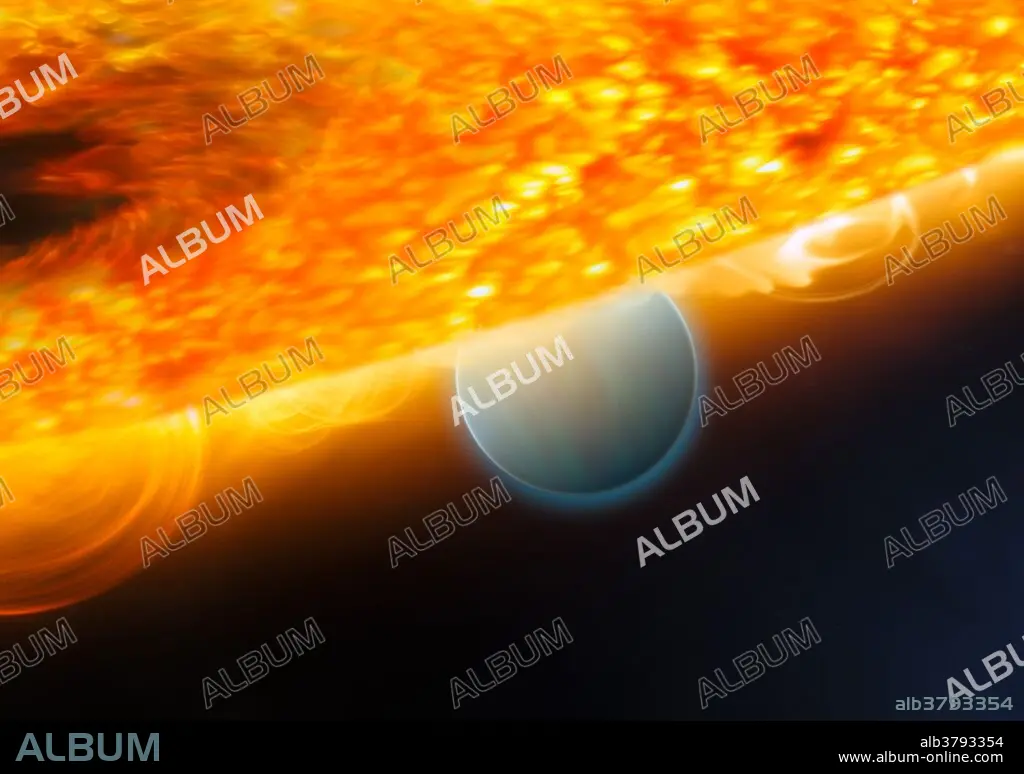
Exoplanet HD 189733b Orbiting its Star
| Partager |
|---|
 Pinterest Pinterest |
 Twitter Twitter |
 Facebook Facebook |
 Copier le lien Copier le lien |
 Email Email |
|
Ajouter à une autre Lightbox |
|
Ajouter à une autre Lightbox |


Avez-vous déjà un compte? S'identifier
Vous n'avez pas de compte ? S'inscrire
Acheter cette image.
Sélectionnez l'usage:

Titre: Exoplanet HD 189733b Orbiting its Star
Légende: Voir la traduction automatique
Artist's impression of the Jupiter-size extrasolar planet, HD 189733b, being eclipsed by its parent star. Astronomers using the Hubble Space Telescope have measured carbon dioxide and carbon monoxide in the planet's atmosphere. The planet is a "hot Jupiter," which is so close to its star that it completes an orbit in only 2.2 days. This type of observation is best done when the planet's orbit carries it behind the star (as seen from Earth), which allows an opportunity to subtract the light of the star alone (when the planet is blocked) from that of the star and planet together prior to eclipse. This allows astronomers to isolate the infrared emission of the planet and make spectroscopic observations that chemically analyze the day-side atmosphere. The planet is too hot for life as we know it. But under the right conditions, on a more Earth-like world, carbon dioxide can indicate the presence of extraterrestrial life. This observation demonstrates that chemical biotracers can be detected by space telescope observations. Release date December 9, 2008.
Artist's impression of the Jupiter-size extrasolar planet, HD 189733b, being eclipsed by its parent star. Astronomers using the Hubble Space Telescope have measured carbon dioxide and carbon monoxide in the planet's atmosphere. The planet is a "hot Jupiter," which is so close to its star that it completes an orbit in only 2.2 days. This type of observation is best done when the planet's orbit carries it behind the star (as seen from Earth), which allows an opportunity to subtract the light of the star alone (when the planet is blocked) from that of the star and planet together prior to eclipse. This allows astronomers to isolate the infrared emission of the planet and make spectroscopic observations that chemically analyze the day-side atmosphere. The planet is too hot for life as we know it. But under the right conditions, on a more Earth-like world, carbon dioxide can indicate the presence of extraterrestrial life. This observation demonstrates that chemical biotracers can be detected by space telescope observations. Release date December 9, 2008.
Crédit: Album / Science Source / NASA, ESA, Martin Kornmesser (ESA/Hubble) and STScI
Autorisations: ? Autorisation de modèle: Non - ? Autorisation de propriété: Non
Questions sur les droits?
Questions sur les droits?
Taille de l'image: 4500 × 3168 px | 40.8 MB
Taille d'impression: 38.1 × 26.8 cm | 1771.7 × 1247.2 in (300 dpi)
Mots clés: 21E SIECLE • ART CONCEPTUEL • ASTRONOMIE • ASTRONOMIE: PLANETES • COSMOS • DIAGRAMME • GRANDE VIVE • GRAPHIQUE • ILLUSTRATION • PLANETE • PLANÈTES • SCIENCE: ASTRONOMIE • XXIE SIECLE
