

alb3817111
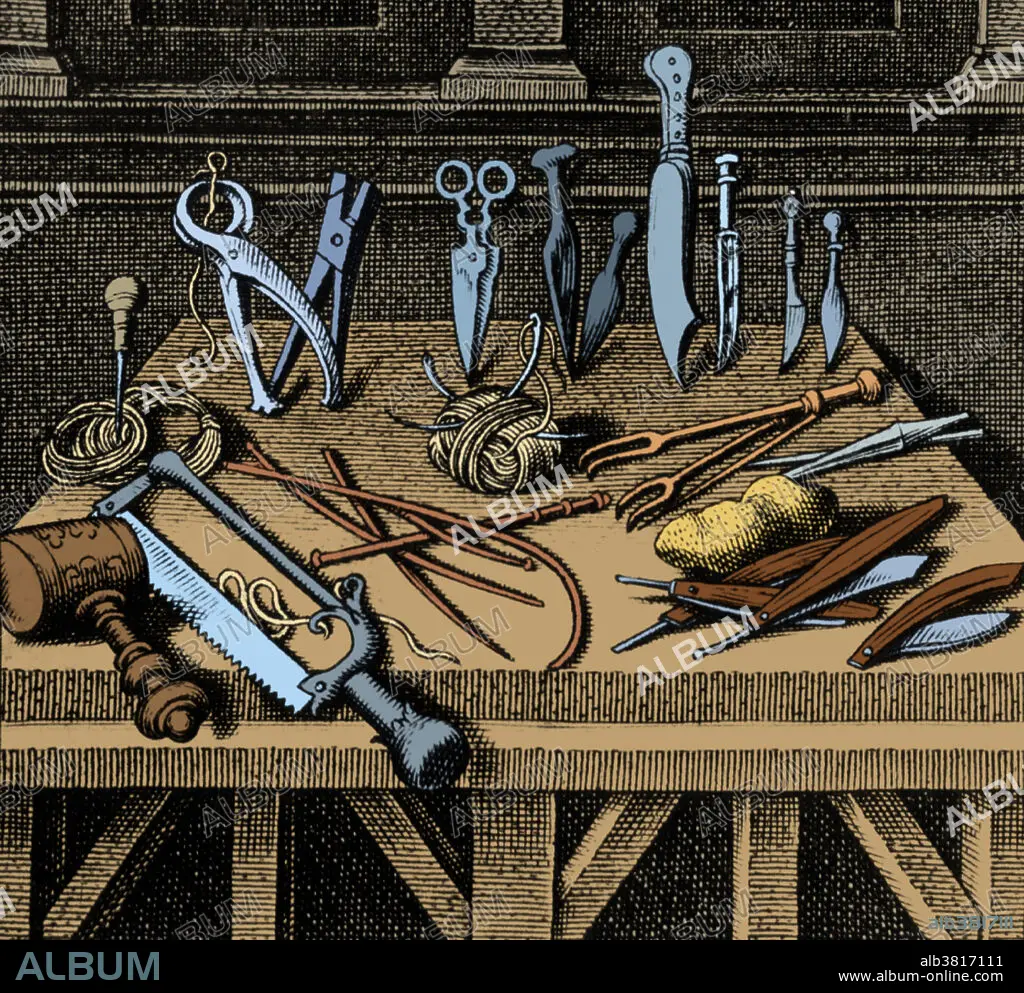
Surgical Equipment, 16th Century
| Partager |
|---|
 Pinterest Pinterest |
 Twitter Twitter |
 Facebook Facebook |
 Copier le lien Copier le lien |
 Email Email |
|
Ajouter à une autre Lightbox |
|
Ajouter à une autre Lightbox |


Avez-vous déjà un compte? S'identifier
Vous n'avez pas de compte ? S'inscrire
Acheter cette image.
Sélectionnez l'usage:

Titre: Surgical Equipment, 16th Century
Légende: Voir la traduction automatique
Vignette from the title page of Workes of that famous French surgeon Ambroise Pare, 1634. Surgical equipment and instruments arranged on a table. Ambroise Pare (1510 - December 20, 1590) was a French surgeon, anatomist and inventor. He was royal surgeon for kings Henry II, Francis II, Charles IX and Henry III and is considered one of the fathers of surgery and modern forensic pathology. He was a leader in surgical techniques and pioneered modern battlefield wound treatment. Battlefield medicine is the treatment of wounded soldiers in or near an area of combat. Civilian medicine has been greatly advanced by procedures that were first developed to treat the wounds inflicted during combat. Pare introduced the ligature of arteries instead of cauterization during amputation. He believed that phantom pains occurred in the brain. He contributed to the practice of surgical amputation and the design of limb prostheses. He died in 1590 from natural
Vignette from the title page of Workes of that famous French surgeon Ambroise Pare, 1634. Surgical equipment and instruments arranged on a table. Ambroise Pare (1510 - December 20, 1590) was a French surgeon, anatomist and inventor. He was royal surgeon for kings Henry II, Francis II, Charles IX and Henry III and is considered one of the fathers of surgery and modern forensic pathology. He was a leader in surgical techniques and pioneered modern battlefield wound treatment. Battlefield medicine is the treatment of wounded soldiers in or near an area of combat. Civilian medicine has been greatly advanced by procedures that were first developed to treat the wounds inflicted during combat. Pare introduced the ligature of arteries instead of cauterization during amputation. He believed that phantom pains occurred in the brain. He contributed to the practice of surgical amputation and the design of limb prostheses. He died in 1590 from natural
Crédit: Album / NLM/Science Source
Autorisations: ? Autorisation de modèle: Non - ? Autorisation de propriété: Non
Questions sur les droits?
Questions sur les droits?
Taille de l'image: 4200 × 3856 px | 46.3 MB
Taille d'impression: 35.6 × 32.6 cm | 1653.5 × 1518.1 in (300 dpi)
Mots clés: 16E SIECLE • 16EME S • AMPUTATION • CHIRURGIE • ILLUSTRATION • MEDECINE CHIRURGIE • MEDICAL • OPERATION MEDICALE • OPERATION • SEIZIÈME SIÈCLE • XVIE SIECLE
