

alb3803124
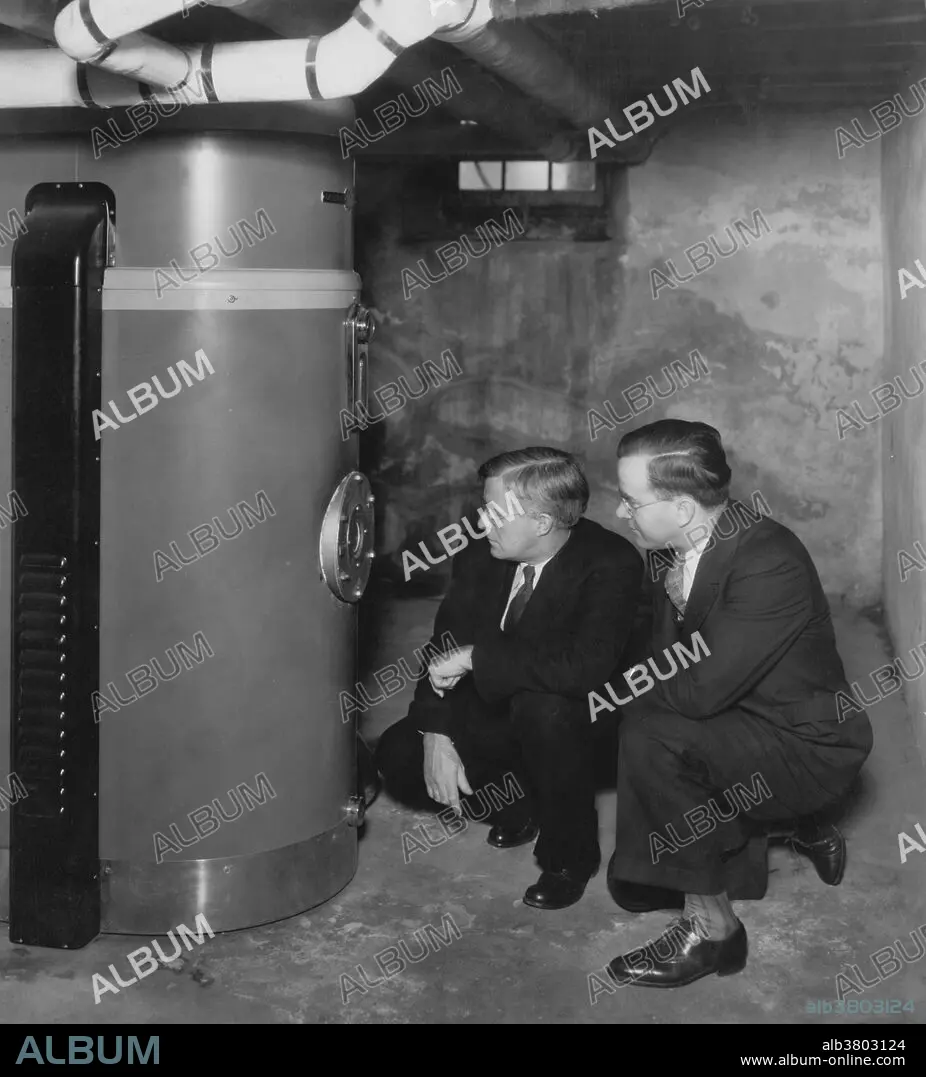
Irving Langmuir with GE Furnace, 1933
| Partager |
|---|
 Pinterest Pinterest |
 Twitter Twitter |
 Facebook Facebook |
 Copier le lien Copier le lien |
 Email Email |
|
Ajouter à une autre Lightbox |
|
Ajouter à une autre Lightbox |


Avez-vous déjà un compte? S'identifier
Vous n'avez pas de compte ? S'inscrire
Acheter cette image.
Sélectionnez l'usage:

Titre: Irving Langmuir with GE Furnace, 1933
Légende: Voir la traduction automatique
Langmuir (left) and J. J. Donovan crouching in front of a General Electric oil burning furnace, 1933. Irving Langmuir ( January 31, 1881 - August 16, 1957) was an American chemist and physicist. His first major development was the improvement of the diffusion pump, which ultimately led to the invention of the high-vacuum tube. A year later, he and colleague Lewi Tonks discovered that the lifetime of a tungsten filament was greatly lengthened by filling the bulb with an inert gas, such as argon. He also discovered that twisting the filament into a tight coil improved its efficiency. He introduced the concept of electron temperature and in 1924 invented the diagnostic method for measuring both temperature and density with an electrostatic probe, now called a Langmuir probe and commonly used in plasma physics. Following WWI he contributed to atomic theory and the understanding of atomic structure by defining the modern concept of valence shells and isotopes. He was awarded the 1932 Nobel Prize in Chemistry for his work in surface chemistry. He died from a heart attack in 1957 at the age of 76. His obituary ran on the front page of The New York Times.
Langmuir (left) and J. J. Donovan crouching in front of a General Electric oil burning furnace, 1933. Irving Langmuir ( January 31, 1881 - August 16, 1957) was an American chemist and physicist. His first major development was the improvement of the diffusion pump, which ultimately led to the invention of the high-vacuum tube. A year later, he and colleague Lewi Tonks discovered that the lifetime of a tungsten filament was greatly lengthened by filling the bulb with an inert gas, such as argon. He also discovered that twisting the filament into a tight coil improved its efficiency. He introduced the concept of electron temperature and in 1924 invented the diagnostic method for measuring both temperature and density with an electrostatic probe, now called a Langmuir probe and commonly used in plasma physics. Following WWI he contributed to atomic theory and the understanding of atomic structure by defining the modern concept of valence shells and isotopes. He was awarded the 1932 Nobel Prize in Chemistry for his work in surface chemistry. He died from a heart attack in 1957 at the age of 76. His obituary ran on the front page of The New York Times.
Crédit: Album / Science Source / New York Public Library
Autorisations: ? Autorisation de modèle: Non - ? Autorisation de propriété: Non
Questions sur les droits?
Questions sur les droits?
Taille de l'image: 2524 × 2792 px | 20.2 MB
Taille d'impression: 21.4 × 23.6 cm | 993.7 × 1099.2 in (300 dpi)
Mots clés: AMÉRICAIN • CÉLÈBRE • CELEBRITE • CHIMIE • CHIMISTE • HOMME DE SCIENCE • HOMME • INVENTEUR • LAUREAT DU PRIX NOBEL • NOBEL • PERSONNAGES • PERSONNALITÉS • PERSONNE • PRIX NOBEL • SAVANT • SCIENCE: CHIMIE • SCIENTIFIQUE • XXE SIECLE
