

alb9390985
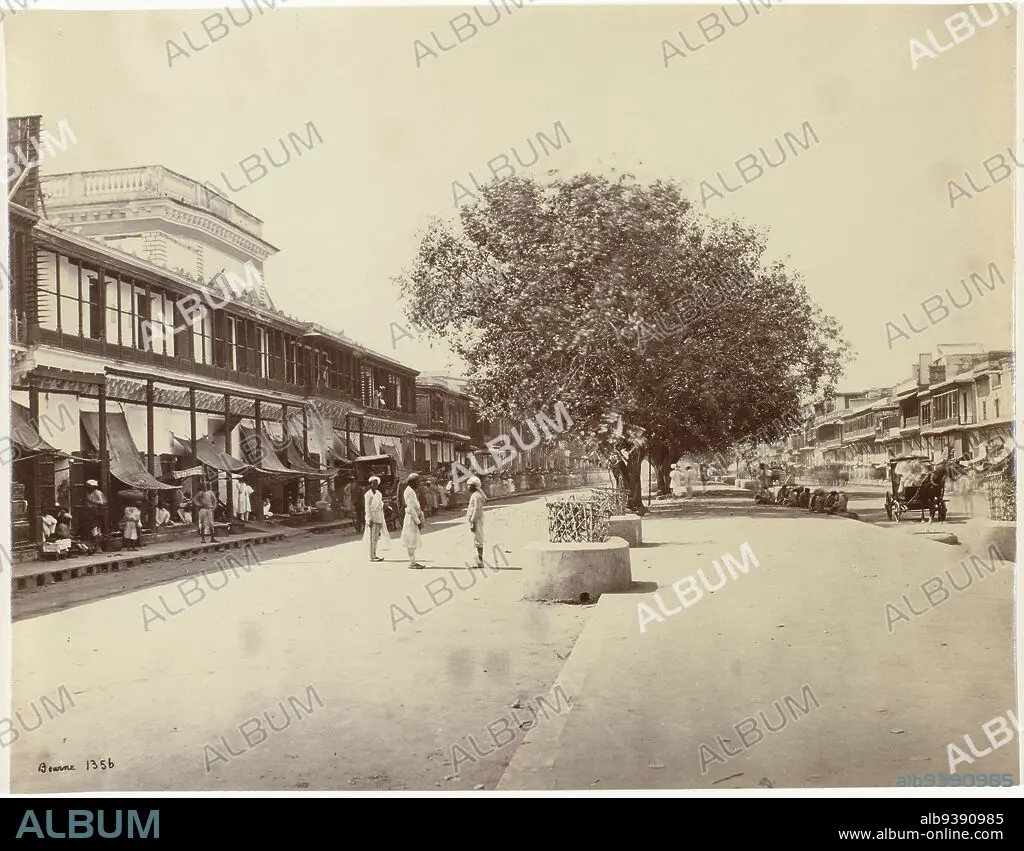
View of Chandni Chowk in Shahjahanabad, Delhi, India, The Chandni-chouk, principal Street in Delhi (original title), Chandni Chowk is the main street of Shahjahanabad, the last of the seven historic cities of Delhi. Along the road are stores and artisans selling their wares. The street was laid out in 1650 by Jahanara Begum, the daughter of Emperor Shah Jahan, and connected the city to their fortified palace, The Red Fort. The street was 36 meters wide (40 yards) and 1.3 kilometers long (1520 yards). Originally, there was a canal along the road to supply the fort with drinking water and irrigation. Between 1840 and the 1860s the canal was filled in by the British. The shot shows a raised ledge where the canal once ran., Samuel Bourne (signed by artist), Old Delhi, 1865 - 1870, paper, albumen print, height 220 mm × width 286 mm.
| Partager |
|---|
 Pinterest Pinterest |
 Twitter Twitter |
 Facebook Facebook |
 Copier le lien Copier le lien |
 Email Email |
|
Ajouter à une autre Lightbox |
|
Ajouter à une autre Lightbox |


Avez-vous déjà un compte? S'identifier
Vous n'avez pas de compte ? S'inscrire
Acheter cette image.
Sélectionnez l'usage:

Légende: Voir la traduction automatique
View of Chandni Chowk in Shahjahanabad, Delhi, India, The Chandni-chouk, principal Street in Delhi (original title), Chandni Chowk is the main street of Shahjahanabad, the last of the seven historic cities of Delhi. Along the road are stores and artisans selling their wares. The street was laid out in 1650 by Jahanara Begum, the daughter of Emperor Shah Jahan, and connected the city to their fortified palace, The Red Fort. The street was 36 meters wide (40 yards) and 1.3 kilometers long (1520 yards). Originally, there was a canal along the road to supply the fort with drinking water and irrigation. Between 1840 and the 1860s the canal was filled in by the British. The shot shows a raised ledge where the canal once ran., Samuel Bourne (signed by artist), Old Delhi, 1865 - 1870, paper, albumen print, height 220 mm × width 286 mm
View of Chandni Chowk in Shahjahanabad, Delhi, India, The Chandni-chouk, principal Street in Delhi (original title), Chandni Chowk is the main street of Shahjahanabad, the last of the seven historic cities of Delhi. Along the road are stores and artisans selling their wares. The street was laid out in 1650 by Jahanara Begum, the daughter of Emperor Shah Jahan, and connected the city to their fortified palace, The Red Fort. The street was 36 meters wide (40 yards) and 1.3 kilometers long (1520 yards). Originally, there was a canal along the road to supply the fort with drinking water and irrigation. Between 1840 and the 1860s the canal was filled in by the British. The shot shows a raised ledge where the canal once ran., Samuel Bourne (signed by artist), Old Delhi, 1865 - 1870, paper, albumen print, height 220 mm × width 286 mm
Personnalités: SAMUEL BOURNE
Crédit: Album / quintlox
Autorisations: ? Autorisation de modèle: Non - ? Autorisation de propriété: Non
Questions sur les droits?
Questions sur les droits?
Taille de l'image: 5182 × 4036 px | 59.8 MB
Taille d'impression: 43.9 × 34.2 cm | 2040.2 × 1589.0 in (300 dpi)
Mots clés: 1870 • ANNEES 1860 • ARTISTE • ARTISTEL • ARTSTE • CITE • DELHI • EAU POTABLE • FILLE (PARENTE) • FILLE • INDE • INDES • PAPIER • RAVITAILLEMENT • RUE • SAMUEL BOURNE • VILE • VILLE
