

alb5142151
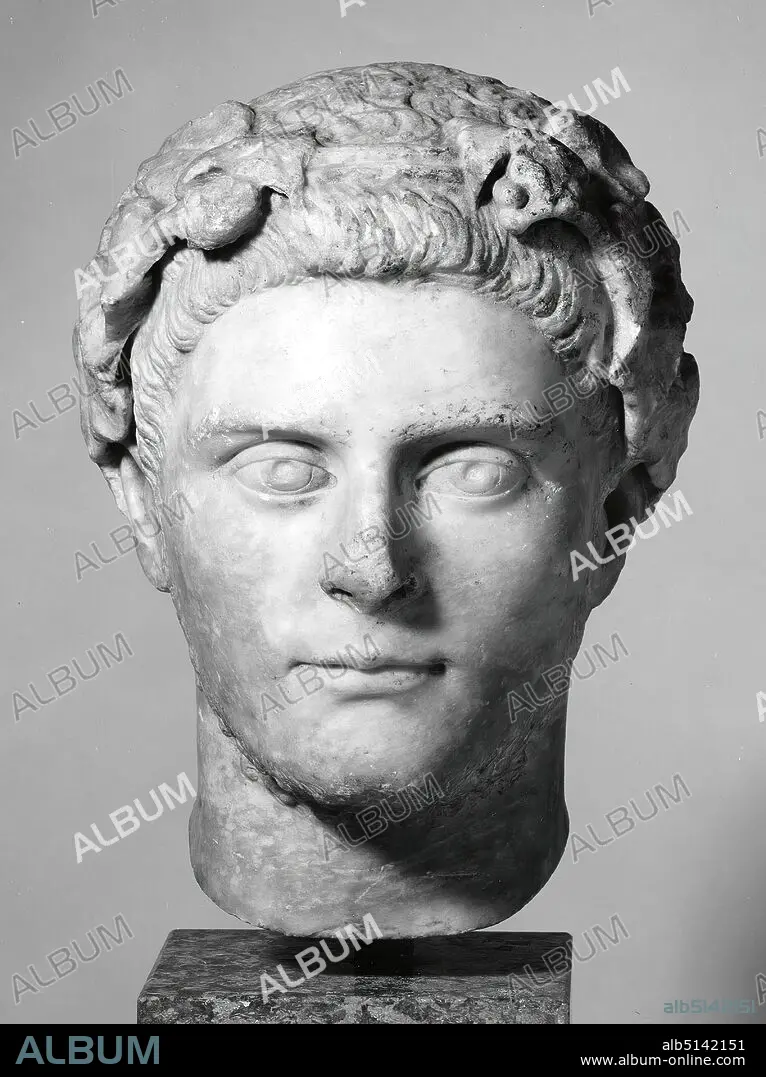
Portrait of an Roman, Formerly Johannes W. F. Collection Reimers (Hamburg), Marble, chiseled, drilled, smoothed, marble, Total: Height: 30 cm; Width: 24.5 cm; Depth: 25 cm, Sculptures, Three-dimensional sculptures, Man, Head, Face, Head image, Hair curl, tuft, strand, Hair fashion, Hair fashion, Wreath, Garland, Portrait, Priest, Soldier Emperor, Roman Antiquity, The portrait formerly belonged to a bust or statue. The antique break at the neck has been worked off in a modern way as a surface to allow a better base. The face must have been cleaned with acid in more recent times, while the hair and the wreath were left in the state in which they were found. The reddish-brown earth deposits are clearly visible. The contrast between the specky-glossy face and the dull hair and wreath leaves results from this different treatment. Depicted is a man of younger age with a throat beard, a beard costume, which is particularly well known from portraits of the Roman emperor Gallienus (reigned 253-268 AD). The portrait of the man shown here also belongs to these years. The ivy wreath in his hair seems to indicate a connection with the wine god Dionysos (lat. Bacchus), whose attributes include ivy or vine wreaths. The high sculptural quality of the head is particularly expressed in the naturalistic formation of the wreath leaves. The elaboration of the portrait becomes more summary towards the back. From this it may be concluded that the portrait was originally placed in front of a wall or in a niche, so that the rear view was hidden from the viewer.
| Partager |
|---|
 Pinterest Pinterest |
 Twitter Twitter |
 Facebook Facebook |
 Copier le lien Copier le lien |
 Email Email |
|
Ajouter à une autre Lightbox |
|
Ajouter à une autre Lightbox |


Avez-vous déjà un compte? S'identifier
Vous n'avez pas de compte ? S'inscrire
Acheter cette image.
Sélectionnez l'usage:

Légende: Voir la traduction automatique
Portrait of an Roman, Formerly Johannes W. F. Collection Reimers (Hamburg), Marble, chiseled, drilled, smoothed, marble, Total: Height: 30 cm; Width: 24.5 cm; Depth: 25 cm, Sculptures, Three-dimensional sculptures, Man, Head, Face, Head image, Hair curl, tuft, strand, Hair fashion, Hair fashion, Wreath, Garland, Portrait, Priest, Soldier Emperor, Roman Antiquity, The portrait formerly belonged to a bust or statue. The antique break at the neck has been worked off in a modern way as a surface to allow a better base. The face must have been cleaned with acid in more recent times, while the hair and the wreath were left in the state in which they were found. The reddish-brown earth deposits are clearly visible. The contrast between the specky-glossy face and the dull hair and wreath leaves results from this different treatment. Depicted is a man of younger age with a throat beard, a beard costume, which is particularly well known from portraits of the Roman emperor Gallienus (reigned 253-268 AD). The portrait of the man shown here also belongs to these years. The ivy wreath in his hair seems to indicate a connection with the wine god Dionysos (lat. Bacchus), whose attributes include ivy or vine wreaths. The high sculptural quality of the head is particularly expressed in the naturalistic formation of the wreath leaves. The elaboration of the portrait becomes more summary towards the back. From this it may be concluded that the portrait was originally placed in front of a wall or in a niche, so that the rear view was hidden from the viewer.
Portrait of an Roman, Formerly Johannes W. F. Collection Reimers (Hamburg), Marble, chiseled, drilled, smoothed, marble, Total: Height: 30 cm; Width: 24.5 cm; Depth: 25 cm, Sculptures, Three-dimensional sculptures, Man, Head, Face, Head image, Hair curl, tuft, strand, Hair fashion, Hair fashion, Wreath, Garland, Portrait, Priest, Soldier Emperor, Roman Antiquity, The portrait formerly belonged to a bust or statue. The antique break at the neck has been worked off in a modern way as a surface to allow a better base. The face must have been cleaned with acid in more recent times, while the hair and the wreath were left in the state in which they were found. The reddish-brown earth deposits are clearly visible. The contrast between the specky-glossy face and the dull hair and wreath leaves results from this different treatment. Depicted is a man of younger age with a throat beard, a beard costume, which is particularly well known from portraits of the Roman emperor Gallienus (reigned 253-268 AD). The portrait of the man shown here also belongs to these years. The ivy wreath in his hair seems to indicate a connection with the wine god Dionysos (lat. Bacchus), whose attributes include ivy or vine wreaths. The high sculptural quality of the head is particularly expressed in the naturalistic formation of the wreath leaves. The elaboration of the portrait becomes more summary towards the back. From this it may be concluded that the portrait was originally placed in front of a wall or in a niche, so that the rear view was hidden from the viewer.
Personnalités: BACO (DIONISIO)
Crédit: Album / quintlox
Autorisations: ? Autorisation de modèle: Non - ? Autorisation de propriété: Non
Questions sur les droits?
Questions sur les droits?
Taille de l'image: 3233 × 4320 px | 40.0 MB
Taille d'impression: 27.4 × 36.6 cm | 1272.8 × 1700.8 in (300 dpi)
Mots clés: ABBE, CLERGE • ACIDE • ACIDITE • ART ROMAIN • BACO (DIONISIO) • BUSTE (SCULPTURE) • BUSTE • CHEVELURE • CHEVEU • CHEVEUX • CISELÉ • CLERGE, ABBE • COIFFURE COUPE CHEVEUX • COIFFURE • COIFFURES • COIFURE • CORPS VISAGE • COU • COUPE DE CHEVEUX • CURE • EPOQUE ROMAINE • FACE • GAUCHE • HAMBOURG • HOMME • MARBRE • NUQUE • PIERRE MARBRE • PORTAIT • PORTRAIT • POTRAIT • PRÊTE • PRETRE • ROMAIN • SCULPTURE • SCULPTURES • STATUE • STATUT • TECHNIQUE: SCULPTURE • TETE (ANATOMIE) • TETE • VISAGE • VISAGES
