

alb5529951
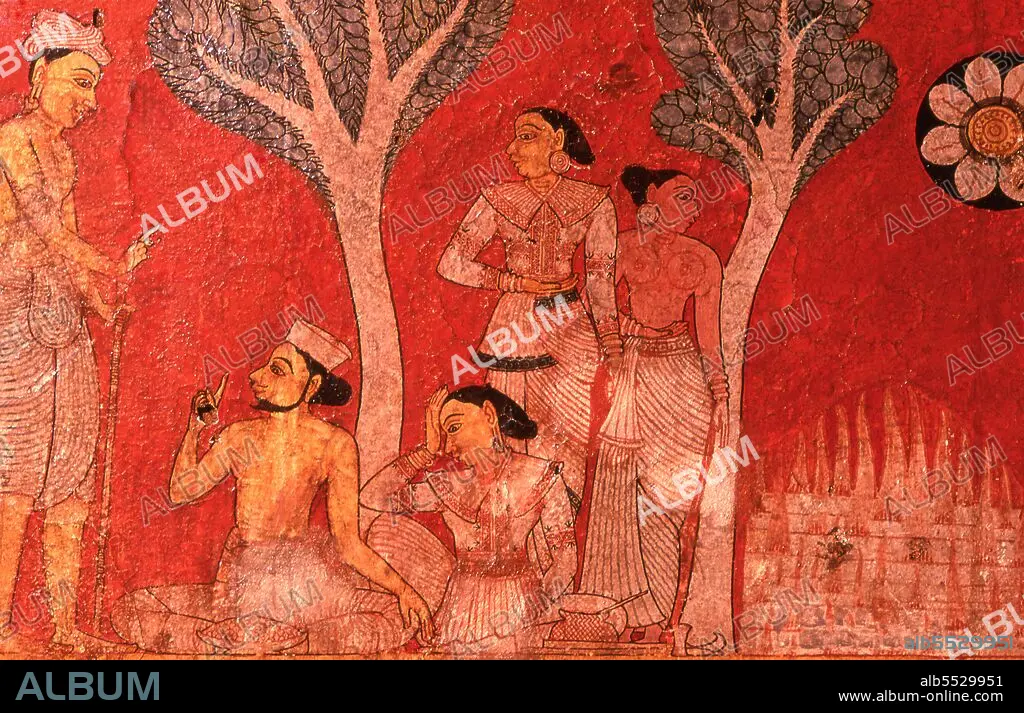
Sri Lanka: Fresco depicting everyday life, Medawala Rajamaha Viharaya (Tempitiya Vihara), north of Kandy
| Partager |
|---|
 Pinterest Pinterest |
 Twitter Twitter |
 Facebook Facebook |
 Copier le lien Copier le lien |
 Email Email |
|
Ajouter à une autre Lightbox |
|
Ajouter à une autre Lightbox |


Avez-vous déjà un compte? S'identifier
Vous n'avez pas de compte ? S'inscrire
Acheter cette image.
Sélectionnez l'usage:

Titre: Sri Lanka: Fresco depicting everyday life, Medawala Rajamaha Viharaya (Tempitiya Vihara), north of Kandy
Légende: Voir la traduction automatique
The Medawala Rajamaha Viharaya or Tempitiya Vihara, north of Kandy is a typical tempath vihara, a small wooden image house or shrine, placed on stilts or piles. The tempath vihara can be regarded as Kandy’s most significant contribution to Buddhist architecture, but there are not many specimen of its kind left. Some of the frescoes in the Rajamaha Viharaya depict the king and the royal family; but they also depict the everyday life of the commoners, such as a farmer tilling his field with the help of a white bull. One enigmatic painting shows a recumbent Buddha, sleeping safely tucked away behind a mosquito net. Though the frescoes exhibit all the hallmarks of the 18th century, the original construction of the Raja Mahavihara is said to go back to much earlier times. Despite the artistic merit of the frescoes, the most remarkable single feature in the image house is the small ivory figure of a Buddha. The figure is surrounded by an intricately carved wooden shrine.
The Medawala Rajamaha Viharaya or Tempitiya Vihara, north of Kandy is a typical tempath vihara, a small wooden image house or shrine, placed on stilts or piles. The tempath vihara can be regarded as Kandy’s most significant contribution to Buddhist architecture, but there are not many specimen of its kind left. Some of the frescoes in the Rajamaha Viharaya depict the king and the royal family; but they also depict the everyday life of the commoners, such as a farmer tilling his field with the help of a white bull. One enigmatic painting shows a recumbent Buddha, sleeping safely tucked away behind a mosquito net. Though the frescoes exhibit all the hallmarks of the 18th century, the original construction of the Raja Mahavihara is said to go back to much earlier times. Despite the artistic merit of the frescoes, the most remarkable single feature in the image house is the small ivory figure of a Buddha. The figure is surrounded by an intricately carved wooden shrine.
Crédit: Album / Pictures From History/Universal Images Group
Autorisations: ? Autorisation de modèle: Non - ? Autorisation de propriété: Non
Questions sur les droits?
Questions sur les droits?
Taille de l'image: 5100 × 3287 px | 48.0 MB
Taille d'impression: 43.2 × 27.8 cm | 2007.9 × 1294.1 in (300 dpi)
Mots clés: ART (CATÉGORIE) • ART • ART, PEINTURE • ASIE • ASIE, CONTINENT • BOUDDHISME • BOUDDHISTE • BOUDDIQUE • BUDA • CONTINENT ASIE • DESSIN MURAL • FRESQUE • FRESQUES • HISOIRE • HISTOIRE • MURAL • PEINTURE • PEINTURES MURALES • RELIGION • RELIGION: BOUDDHISME • SRI LANKA • TABLEAU MURAL • TABLEAU • TABLEAUX • TECHNIQUE: FRESQUES • TEMPLE • TEMPLES
