

alb9617039
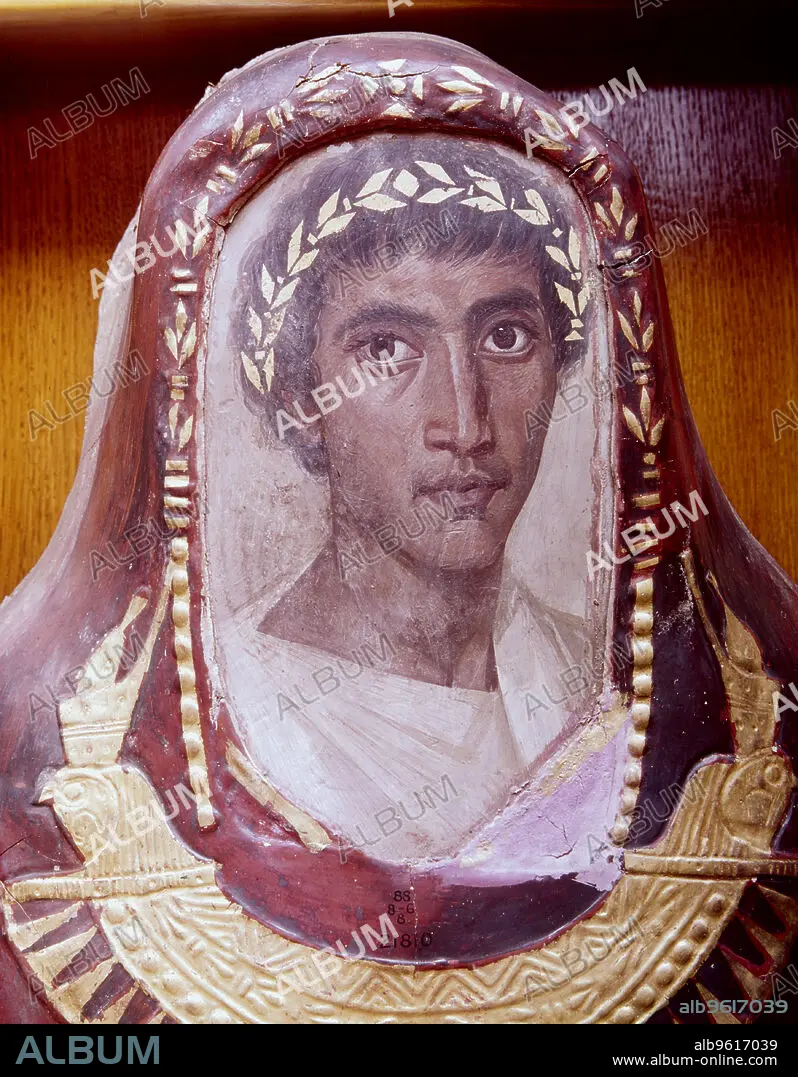
Mummy case and portrait of Artemidorus, from Hawara, Egypt, Roman Period, c100-c120. Artist: Unknown
| Partager |
|---|
 Pinterest Pinterest |
 Twitter Twitter |
 Facebook Facebook |
 Copier le lien Copier le lien |
 Email Email |
|
Ajouter à une autre Lightbox |
|
Ajouter à une autre Lightbox |


Avez-vous déjà un compte? S'identifier
Vous n'avez pas de compte ? S'inscrire
Acheter cette image.
Sélectionnez l'usage:

Titre: Mummy case and portrait of Artemidorus, from Hawara, Egypt, Roman Period, c100-c120. Artist: Unknown
Légende: Voir la traduction automatique
Mummy case and portrait of Artemidorus, from Hawara, Egypt, Roman Period, c100-c120. The mummified body is enclosed in a red-painted stucco casing. A portrait panel has been inserted at the head of the case. It is painted in encaustic, a mixture of pigment and beeswax with a hardening agent such as resin or egg. Below the portrait is a falcon-collar and a series of traditional Egyptian funerary scenes applied in gold leaf. The identity of the dead man is preserved in a short, mis-spelled Greek inscription across the breast, which reads: 'Farewell, Artemidorus'. This mummy represents an excellent example of the merging of cultural influences: a Greek personal name, a Roman-style portrait, together with traditional Egyptian funerary practices. CT scans have been made of Artemidorus' mummy. There is evidence of damage to the bones in the area of the nose, and cracks to the back of the skull. Interestingly, there are no signs of healing. While it is possible that the damage is a result of rough treatment when the body was being mummified, the injuries may have been the result of an assault and may have even been the cause of death. Artemidorus was probably between 18 and 21 when he died, which is in keeping with the age suggested by the mummy's portrait.
Mummy case and portrait of Artemidorus, from Hawara, Egypt, Roman Period, c100-c120. The mummified body is enclosed in a red-painted stucco casing. A portrait panel has been inserted at the head of the case. It is painted in encaustic, a mixture of pigment and beeswax with a hardening agent such as resin or egg. Below the portrait is a falcon-collar and a series of traditional Egyptian funerary scenes applied in gold leaf. The identity of the dead man is preserved in a short, mis-spelled Greek inscription across the breast, which reads: 'Farewell, Artemidorus'. This mummy represents an excellent example of the merging of cultural influences: a Greek personal name, a Roman-style portrait, together with traditional Egyptian funerary practices. CT scans have been made of Artemidorus' mummy. There is evidence of damage to the bones in the area of the nose, and cracks to the back of the skull. Interestingly, there are no signs of healing. While it is possible that the damage is a result of rough treatment when the body was being mummified, the injuries may have been the result of an assault and may have even been the cause of death. Artemidorus was probably between 18 and 21 when he died, which is in keeping with the age suggested by the mummy's portrait.
Personnalités: ARTEMIDORUS
Crédit: Album / Ann Ronan Picture Library/Heritage-Images
Autorisations: ? Autorisation de modèle: Non - ? Autorisation de propriété: Non
Questions sur les droits?
Questions sur les droits?
Taille de l'image: 3693 × 4736 px | 50.0 MB
Taille d'impression: 31.3 × 40.1 cm | 1453.9 × 1864.6 in (300 dpi)
Mots clés: ARCHITECTURE: STUC • ARTEMIDORUS • BONHOMME • COULEUR • FEUILLE D'OR • FEUILLES D'OR • GRECE • HOMME • ITALIE • MATERIAU STUC • MOMIE • OR FEUILLES • PORTAIT • PORTRAIT • POTRAIT • ROME • STUC • TECHNIQUE: STUC
