

alb9508021
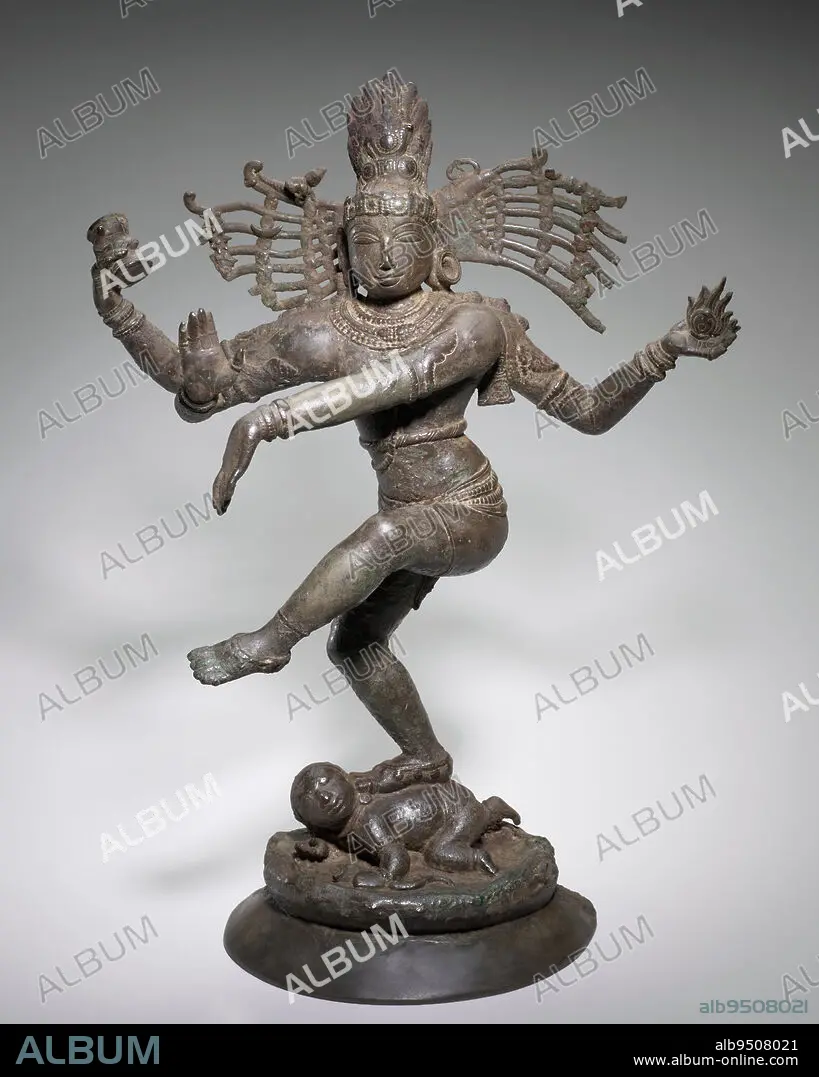
Shiva Nataraja (Lord of the Dance), c. 1100, 28 in. (71.12 cm), Bronze, India, 11th or 12th century, The Hindu god Shiva appears in several incarnations. Here, Shiva appears as Nataraja, or Lord of the Dance. He raises his left foot in a graceful dance pose. In his upper right hand, Nataraja holds a drum, the sound of which manifests creation. The flame that he holds in his upper left hand symbolizes destruction. Together, they symbolize the creation and destruction of the cosmic universe. The posture of the icons lower left and right palms signifies protection. The foot that rests on the demons back symbolizes the elimination of ignorance, while the raised left foot signifies salvation. A now missing ring of fire, symbolic of the simultaneous and continuous creation and destruction of the universe, would have encircled the bronze icon.
| Partager |
|---|
 Pinterest Pinterest |
 Twitter Twitter |
 Facebook Facebook |
 Copier le lien Copier le lien |
 Email Email |
|
Ajouter à une autre Lightbox |
|
Ajouter à une autre Lightbox |


Avez-vous déjà un compte? S'identifier
Vous n'avez pas de compte ? S'inscrire
Acheter cette image.
Sélectionnez l'usage:

Légende: Voir la traduction automatique
Shiva Nataraja (Lord of the Dance), c. 1100, 28 in. (71.12 cm), Bronze, India, 11th or 12th century, The Hindu god Shiva appears in several incarnations. Here, Shiva appears as Nataraja, or Lord of the Dance. He raises his left foot in a graceful dance pose. In his upper right hand, Nataraja holds a drum, the sound of which manifests creation. The flame that he holds in his upper left hand symbolizes destruction. Together, they symbolize the creation and destruction of the cosmic universe. The posture of the icons lower left and right palms signifies protection. The foot that rests on the demons back symbolizes the elimination of ignorance, while the raised left foot signifies salvation. A now missing ring of fire, symbolic of the simultaneous and continuous creation and destruction of the universe, would have encircled the bronze icon.
Shiva Nataraja (Lord of the Dance), c. 1100, 28 in. (71.12 cm), Bronze, India, 11th or 12th century, The Hindu god Shiva appears in several incarnations. Here, Shiva appears as Nataraja, or Lord of the Dance. He raises his left foot in a graceful dance pose. In his upper right hand, Nataraja holds a drum, the sound of which manifests creation. The flame that he holds in his upper left hand symbolizes destruction. Together, they symbolize the creation and destruction of the cosmic universe. The posture of the icons lower left and right palms signifies protection. The foot that rests on the demons back symbolizes the elimination of ignorance, while the raised left foot signifies salvation. A now missing ring of fire, symbolic of the simultaneous and continuous creation and destruction of the universe, would have encircled the bronze icon.
Crédit: Album / quintlox
Autorisations: ? Autorisation de modèle: Non - ? Autorisation de propriété: Non
Questions sur les droits?
Questions sur les droits?
Taille de l'image: 5280 × 6600 px | 99.7 MB
Taille d'impression: 44.7 × 55.9 cm | 2078.7 × 2598.4 in (300 dpi)
Mots clés: 12E SIECLE • 12EME S • ATTITUDE (DANSE) • BAL • BRONZE • BRONZES • CORPS PIEDS • CREATION (BIBLE) • CREATION DU MONDE • CREATION • CREATION, MYTHE DE LA • DANCEUR • DANSE • DESTRCUTION • DESTRUCTION • DESTRUCUTION • DIVINITE HINDOU, SHIVA • DOUZIÈME SIÈCLE • ENSEMBLE • FEU • FLAMME • HINDOUISME, DIEU, SHIVA • HISTOIRE DE LA CREATION • INDE • INDES • INSTR. MUS. TAMBOUR • LORD • MATERIAU BRONZE • MYTHE CREATEUR • MYTHE DE LA CREATION • MYTHE: CREATION • PIED • PIEDS • QUATRE ELEMENTS: FEU • SHIVA, DIVINITE HINDOUE • SYMBOLIQUE • TAMBOUR (INSTRUMENT) • TAMBOUR • TAMBOUR, INSTR. MUS. • XIIE SIECLE
