

alb3679052
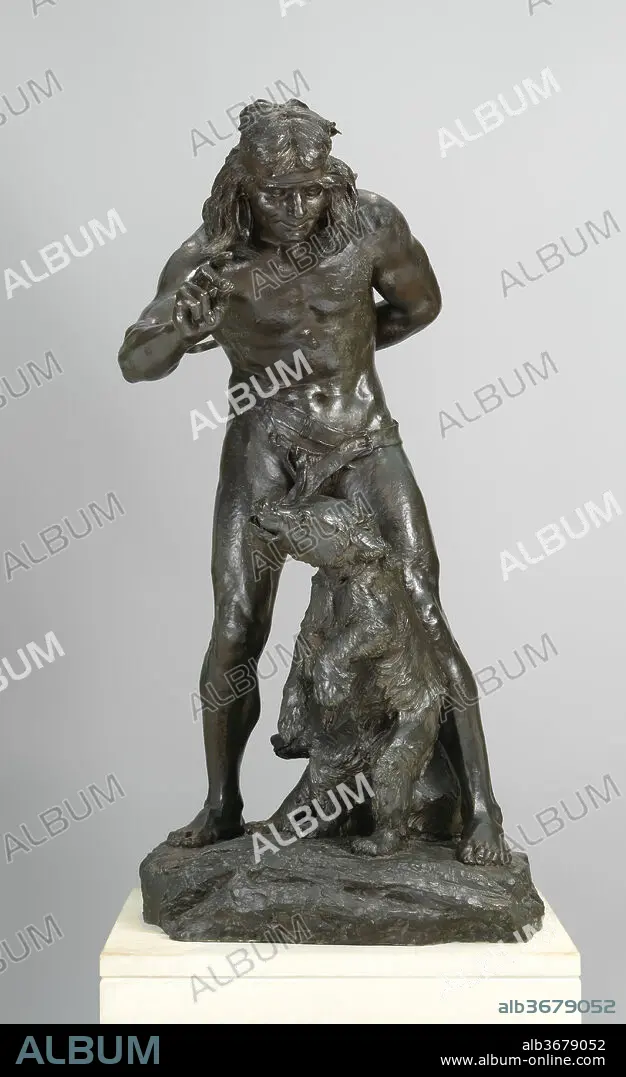
PAUL WAYLAND BARTLETT. Bohemian Bear Tamer
| Partager |
|---|
 Pinterest Pinterest |
 Twitter Twitter |
 Facebook Facebook |
 Copier le lien Copier le lien |
 Email Email |
|
Ajouter à une autre Lightbox |
|
Ajouter à une autre Lightbox |


Avez-vous déjà un compte? S'identifier
Vous n'avez pas de compte ? S'inscrire
Acheter cette image.
Sélectionnez l'usage:

Titre: Bohemian Bear Tamer
Légende: Voir la traduction automatique
Bohemian Bear Tamer. Artist: Paul Wayland Bartlett (American, New Haven, Connecticut 1865-1925 Paris). Dimensions: 69 3/8 x 33 x 45 1/2 in. (176.2 x 83.8 x 115.6 cm). Date: 1885-87, cast 1888. Trained at the prestigious École des Beaux-Arts in Paris, Bartlett completed Bohemian Bear Tamer, his first large group, when he was just twenty-two years old. It depicts a well-muscled Gypsy with two bear cubs, one diligently responding to the animated snap of its trainer's fingers, the other lazily scratching behind its ear. The bears are not aware of their potential brute power; thus, the underlying theme is man's superiority as the thinking species. Bartlett was inspired not only by itinerant animal shows he had seen around Paris but also by intense contemporary interest in the evolutionary principles of Charles Darwin (1809-1882) and the 1868 discovery of Paleolithic skeletons at Cro-Magnon, in southwestern France.
Bohemian Bear Tamer. Artist: Paul Wayland Bartlett (American, New Haven, Connecticut 1865-1925 Paris). Dimensions: 69 3/8 x 33 x 45 1/2 in. (176.2 x 83.8 x 115.6 cm). Date: 1885-87, cast 1888. Trained at the prestigious École des Beaux-Arts in Paris, Bartlett completed Bohemian Bear Tamer, his first large group, when he was just twenty-two years old. It depicts a well-muscled Gypsy with two bear cubs, one diligently responding to the animated snap of its trainer's fingers, the other lazily scratching behind its ear. The bears are not aware of their potential brute power; thus, the underlying theme is man's superiority as the thinking species. Bartlett was inspired not only by itinerant animal shows he had seen around Paris but also by intense contemporary interest in the evolutionary principles of Charles Darwin (1809-1882) and the 1868 discovery of Paleolithic skeletons at Cro-Magnon, in southwestern France.
Technique/matériel: BRONZE
Musée: Metropolitan Museum of Art, New York, USA
Crédit: Album
Taille de l'image: 2690 × 4400 px | 33.9 MB
Taille d'impression: 22.8 × 37.3 cm | 1059.1 × 1732.3 in (300 dpi)
