

alb5465914
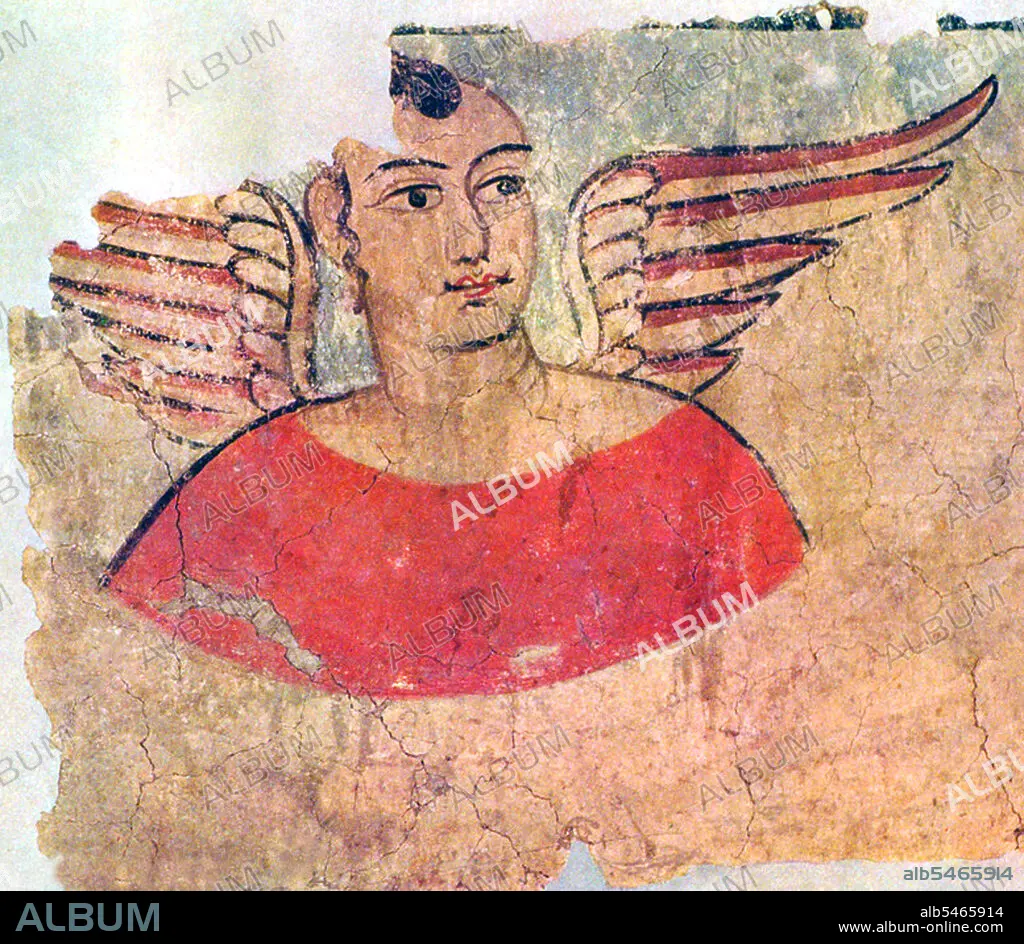
Mural of a winged angel from Miran, Xinjiang.
| Partager |
|---|
 Pinterest Pinterest |
 Twitter Twitter |
 Facebook Facebook |
 Copier le lien Copier le lien |
 Email Email |
|
Ajouter à une autre Lightbox |
|
Ajouter à une autre Lightbox |


Avez-vous déjà un compte? S'identifier
Vous n'avez pas de compte ? S'inscrire
Acheter cette image.
Sélectionnez l'usage:

Titre: Mural of a winged angel from Miran, Xinjiang.
Légende: Voir la traduction automatique
In ancient times Miran was a busy trading center on the southern part of the Silk Road, after the route split into two (the northern route and the southern route), as caravans of merchants sought to escape travel across the harsh wasteland of the desert (called by the Chinese 'The Sea of Death') and the Tarim Basin. They went by going around its north or south rim. It was also a thriving center of Buddhism with many monasteries and stupas. Marc Aurel Stein was the first archaeologist to systematically study the ruins at Miran in 1907. The many artifacts found in Miran demonstrate the extensive and sophisticated trade connections these ancient towns had with places as far away as the Mediterranean Sea. Archaeological evidence from Miran shows the influence of Buddhism on artistic work as early as the first century BCE. Early Buddhist sculptures and murals excavated from the site show stylistic similarities to the traditions of Central Asia and North India and other artistic aspects of the paintings found there suggest that Miran had a direct connection with Rome and its provinces.
In ancient times Miran was a busy trading center on the southern part of the Silk Road, after the route split into two (the northern route and the southern route), as caravans of merchants sought to escape travel across the harsh wasteland of the desert (called by the Chinese 'The Sea of Death') and the Tarim Basin. They went by going around its north or south rim. It was also a thriving center of Buddhism with many monasteries and stupas. Marc Aurel Stein was the first archaeologist to systematically study the ruins at Miran in 1907. The many artifacts found in Miran demonstrate the extensive and sophisticated trade connections these ancient towns had with places as far away as the Mediterranean Sea. Archaeological evidence from Miran shows the influence of Buddhism on artistic work as early as the first century BCE. Early Buddhist sculptures and murals excavated from the site show stylistic similarities to the traditions of Central Asia and North India and other artistic aspects of the paintings found there suggest that Miran had a direct connection with Rome and its provinces.
Crédit: Album / Pictures From History/Universal Images Group
Autorisations: ? Autorisation de modèle: Non - ? Autorisation de propriété: Non
Questions sur les droits?
Questions sur les droits?
Taille de l'image: 4500 × 3915 px | 50.4 MB
Taille d'impression: 38.1 × 33.1 cm | 1771.7 × 1541.3 in (300 dpi)
Mots clés: ANGE • ANGEL • ANGES • ART (CATÉGORIE) • ART • ASIE • ASIE, CONTINENT • BOUDDHISME • BOUDDHISTE • BOUDDIQUE • CHINE • CHINOIS • CHINOISE • CONTINENT ASIE • HISOIRE • HISTOIRE • METIER • RELIGION • RELIGION: BOUDDHISME
