

alb9033229
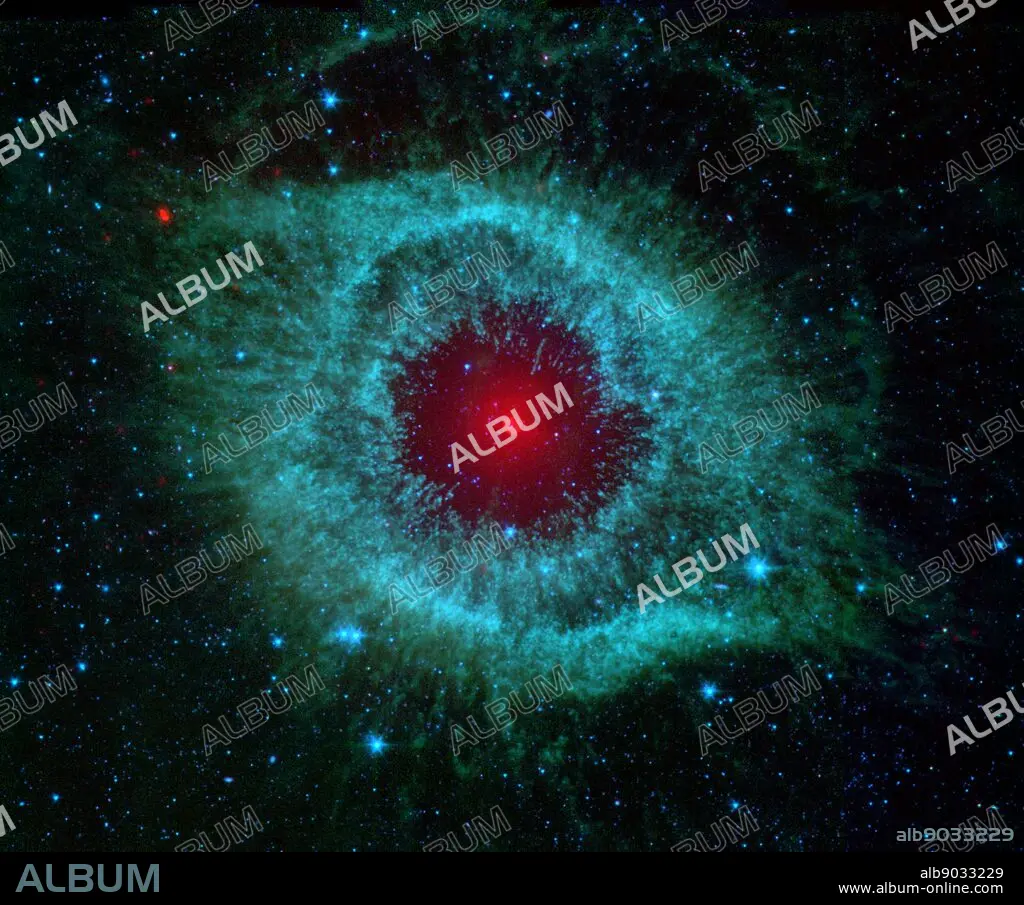
infrared image from NASA's Spitzer Space Telescope shows the Helix Nebula located about 700 light-years away in the constellation Aquarius, belongs to a class of objects called planetary nebulae. Planetary nebulae are the remains of stars that once looked a lot like the sun. When sun-like stars die, they puff out their outer gaseous layers. In Spitzer's infrared view of the Helix nebula, the eye looks more like that of a green monster's. Infrared light from the outer gaseous layers is represented in blues and greens. The white dwarf is visible as a tiny white dot in the center of the picture. The red color in the middle of the eye denotes the final layers of gas blown out when the star died. The brighter red circle in the very center is the glow of a dusty disk circling the white dwarf (the disk itself is too small to be resolved). This dust, discovered by Spitzer's infrared heat-seeking vision, was most likely kicked up by comets that survived the death of their star. Before the star died, its comets and possibly planets would have orbited the star in an orderly fashion.
| Partager |
|---|
 Pinterest Pinterest |
 Twitter Twitter |
 Facebook Facebook |
 Copier le lien Copier le lien |
 Email Email |
|
Ajouter à une autre Lightbox |
|
Ajouter à une autre Lightbox |


Avez-vous déjà un compte? S'identifier
Vous n'avez pas de compte ? S'inscrire
Acheter cette image.
Sélectionnez l'usage:

Légende: Voir la traduction automatique
infrared image from NASA's Spitzer Space Telescope shows the Helix Nebula located about 700 light-years away in the constellation Aquarius, belongs to a class of objects called planetary nebulae. Planetary nebulae are the remains of stars that once looked a lot like the sun. When sun-like stars die, they puff out their outer gaseous layers. In Spitzer's infrared view of the Helix nebula, the eye looks more like that of a green monster's. Infrared light from the outer gaseous layers is represented in blues and greens. The white dwarf is visible as a tiny white dot in the center of the picture. The red color in the middle of the eye denotes the final layers of gas blown out when the star died. The brighter red circle in the very center is the glow of a dusty disk circling the white dwarf (the disk itself is too small to be resolved). This dust, discovered by Spitzer's infrared heat-seeking vision, was most likely kicked up by comets that survived the death of their star. Before the star died, its comets and possibly planets would have orbited the star in an orderly fashion.
infrared image from NASA's Spitzer Space Telescope shows the Helix Nebula located about 700 light-years away in the constellation Aquarius, belongs to a class of objects called planetary nebulae. Planetary nebulae are the remains of stars that once looked a lot like the sun. When sun-like stars die, they puff out their outer gaseous layers. In Spitzer's infrared view of the Helix nebula, the eye looks more like that of a green monster's. Infrared light from the outer gaseous layers is represented in blues and greens. The white dwarf is visible as a tiny white dot in the center of the picture. The red color in the middle of the eye denotes the final layers of gas blown out when the star died. The brighter red circle in the very center is the glow of a dusty disk circling the white dwarf (the disk itself is too small to be resolved). This dust, discovered by Spitzer's infrared heat-seeking vision, was most likely kicked up by comets that survived the death of their star. Before the star died, its comets and possibly planets would have orbited the star in an orderly fashion.
Crédit: Album / NASA/World History Archive
Autorisations: ? Autorisation de modèle: Non - ? Autorisation de propriété: Non
Questions sur les droits?
Questions sur les droits?
Taille de l'image: 4700 × 3909 px | 52.6 MB
Taille d'impression: 39.8 × 33.1 cm | 1850.4 × 1539.0 in (300 dpi)
Mots clés: ASTRONOMIE • SCIENCE: ASTRONOMIE
