

alb3678468
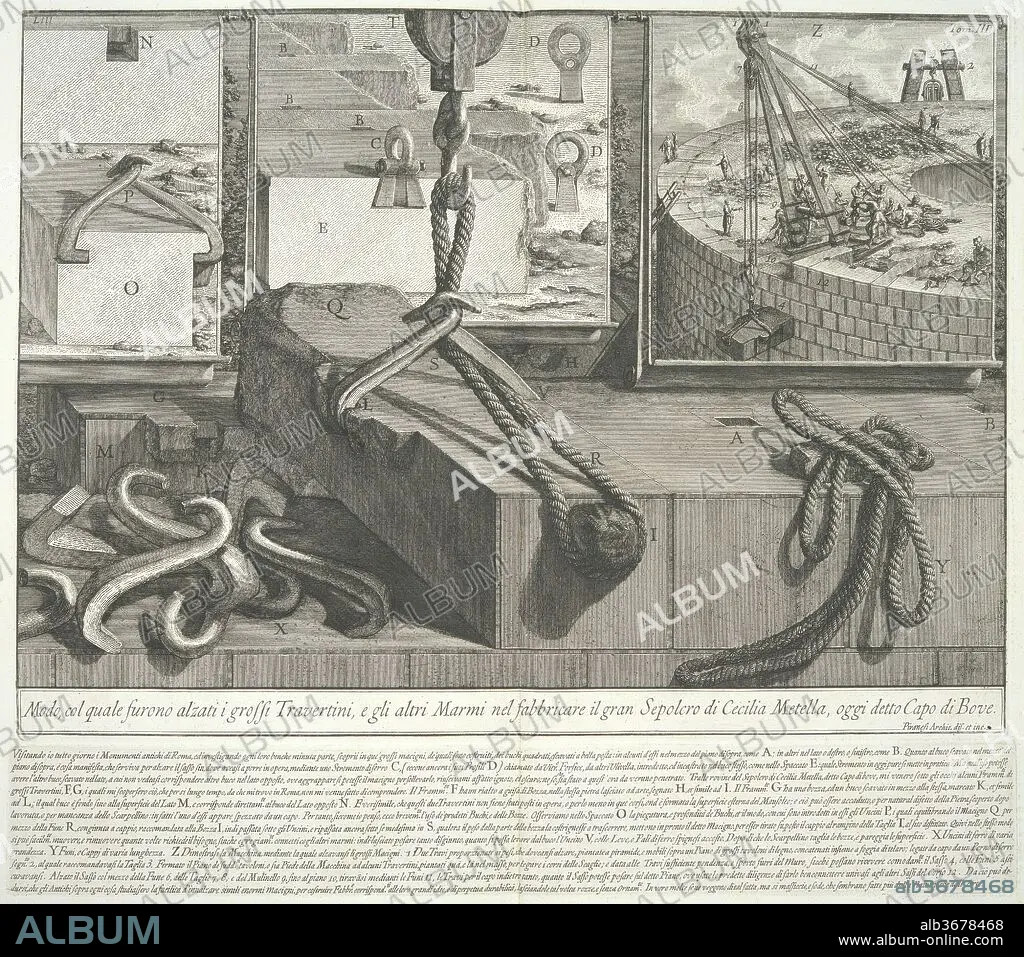
GIOVANNI BATTISTA PIRANESI, ANGELO ROTILI. Means by which the large blocks of travertine and marble were lifted during the construction of the large Tomb of Caecilia Metella, from Le Antichità Romane (Roman Antiquities), tome 3, tavola 53
| Partager |
|---|
 Pinterest Pinterest |
 Twitter Twitter |
 Facebook Facebook |
 Copier le lien Copier le lien |
 Email Email |
|
Ajouter à une autre Lightbox |
|
Ajouter à une autre Lightbox |


Avez-vous déjà un compte? S'identifier
Vous n'avez pas de compte ? S'inscrire
Acheter cette image.
Sélectionnez l'usage:

Titre:
Means by which the large blocks of travertine and marble were lifted during the construction of the large Tomb of Caecilia Metella, from Le Antichità Romane (Roman Antiquities), tome 3, tavola 53
Légende:
Voir la traduction automatique
Means by which the large blocks of travertine and marble were lifted during the construction of the large Tomb of Caecilia Metella, from Le Antichità Romane (Roman Antiquities), tome 3, tavola 53. Artist: Giovanni Battista Piranesi (Italian, Mogliano Veneto 1720-1778 Rome); Angelo Rotili. Dimensions: Sheet: 21 1/4 x 30 5/16 in. (54 x 77 cm)
Plate: 18 1/8 x 20 7/8 in. (46 x 53 cm). Series/Portfolio: Le Antichità Romane, tome 3. Date: published 1756-57.
While Piranesi was at work on the Antichità Romane, the result of years of research into the highly developed engineering skills of the Romans, the first threats to Roman preeminence were heard. In the early 1750s, certain French and British scholars and architects had begun to assert that the Romans were mere imitators of the Greeks, under whom all the arts had attained perfection. A desire to defend the Romans from this charge may lie behind the exaggeration that appears in some of the plates of this publication--here Piranesi makes the mausoleum appear much larger than it actually is and exaggerates the difficulty of its construction. This page provides a good example of Piranesi's novel illustrative techniques: he represents three supplemental views on scrolls of paper hung behind the primary scene, while playfully undermining the illusion he has created by making the hook on the left scroll overlap the edge of the sheet.
Technique/matériel:
EAU-FORTE
Musée:
Metropolitan Museum of Art, New York, USA
Crédit:
Album
Autorisations:
Taille de l'image:
4050 x 3576 px | 41.4 MB
Taille d'impression:
34.3 x 30.3 cm | 13.5 x 11.9 in (300 dpi)
