

alb3814949
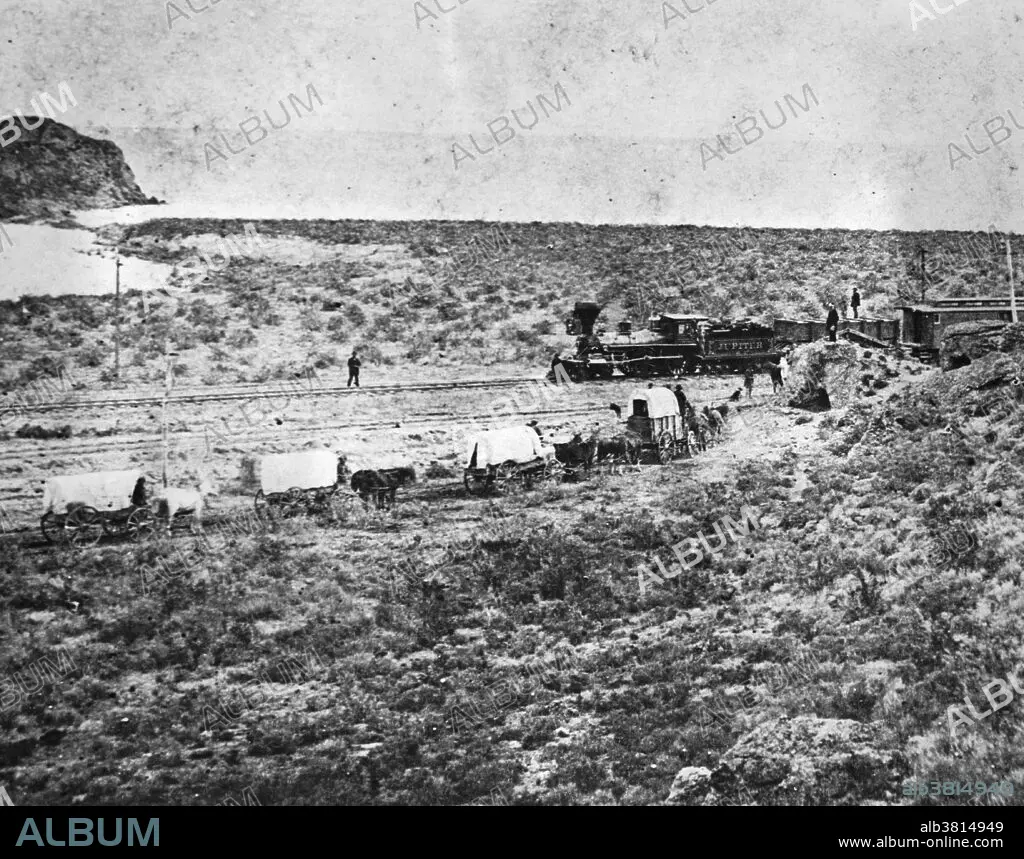
Stanford En Route to Golden Spike Ceremony, 1869
| Partager |
|---|
 Pinterest Pinterest |
 Twitter Twitter |
 Facebook Facebook |
 Copier le lien Copier le lien |
 Email Email |
|
Ajouter à une autre Lightbox |
|
Ajouter à une autre Lightbox |


Avez-vous déjà un compte? S'identifier
Vous n'avez pas de compte ? S'inscrire
Acheter cette image.
Sélectionnez l'usage:

Titre:
Stanford En Route to Golden Spike Ceremony, 1869
Légende:
Voir la traduction automatique
The Central Pacific train "Jupiter," carrying Governor Leland Stanford to the "Golden Spike" ceremony in Promontory, Utah, me this wagon train of immigrants bound for California at Monument Point, on the shores of the Great Salt Lake, about May 7th-8th, 1869. Photo by Alfred A. Hart. On May 10, in anticipation of the ceremony, Union Pacific No. 119 and Central Pacific No. 60 (better known as the Jupiter) locomotives were drawn up face-to-face on Promontory Summit in the Utah Territory. It is unknown how many people attended the event; estimates run from as low as 500 to as many as 3,000; government and railroad officials and track workers were present to witness the event. Completing the last link in the Transcontinental Railroad with a spike of gold was the brainchild of David Hewes, a San Francisco financier and contractor. Two of the sides were engraved with the names of the railroad officers and directors. A special tie of polished California laurel was chosen to complete the line where the spike would be driven. The ceremony was originally to be held on May 8, 1869 (the date actually engraved on the spike), but it was postponed two days because of bad weather and a labor dispute that delayed the arrival of the Union Pacific side of the rail line. The the ceremonial final spike driven by Leland Stanford to join the rails of the First Transcontinental Railroad across the United States connecting the Central Pacific and Union Pacific railroads.
Crédit:
Album / Science Source / Omikron
Autorisations:
Taille de l'image:
4711 x 3708 px | 50.0 MB
Taille d'impression:
39.9 x 31.4 cm | 15.7 x 12.4 in (300 dpi)
Mots clés:
