

alb3665570
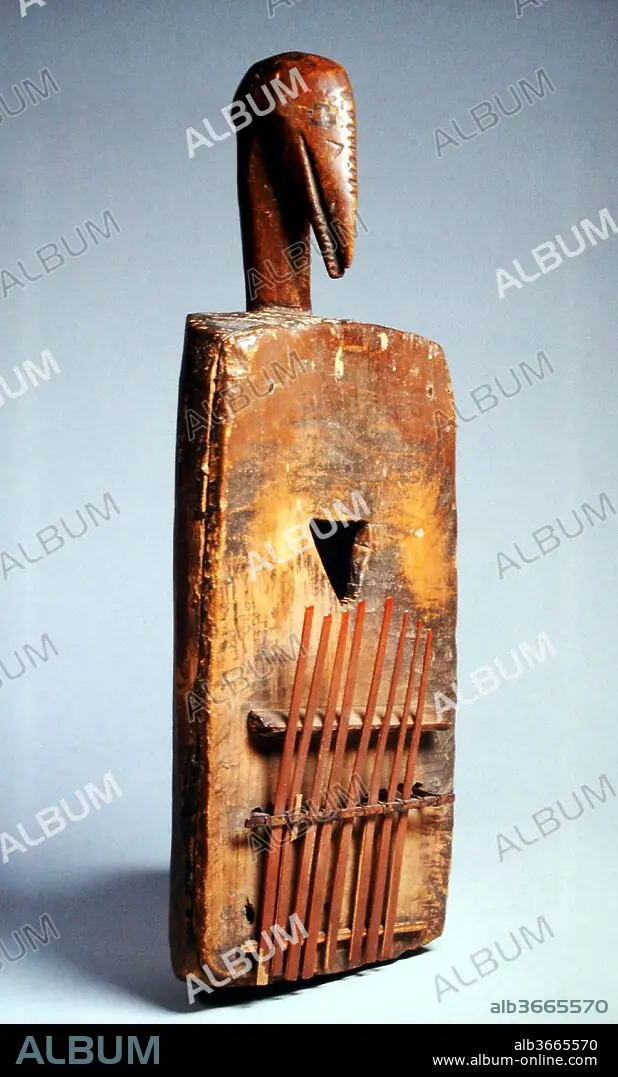
Kisanji (Cisaji)
| Partager |
|---|
 Pinterest Pinterest |
 Twitter Twitter |
 Facebook Facebook |
 Copier le lien Copier le lien |
 Email Email |
|
Ajouter à une autre Lightbox |
|
Ajouter à une autre Lightbox |


Avez-vous déjà un compte? S'identifier
Vous n'avez pas de compte ? S'inscrire
Acheter cette image.
Sélectionnez l'usage:

Titre: Kisanji (Cisaji)
Légende: Voir la traduction automatique
Kisanji (Cisaji). Culture: Bateke. Dimensions: 17 × 3 1/2 in. (43.2 × 8.9 cm). Date: late 19th century. This Kisanji (Cisaji), decorated with a carved bird's head is a Lamellaphone. Lamellaphone is a term to designate instruments consisting of thin tongues of metal or split cane, mounted on a resonating board or box. Depressing the free ends of the tongues with the thumbs produces a gentle ringing sound, sometimes augmented by jingling objects attached to the board, and amplified by holding the instrument in a hollow gourd. Tuning is accomplished by sliding the tongues in or out in order to change their vibrating length. Lamellaphones are distributed across sub-Sahara Africa and were brought by slaves to Latin America. They are known by many names that may also be shared with xylophones. Most names have word stems which include: -mbila; -mira; -limba; or -rima. Westerners, not recognizing differences in construction, have simplified the name to two regional terms calling them either mbira or sanza.
Kisanji (Cisaji). Culture: Bateke. Dimensions: 17 × 3 1/2 in. (43.2 × 8.9 cm). Date: late 19th century. This Kisanji (Cisaji), decorated with a carved bird's head is a Lamellaphone. Lamellaphone is a term to designate instruments consisting of thin tongues of metal or split cane, mounted on a resonating board or box. Depressing the free ends of the tongues with the thumbs produces a gentle ringing sound, sometimes augmented by jingling objects attached to the board, and amplified by holding the instrument in a hollow gourd. Tuning is accomplished by sliding the tongues in or out in order to change their vibrating length. Lamellaphones are distributed across sub-Sahara Africa and were brought by slaves to Latin America. They are known by many names that may also be shared with xylophones. Most names have word stems which include: -mbila; -mira; -limba; or -rima. Westerners, not recognizing differences in construction, have simplified the name to two regional terms calling them either mbira or sanza.
Technique/matériel: wood
Musée: Metropolitan Museum of Art, New York, USA
Crédit: Album
Autorisations: ? Autorisation de modèle: Non - ? Autorisation de propriété: Non
Questions sur les droits?
Questions sur les droits?
Taille de l'image: 2751 × 4558 px | 35.9 MB
Taille d'impression: 23.3 × 38.6 cm | 1083.1 × 1794.5 in (300 dpi)
Mots clés: AFRICA • METROPOLITAN MUSEUM OF ART, NEW YORK, USA • REPUBLIC OF THE CONGO
