

alb3813095
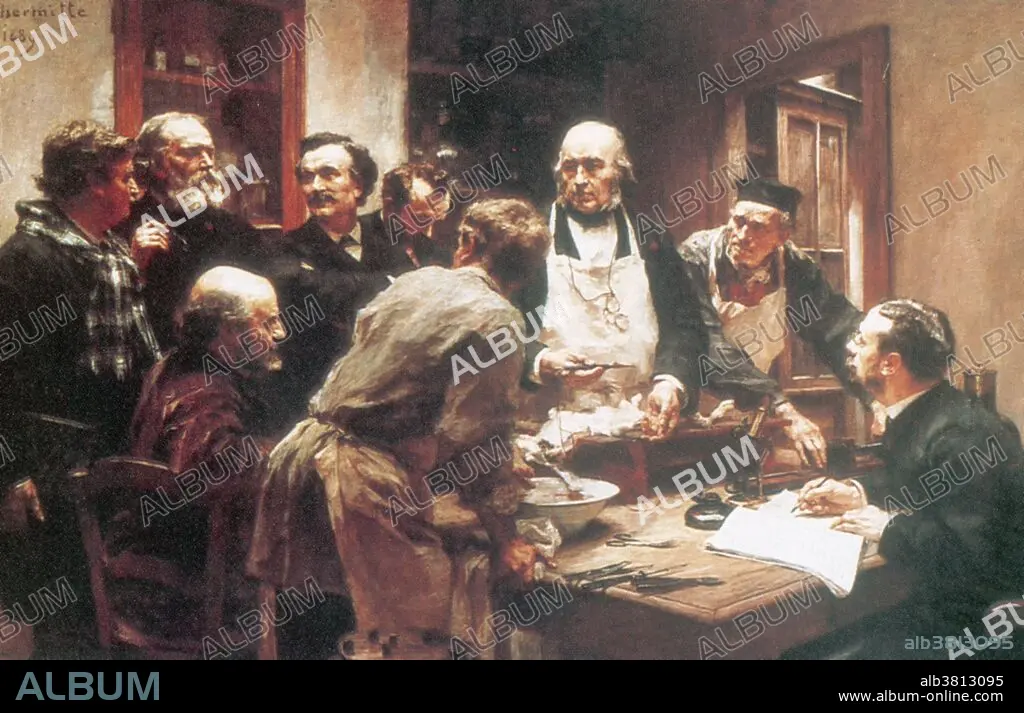
Scientific Demonstration, 19th Century
| Partager |
|---|
 Pinterest Pinterest |
 Twitter Twitter |
 Facebook Facebook |
 Copier le lien Copier le lien |
 Email Email |
|
Ajouter à une autre Lightbox |
|
Ajouter à une autre Lightbox |


Avez-vous déjà un compte? S'identifier
Vous n'avez pas de compte ? S'inscrire
Acheter cette image.
Sélectionnez l'usage:

Titre: Scientific Demonstration, 19th Century
Légende: Voir la traduction automatique
Claude Bernard demonstrates an experiment for the chemist Henri Sainte-Claire Deville (seated at left), in a prize winning painting by Leon Lhermitte (1889). Claude Bernard (1813-1878) was a French physiologist. Milieu interieur is the key process with which Bernard is associated. He wrote, "La fixite du milieu interieur est la condition d'une vie libre et independante" (The constancy of the internal environment is the condition for a free and independent life). This is still the underlying principle of homeostasis today. He was one of the first to suggest the use of blind experiments to ensure the objectivity of scientific observations. In An Introduction to the Study of Experimental Medicine (1865), Bernard describes what makes a scientific theory good and what makes a scientist important, a true discoverer. Unlike many scientific writers of his time, Bernard writes about his own experiments and thoughts, and uses the first person. The basic principles are: known and unknown, induction and deduction, cause and effect, verification and disproof, determinism and averages, truth versus falsification and discovering versus despising.
Claude Bernard demonstrates an experiment for the chemist Henri Sainte-Claire Deville (seated at left), in a prize winning painting by Leon Lhermitte (1889). Claude Bernard (1813-1878) was a French physiologist. Milieu interieur is the key process with which Bernard is associated. He wrote, "La fixite du milieu interieur est la condition d'une vie libre et independante" (The constancy of the internal environment is the condition for a free and independent life). This is still the underlying principle of homeostasis today. He was one of the first to suggest the use of blind experiments to ensure the objectivity of scientific observations. In An Introduction to the Study of Experimental Medicine (1865), Bernard describes what makes a scientific theory good and what makes a scientist important, a true discoverer. Unlike many scientific writers of his time, Bernard writes about his own experiments and thoughts, and uses the first person. The basic principles are: known and unknown, induction and deduction, cause and effect, verification and disproof, determinism and averages, truth versus falsification and discovering versus despising.
Crédit: Album / Science Source / New York Public Library
Autorisations: ? Autorisation de modèle: Non - ? Autorisation de propriété: Non
Questions sur les droits?
Questions sur les droits?
Taille de l'image: 3694 × 2380 px | 25.2 MB
Taille d'impression: 31.3 × 20.2 cm | 1454.3 × 937.0 in (300 dpi)
Mots clés: CÉLÈBRE • CELEBRITE • DEMONSTRATION • EUROPÉEN • EXPERIENCE • EXPERIENCES • EXPERIMENTATION • HOMME • PERSONNAGES • PERSONNALITÉS • PERSONNE • PHYSIOLOGIE • PREPARATION D'EXPERIENCE • SCIENCE: EXPERIENCES
