

alb5144314
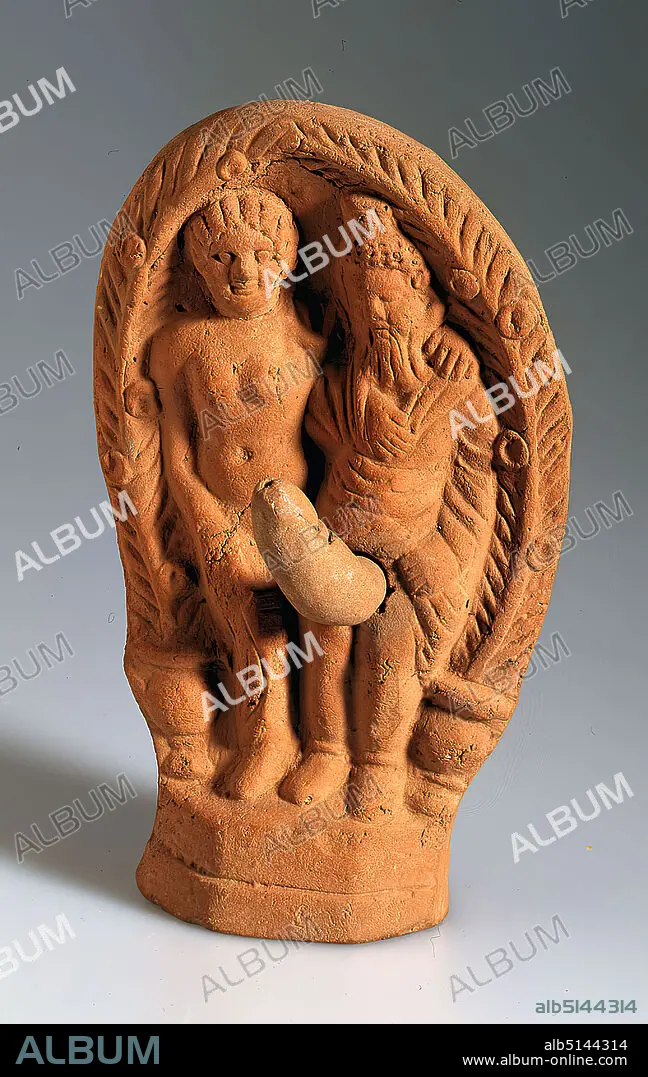
Aphrodite and Priapos in a palm arbour, Clay, pressed into the form, hand modeled, fired (ceramic), Total: Height: 15 cm; Width: 9.8 cm; Depth: 5.4 cm, ceramic, Gods (classical. Mythology), Hellenism, In an arbour, which is made of two vessels with palm fronds, Aphrodite and her son Priapos are standing on a raised base on the left and on the right. The goddess is dressed only with a cloak draped around her hips and falling to the ground. The hair is combined in a curly hairstyle. She has put her left arm around Priapos. This one is bald and bearded. On his head he carries a wreath and a basket (Greek kalathos). He has raised his long robe; an inserted oversized phallus is visible. Aphrodite and Priapos are to be connected as deities of love and desire with fertility cults and are accordingly depicted in a body-stressed manner. As a talisman, such figures were hung up in the house or at the entrance and thus ensured the protection of the two gods. The figure belongs to the group of the so-called Fayum terracottas. In Alexandria, the international, Greek-influenced center of Egypt, lives a multicultural society of Egyptians, Orientals, Greeks, Romans, Jews and others, whose different religious ideas are gradually blending together. Insights into this world of faith are provided by the so-called Fayum terracottas. They are part of the religious household, children's toys, knick-knacks, but also cult symbols, grave goods, pilgrimage images, votive offerings and magical objects for banishing evil forces. They can be found in houses, graves and sanctuaries.
| Partager |
|---|
 Pinterest Pinterest |
 Twitter Twitter |
 Facebook Facebook |
 Copier le lien Copier le lien |
 Email Email |
|
Ajouter à une autre Lightbox |
|
Ajouter à une autre Lightbox |


Avez-vous déjà un compte? S'identifier
Vous n'avez pas de compte ? S'inscrire
Acheter cette image.
Sélectionnez l'usage:

Légende: Voir la traduction automatique
Aphrodite and Priapos in a palm arbour, Clay, pressed into the form, hand modeled, fired (ceramic), Total: Height: 15 cm; Width: 9.8 cm; Depth: 5.4 cm, ceramic, Gods (classical. Mythology), Hellenism, In an arbour, which is made of two vessels with palm fronds, Aphrodite and her son Priapos are standing on a raised base on the left and on the right. The goddess is dressed only with a cloak draped around her hips and falling to the ground. The hair is combined in a curly hairstyle. She has put her left arm around Priapos. This one is bald and bearded. On his head he carries a wreath and a basket (Greek kalathos). He has raised his long robe; an inserted oversized phallus is visible. Aphrodite and Priapos are to be connected as deities of love and desire with fertility cults and are accordingly depicted in a body-stressed manner. As a talisman, such figures were hung up in the house or at the entrance and thus ensured the protection of the two gods. The figure belongs to the group of the so-called Fayum terracottas. In Alexandria, the international, Greek-influenced center of Egypt, lives a multicultural society of Egyptians, Orientals, Greeks, Romans, Jews and others, whose different religious ideas are gradually blending together. Insights into this world of faith are provided by the so-called Fayum terracottas. They are part of the religious household, children's toys, knick-knacks, but also cult symbols, grave goods, pilgrimage images, votive offerings and magical objects for banishing evil forces. They can be found in houses, graves and sanctuaries.
Aphrodite and Priapos in a palm arbour, Clay, pressed into the form, hand modeled, fired (ceramic), Total: Height: 15 cm; Width: 9.8 cm; Depth: 5.4 cm, ceramic, Gods (classical. Mythology), Hellenism, In an arbour, which is made of two vessels with palm fronds, Aphrodite and her son Priapos are standing on a raised base on the left and on the right. The goddess is dressed only with a cloak draped around her hips and falling to the ground. The hair is combined in a curly hairstyle. She has put her left arm around Priapos. This one is bald and bearded. On his head he carries a wreath and a basket (Greek kalathos). He has raised his long robe; an inserted oversized phallus is visible. Aphrodite and Priapos are to be connected as deities of love and desire with fertility cults and are accordingly depicted in a body-stressed manner. As a talisman, such figures were hung up in the house or at the entrance and thus ensured the protection of the two gods. The figure belongs to the group of the so-called Fayum terracottas. In Alexandria, the international, Greek-influenced center of Egypt, lives a multicultural society of Egyptians, Orientals, Greeks, Romans, Jews and others, whose different religious ideas are gradually blending together. Insights into this world of faith are provided by the so-called Fayum terracottas. They are part of the religious household, children's toys, knick-knacks, but also cult symbols, grave goods, pilgrimage images, votive offerings and magical objects for banishing evil forces. They can be found in houses, graves and sanctuaries.
Personnalités: GRAVES (active 1940s)
Crédit: Album / quintlox
Autorisations: ? Autorisation de modèle: Non - ? Autorisation de propriété: Non
Questions sur les droits?
Questions sur les droits?
Taille de l'image: 2732 × 4320 px | 33.8 MB
Taille d'impression: 23.1 × 36.6 cm | 1075.6 × 1700.8 in (300 dpi)
Mots clés: ALEXANDRIE • ALLEGORIE: DESIR • AMANTS • AMOUR • AMULETTE • ARGILE • ARTISANAT CORBEILLES • BARBU • BIBELOT • BIBELOTS • CABANE DE JARDIN • CERAMIQUE • CHAUVE • CHEVELURE • CHEVEU • CHEVEUX • CLASSIQUE • CONFIANCE • CORBEILLE • CORBEILLES • DEBOUT • DECORATION • DECORATIONS • DEESSE • DÉSIR • DESIR, ALLEGORIE • DIEUX • EGYPTE • ENTREE • FOI • FORMULAIRE • GAUCHE • GRAOUPE • GRAVES • GROUPE • INTERNATIONAL • JUIF (ADJECTIF) • JUIF • JUIFS (NOM) • JUIFS • JUIVE • LANGUEUR • MAISON • MAISONS • MATERIAU CERAMIQUE • MATERIAU TERRE CUITE • MONDE • MYTHOLOGIE • ORNEMENT • ORNEMENTS • OSIER, CORBEILLES • PANIER • PARURE • PORTE-BONHEUR • POTERIE • PROTECTION • PROTECTIONS • RECIPIENT, CORBEILLE • RELIGIOSITE • SENSATION LANGUEUR • SENTIMENT: AMOUR • SOUTIEN • TALISMAN • TERRE CUITE, VAISSELLE • TETE (ANATOMIE) • TETE • TONNELLE • VAISSELLE EN TERRE CUITE • VANNERIE, CORBEILLES
