

alb3811625
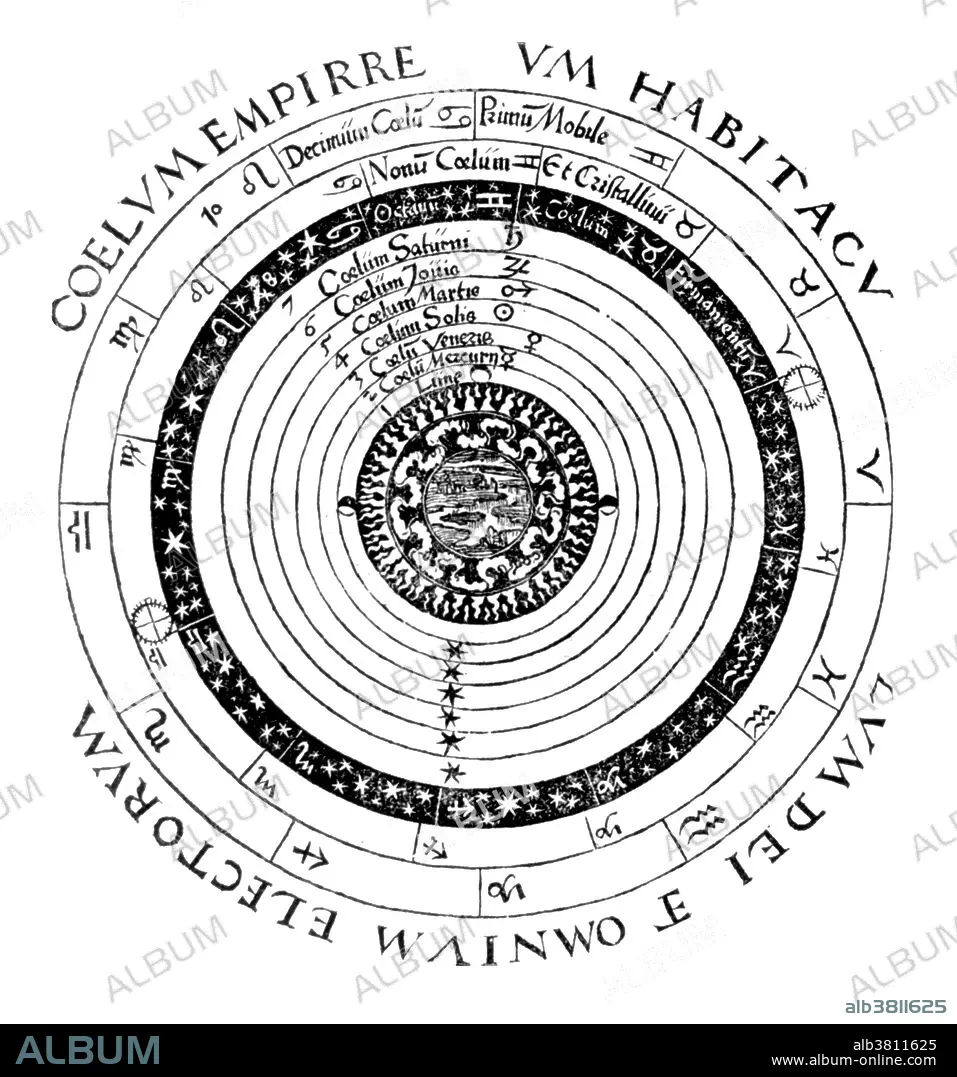
Cosmographicus liber, Petrus Apianus, 1524
| Partager |
|---|
 Pinterest Pinterest |
 Twitter Twitter |
 Facebook Facebook |
 Copier le lien Copier le lien |
 Email Email |
|
Ajouter à une autre Lightbox |
|
Ajouter à une autre Lightbox |


Avez-vous déjà un compte? S'identifier
Vous n'avez pas de compte ? S'inscrire
Acheter cette image.
Sélectionnez l'usage:

Titre: Cosmographicus liber, Petrus Apianus, 1524
Légende: Voir la traduction automatique
The grafting of Aristotelian theory onto the Christian version of the cosmos, engraving from Peter Apian's Cosmographicus liber (1524). Petrus Apianus (April 16, 1495 - April 21, 1552) was a German humanist, known for his works in mathematics, astronomy and cartography. In 1524 he produced his Cosmographicus liber, a respected work on astronomy and navigation that was to see at least 30 reprints in 14 languages. Aristotle (384-322 BC) developed an early model of the cosmos based on the concept of uniform circular motion. To account for the motions of the stars, sun, moon, and the five known planets, his model used 56 spherical shells each centered on the earth. These shells were divided into two regions: the realm of change near the earth and the eternally unchanging heavens. The realm of change consisted of spheres of each of the four classical elements: earth, water, air, and fire. The heavens were made of an unchangeable, transparent material called the ether.
The grafting of Aristotelian theory onto the Christian version of the cosmos, engraving from Peter Apian's Cosmographicus liber (1524). Petrus Apianus (April 16, 1495 - April 21, 1552) was a German humanist, known for his works in mathematics, astronomy and cartography. In 1524 he produced his Cosmographicus liber, a respected work on astronomy and navigation that was to see at least 30 reprints in 14 languages. Aristotle (384-322 BC) developed an early model of the cosmos based on the concept of uniform circular motion. To account for the motions of the stars, sun, moon, and the five known planets, his model used 56 spherical shells each centered on the earth. These shells were divided into two regions: the realm of change near the earth and the eternally unchanging heavens. The realm of change consisted of spheres of each of the four classical elements: earth, water, air, and fire. The heavens were made of an unchangeable, transparent material called the ether.
Crédit: Album / LOC/Science Source
Autorisations: ? Autorisation de modèle: Non - ? Autorisation de propriété: Non
Questions sur les droits?
Questions sur les droits?
Taille de l'image: 3900 × 4172 px | 46.6 MB
Taille d'impression: 33.0 × 35.3 cm | 1535.4 × 1642.5 in (300 dpi)
Mots clés: 16E SIECLE • 16EME S • ASTRONOMIE • CATHOLIQUE (ADJECTIF) • CATHOLIQUE (PERSONNE) • CATHOLIQUE • CÉLÈBRE • CELEBRITE • COSMOLOGIE • COSMOS • ILLUSTRATION • SCIENCE: ASTRONOMIE • SEIZIÈME SIÈCLE • THÉORIE • THÉRORIE • XVIE SIECLE
