

alb3821820
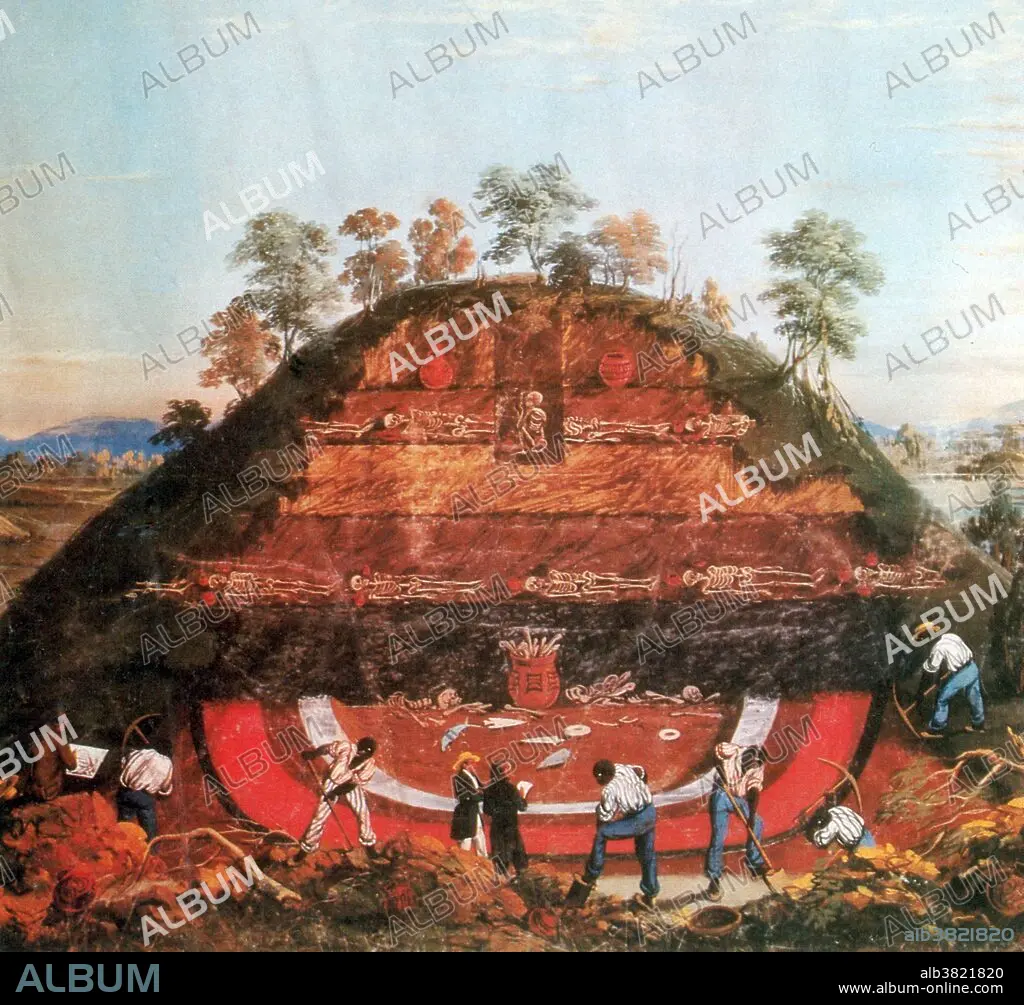
Excavation of Indian Mound, 1850
| Partager |
|---|
 Pinterest Pinterest |
 Twitter Twitter |
 Facebook Facebook |
 Copier le lien Copier le lien |
 Email Email |
|
Ajouter à une autre Lightbox |
|
Ajouter à une autre Lightbox |


Avez-vous déjà un compte? S'identifier
Vous n'avez pas de compte ? S'inscrire
Acheter cette image.
Sélectionnez l'usage:

Titre: Excavation of Indian Mound, 1850
Légende: Voir la traduction automatique
Mound building was a central feature of the public architecture of many Native American and Mesoamerican cultures from Chile to Minnesota. Thousands of mounds in America have been destroyed as a result of farming, pot-hunting, amateur and professional archaeology, road-building and construction. Surviving mounds are still found in river valleys, especially along the Mississippi, Tennessee and Ohio Rivers, and as far west as Spiro Mounds in Oklahoma. Mounds were used for burial, to support residential and religious structures, to represent a shared cosmology, and to unite and demarcate community. Common forms include conical mounds, ridge-top mounds, platform mounds, and animal effigy mounds, but there are many variations. Mound building in America is believed to date back to at least 3400 BC in the Southeast. The Adena and the Mississippian cultures are principally known for their mounds, as is the Hopewell tradition. Illustration originally captioned: Cutaway version of an Indian mound is one of the few surviving panels from the "Panaroma of the Mississippi Valley" commissioned by Doctor Montroville Wilson Dickeson. Painted by J.J. Egan in 1950, based on Dickeson's sketches who appears as the artist in the bottom of the far left corner.
Mound building was a central feature of the public architecture of many Native American and Mesoamerican cultures from Chile to Minnesota. Thousands of mounds in America have been destroyed as a result of farming, pot-hunting, amateur and professional archaeology, road-building and construction. Surviving mounds are still found in river valleys, especially along the Mississippi, Tennessee and Ohio Rivers, and as far west as Spiro Mounds in Oklahoma. Mounds were used for burial, to support residential and religious structures, to represent a shared cosmology, and to unite and demarcate community. Common forms include conical mounds, ridge-top mounds, platform mounds, and animal effigy mounds, but there are many variations. Mound building in America is believed to date back to at least 3400 BC in the Southeast. The Adena and the Mississippian cultures are principally known for their mounds, as is the Hopewell tradition. Illustration originally captioned: Cutaway version of an Indian mound is one of the few surviving panels from the "Panaroma of the Mississippi Valley" commissioned by Doctor Montroville Wilson Dickeson. Painted by J.J. Egan in 1950, based on Dickeson's sketches who appears as the artist in the bottom of the far left corner.
Crédit: Album / Science Source / New York Public Library
Autorisations: ? Autorisation de modèle: Non - ? Autorisation de propriété: Non
Questions sur les droits?
Questions sur les droits?
Taille de l'image: 4026 × 3744 px | 43.1 MB
Taille d'impression: 34.1 × 31.7 cm | 1585.0 × 1474.0 in (300 dpi)
Mots clés: AMÉRICAIN • ARCHÉLOGIE • ARCHEOLOGIE SITES • ARCHEOLOGIE • ARCHÉOLOLOGIE • CÉLÈBRE • CELEBRITE • COUPE (COUTURE) • COUPER • COUR • DELABREMENT • ILLUSTRATION • INDIEN D'AMERIQUE • INDIEN • INDIENNE • INDIENS AMERICAINS • INDIENS • JAQUETTE (VETEMENT) • RUINE • RUINES • SITE ARCHEOLOGIQUE • SITE • SITES ARCHEOLOGIQUES • TAILLE • TRANCHER • TRAVAUX DE TERRASSEMENT
