

alb8370302
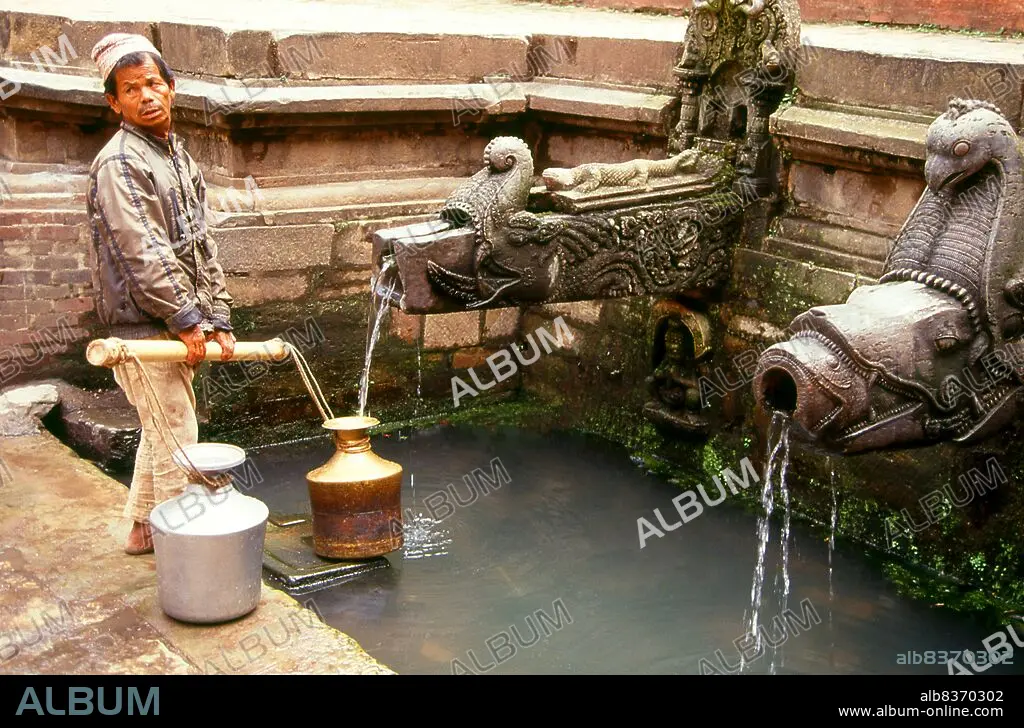
Nepal: A man fills his water pots at the Tusha Hiti, a well lined with a profusion of stone carvings in the Sundari Chowk or 'Courtyard of Beauty' within the Royal Palace, Patan, Kathmandu
| Partager |
|---|
 Pinterest Pinterest |
 Twitter Twitter |
 Facebook Facebook |
 Copier le lien Copier le lien |
 Email Email |
|
Ajouter à une autre Lightbox |
|
Ajouter à une autre Lightbox |


Avez-vous déjà un compte? S'identifier
Vous n'avez pas de compte ? S'inscrire
Acheter cette image.
Sélectionnez l'usage:

Titre: Nepal: A man fills his water pots at the Tusha Hiti, a well lined with a profusion of stone carvings in the Sundari Chowk or 'Courtyard of Beauty' within the Royal Palace, Patan, Kathmandu
Légende: Voir la traduction automatique
The Tusha Hiti is a well lined with stone carvings portraying numerous deities. It was formerly used as a royal bath. The figures depicted are the eight mother goddesses, the eight serpent gods and the eight Bhairavs. The outer perimeter of the tank is encircled by two carved naga, or snake deities, which are traditionally associated with tanks or wells and believed to ensure an uninterrupted water supply.
. The Royal Palace supposedly dates back to the Licchavi period (5th-13th century), but, with the exception of a few inscriptions, there is little substantial evidence for this. In the earliest inscription, which hails from the year 643 CE and which was found at the Keshav Narayan Chowk, Licchavi King Narendra Deva announced the abolition of three types of taxes, presumably making him popular with his subjects. This indicates that there may at the time have been a palace at the site of Keshav Narayan Chowk, which is part of the present royal palace complex.
. The royal palace as seen today in Durbar Square has its origins in the 14th century; however, the most active building period was the 17th century.
The Tusha Hiti is a well lined with stone carvings portraying numerous deities. It was formerly used as a royal bath. The figures depicted are the eight mother goddesses, the eight serpent gods and the eight Bhairavs. The outer perimeter of the tank is encircled by two carved naga, or snake deities, which are traditionally associated with tanks or wells and believed to ensure an uninterrupted water supply.
. The Royal Palace supposedly dates back to the Licchavi period (5th-13th century), but, with the exception of a few inscriptions, there is little substantial evidence for this. In the earliest inscription, which hails from the year 643 CE and which was found at the Keshav Narayan Chowk, Licchavi King Narendra Deva announced the abolition of three types of taxes, presumably making him popular with his subjects. This indicates that there may at the time have been a palace at the site of Keshav Narayan Chowk, which is part of the present royal palace complex.
. The royal palace as seen today in Durbar Square has its origins in the 14th century; however, the most active building period was the 17th century.
Crédit: Album / Universal Images Group / Rainer Krack / Pictures From History
Autorisations: ? Autorisation de modèle: Non - ? Autorisation de propriété: Non
Questions sur les droits?
Questions sur les droits?
Taille de l'image: 5100 × 3364 px | 49.1 MB
Taille d'impression: 43.2 × 28.5 cm | 2007.9 × 1324.4 in (300 dpi)
Mots clés: ARCHITCETURE • ARCHITECTURE • ARCITECTURE • ASIE • ASIE, CONTINENT • CONTINENT ASIE • HIDOUISME • HINDOU • HINDOUE • HINDOUISME • INTERIEUR: PALAIS • NEPAL • PALACE • PALAIS ÉTÉ • PALAIS ROYAL • PALAIS • PALAIS, INTERIEUR • PALAIS-ROYAL • PALAZZO • PERIODE DES PREMIERS PALAIS • REALE • RELIGION
